


Save civilians in Rakhine, Chin states
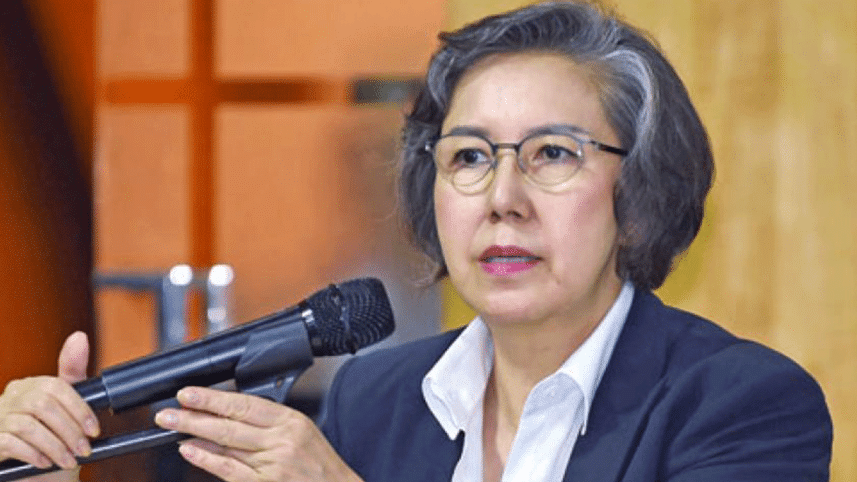
UN human rights expert Yanghee Lee has called upon the United Nations to step up its efforts to protect civilians in Rakhine and Chin states of Myanmar, alleging ongoing war crimes and crimes against humanity being committed by the Myanmar military there.
She called for investigations into the crimes and actions to ensure that there is not another systemic failure like in 2017 when a military crackdown led to the killings of thousands of Rohingyas and an exodus of some 750,000 Rohingyas to Bangladesh.

The International Court of Justice on January 23 ordered for provisional measures to prevent crimes of genocide against Rohingyas in Rakhine State and submit reports relating to those within four months.
The schedule for submission of the report for Myanmar is May 23.
Lee, who is concluding her tenure as the UN Special Rapporteur on the situation of human rights in Myanmar, in her last report said the Myanmar military, Tatmadaw, is systematically violating the most fundamental principles of international humanitarian law and human rights.
Its conduct against the civilians of Rakhine and Chin may amount to war crimes and crimes against humanity, Lee said.
"Myanmar and its security forces must abide by the International Court of Justice's provisional measures and its own presidential directive to respect the Genocide Convention," she said in a statement yesterday.
"While the world is occupied with the Covid-19 pandemic, the Myanmar military continues to escalate its assault in Rakhine state, targeting the civilian population," she said, regretting that calls for a ceasefire, including by the Arakan Army, have gone unheeded.
Stressing that accountability was critical to ending the conflict, she said the Tatmadaw continues to operate with impunity. For decades, its tactics have intentionally maximised civilian suffering.
Recalling the atrocities against the Rohingyas in 2017 by the Myanmar army, Lee said they were now targeting all civilians in the conflict areas, with people from Rakhine, Rohingya, Mro, Daignet and Chin communities being killed in recent months.
"Their alleged crimes must be investigated in accordance with international standards, with perpetrators being held accountable."
An armed conflict has raged in Rakhine and Chin States since December 2018 between the Myanmar military and the Arakan Army but in recent weeks the Tatmadaw has ramped up attacks against civilians, displacing more than 157,000 people. Hundreds including women and children have been killed and wounded since the conflict started, the statement said.
The Arakan Army has also conducted its hostilities in a manner that has had negative impacts on civilians, including kidnapping local officials and parliamentarians, it said.
Most recently, on April 12, the Arakan Army reportedly abducted an elected member of a Paletwa Township committee. However, it was declared a unilateral ceasefire which has the effect of increasing civilian protection, the statement added.
"The focus of all authorities, including security forces, should be on dealing with the Covid-19 crisis," said Yanghee Lee.
The Special Rapporteur said the recent Tatmadaw air and artillery strikes in civil areas in Rakhine and neighbouring Chin states have killed and injured scores of adults and children, and the Tatmadaw has prevented some of the injured from accessing urgent medical care.
Men suspected to be linked with the Arakan Army have been detained for days and tortured. Schools, houses and a Buddhist temples have been burned or destroyed, even an entire village of up to 700 homes, Lee said.
"In one artillery attack on April 13, the Tatmadaw killed eight civilians, including at least two children, when it targeted Kyauk Seik village, in Ponnagyun Township, with artillery from its nearby Battalion 550 base," she said.
Witnesses say entire populations of villages have fled following the attacks.
The UN expert said the military has disappeared, arrested, tortured or killed dozens of men. After burning up to 700 homes in Tin Ma village in Kyauktaw on March 22, 10 men disappeared. One man was found shot dead and decapitated bodies were later located in a nearby river.
 For all latest news, follow The Daily Star's Google News channel.
 In the face of tight restrictions on humanitarian access since January 2019, the Tatmadaw is blocking aid from reaching certain areas, including Paletwa Township in Chin, where there are over 8,000 displaced people, with dire consequences for local populations, she said.
"It is also stopping people from accessing urgent medical care. Most heinously, a severely injured teenage boy died at a military checkpoint in Rakhine after the Tatmadaw forced the vehicle transporting him to wait there on the way to hospital."
Aid workers also have been targeted in the conflict. Last week, a WHO driver and Ministry of Health and Sports worker were injured, and the driver later died, after their UN-marked car was shot at.
"Humanitarian workers should not be a target; attacking them is a serious violation of international humanitarian law," Lee stressed.
Even, ethnic Rakhine journalists have gone into hiding in fear of arrest as they work for news outlets that have reported on the conflict, she said.


Comments