


Outbreak worse ‘attack’ than 9/11
China yesterday accused the United States of trying to shift blame over the coronavirus, after President Donald Trump said the pandemic was a worse "attack" than Pearl Harbor or 9/11.

Tension between the world's two biggest economies has reached fever pitch in recent days as they have exchanged barbed comments on each other's handling of the virus.
"We urge the US side to stop shifting the blame to China and turn to facts," said foreign ministry spokeswoman Hua Chunying at a press briefing.
On Wednesday Trump drew analogies with the virus, which emerged in the Chinese city of Wuhan last year, and infamous military and terrorist attacks on the United States.
"This is really the worst attack we've ever had," Trump told reporters. "This is worse than Pearl Harbor. This is worse than the World Trade Center."
The Japanese assault on the Pearl Harbor naval base in Hawaii drew the United States into World War II.
The September 11, 2001 jihadist attacks on that killed about 3,000 people and triggered two decades of war.
Trump said the coronavirus pandemic "should never have happened".
"Could have been stopped at the source. Could have been stopped in China," he said.
Hua responded: "They might say the pandemic is comparable to Pearl Harbor or 9/11, but the enemy facing the US is the novel coronavirus".
She said Washington should "fight side-by-side" with Beijing instead of as "enemies".
Hua added that "lots of foreign countries, experts and scientists have all made positive comments on China's effective virus prevention and control."
"But the US alone has made some very disharmonious, untruthful and insincere remarks," said Hua.
The coronavirus, which first emerged in central China late last year, has now killed more than 73,000 people in the US.
'EXTREMELY CAREFULLY'
The World Health Organization (WHO) warned on Wednesday that countries emerging from restrictions to halt the new coronavirus must proceed "extremely carefully" or risk a rapid rise in new cases.
Director-General Tedros Adhanom Ghebreyesus said countries needed to ensure they had adequate measures to control the spread of the Covid-19 respiratory disease like tracking systems and quarantine provision.
"The risk of returning to lockdown remains very real if countries do not manage the transition extremely carefully and in a phased approach," he said at a virtual briefing in Geneva.
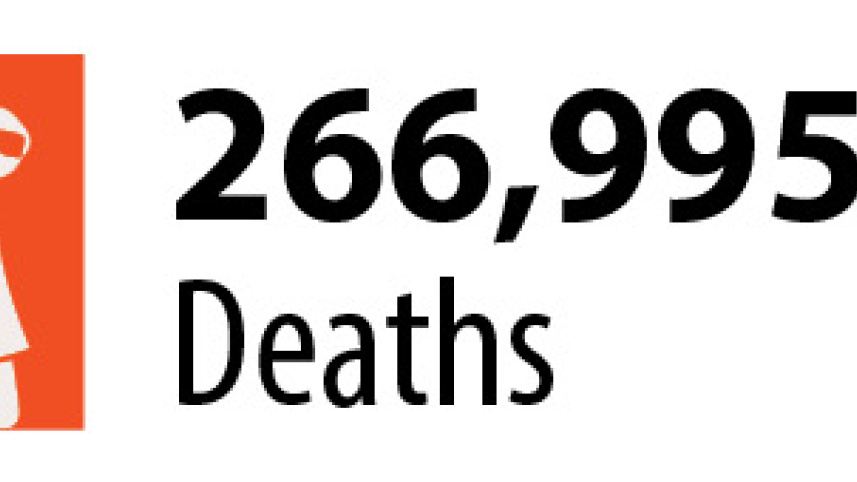
WHO epidemiologist Maria Van Kerkhove supported his concerns about the disease which has infected 3.77 million globally and killed more than 263,000 people, according to a Reuters tally.
 For all latest news, follow The Daily Star's Google News channel.
 "If lockdown measures are lifted too quickly, the virus can take off," Van Kerkhove told the briefing.
Government-ordered lockdowns have become increasingly unpopular as countries suffer rising unemployment and economic activity grinds to a halt.
The eurozone economy will contract by a record 7.7% this year because of the pandemic, while US private employers laid off 20.2 million workers last month as business shut their doors.
Some countries, like Germany, Spain and Italy have started to relax restrictions, while the US President Trump has said his focus is on opening up the country again.
Soccer authorities have also started to consider how they can salvage interrupted competitions, with Germany's Bundesliga getting permission to restart later this month.
FIRE RAGING
WHO official Mike Ryan said it was up to governments and sporting federations to decide how and when to restart, adding the UN organisaton would offer risk management advice if needed.
Tedros, who has come under fire mainly from the Trump administration for his handling of the outbreak, said that he would conduct an assessment of the WHO's actions when the pandemic recedes.
"While the fire is raging I think our focus should not be divided," he said.
Tedros also defended the WHO's record on warning about the potential for human-to-human transmission of the new coronavirus, saying it informed the world in the first half of January.
The Geneva-based body has been accused of being "China- centric" by top donor the United States which has cut off funding to the body.
US Secretary of State Mike Pompeo renewed his criticism on China on Wednesday, blaming the country for the deaths the outbreak has caused and demanding Beijing share information about the outbreak.
The WHO, which is preparing another mission to China to discover the animal origin of the virus, treated the country no differently to any of its 194 members, Tedros said.
"The rule we have in WHO and other UN agencies is that when a member state reports we post as is," Tedros said.
"The most important thing is our guidance before, during and after 14 January included the likelihood of human to human transmission that helped countries to prepare, he added. "This is the whole truth."


Comments