


Covid-19 Vaccine, Treatments: Europe pledges to raise money
The European Union will set up an international medical programme to lead the global response to fighting coronavirus with an initial pledge of raising $8bn (£6.3bn) to find a vaccine and treatment for the pandemic.

The virtual pledging conference, due to take place today, was organised following Donald Trump's suspension of US contributions to the World Health Organization (WHO) after accusing the organization of colluding with the Chinese government in hiding the initial outbreak of the disease.
Heads of states and senior officials of the European Union, writing in The Independent, have declared their support for the WHO while unveiling the plan to work with scientists and international welfare organisations, including the Bill and Melinda Gates Foundation and the Wellcome Trust, to counter the contagion.
The EU states will be joined by Norway in filling the immediate global funding shortfall estimated by the Global Preparedness Monitoring Board (GPMB). Vaccines and treatments, say the leaders, will be made available throughout the world to developing nations with an emphasis on states in Africa.
The urgent need for international unity in the crisis, and the warning that no country can go it alone, is stressed in an article in The Independent signed by German Chancellor Angela Merkel; French President Emmanuel Macron; Italian Prime Minister Giuseppe Conte; Norwegian Prime Minister Erna Solberg; European Council President Charles Michel and Ursula von der Leyen, president of the European Commission.
The article says: "We are building on the commitment by G20 leaders to develop a massive and coordinated response to the virus. We are supporting the call to action that the World Health Organization and other global health actors have made together.
"If we can develop a vaccine that is produced by the world, for the whole world, this will be a unique global public good of the 21st century. Together with our partners, we commit to making it available, accessible and affordable to all."
MORE LOCKDOWN EASING
Europe yesterday prepared for a further cautious easing of coronavirus restrictions following signs the pandemic may be slowing, after Spaniards flocked to the streets to jog, cycle and rollerskate for the first time after 48 days of confinement.
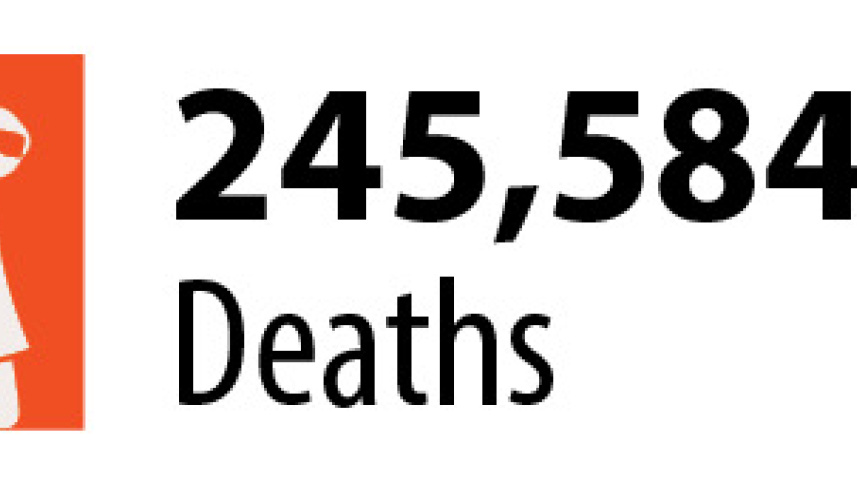
More than 244,000 people have been killed and 3.4 million infected worldwide by the virus, which has left half of humanity under some form of lockdown and pushed the global economy towards its worst downturn since the Great Depression.
After a two-month lockdown in Italy -- with the second-highest number of virus deaths in the world -- people will be allowed to stroll in parks and visit relatives today. Restaurants can open for takeaway and wholesale stores can resume business.
And in Hungary, some stores and museums, outdoor spaces of restaurants and hotels, beaches and baths can reopen from today -- but restrictions will remain in the capital Budapest, which has recorded about 70 percent of the country's cases.
Germany will also continue its easing at the start of the week, with schools in some areas expected to reopen, while Slovenia and Poland will allow some businesses and public spaces to operate again.
France has said it will partially lift its lockdown on May 11, reports AFP.
BEYOND BREAKING POINT
Across the Atlantic, the pressure to ease virus measures is intense on leaders in the United States, where the economy has been hammered with tens of millions left jobless and anti-lockdown protests erupting in many areas.
Crowds of demonstrators, some armed, denounced the lockdowns in New Hampshire and Kentucky, while at California's Huntington Beach, some surfers defied orders to stay away from the shore.
Billionaire investor Warren Buffett was optimistic, saying Saturday he's confident the American economy will bounce back because "American magic has always prevailed" -- though it is far from certain if that recovery will come in time to help Trump win re-election in November.
In New York City, the epicentre of the US outbreak, an emergency field hospital erected in Central Park is set to close, the Christian charity running it said Saturday, as virus cases decline in the city.
 For all latest news, follow The Daily Star's Google News channel.
 Riots over inadequate protection and slow responses by authorities have already taken place in prisons in Washington state and Kansas.
"Things are beyond breaking point at this facility," said Brian Miller, an officer at the Marion prison in Ohio. "Right now it's hell."
EMOTIONAL TOLL
In addition to Europe, countries elsewhere are also relaxing some coronavirus measures.
Singapore has announced it would gradually ease some of its restrictions, while Turkey on Saturday said it would lift curbs on the export of medical supplies.
Thailand allowed businesses such as restaurants, hair salons and outdoor markets to reopen yesterday so long as social distancing was maintained and temperature checks carried out.
But experts have warned that some countries are still in the first stages of their outbreaks and things could get worse there.
China reported two new coronavirus cases for May 2, up from one the day before, data from the country's national health authority showed yesterday.
One case was imported and the other was local, the National Health Commission (NHC) said. This compares to one imported case and no domestic transmissions on May 1, reports Reuters.
In a sign of the pandemic's emotional toll, families of coronavirus victims in the Philippines are being denied traditional death rites in favour of hurried, impersonal cremations, with virus restrictions often meaning they cannot take a last look at their loved ones.


Comments