


Qatar boycott to remain in place
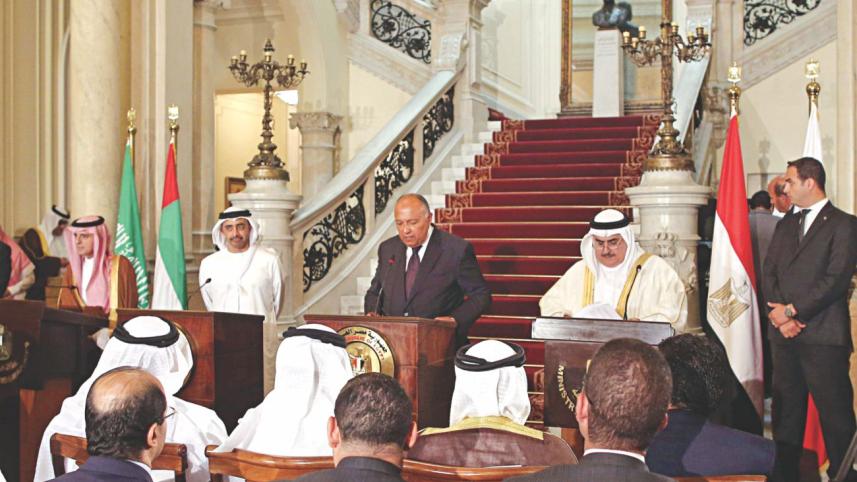
Arab states that have cut ties with Qatar vowed yesterday to maintain their boycott of the emirate, criticising its "negative" response to their list of demands to end the diplomatic crisis.
Qatar appealed for "dialogue" to resolve the row while US President Donald Trump spoke to Egyptian counterpart Abdel Fattah al-Sisi from aboard Air Force One to urge all parties "to negotiate constructively".

Following a meeting in Cairo, the foreign ministers of Egypt, Saudi Arabia, Bahrain and the United Arab Emirates said in a statement that they "regret the negative response from Qatar".
Egyptian Foreign Minister Sameh Shoukry said Qatar's response to the bloc's conditions had "no substance" and "reflects a lack of understanding of the gravity of the situation".
The talks in Cairo came a month after the four countries severed ties with Qatar, accusing Doha of supporting extremism.
"The boycott will remain," Saudi Foreign Minister Adel al-Jubeir said at the same news conference in the Egyptian capital
The four Arab states stopped short of announcing new sanctions but Jubeir said they would "take steps at the appropriate time".
The demands include Doha ending support for the Muslim Brotherhood and closing broadcaster Al-Jazeera.
Saudi Arabia and its allies have not said what steps they could take next, but there are fears of a wider embargo that would hurt the Qatari economy, with credit ratings agency Moody's announcing it was changing Qatar's outlook to negative over the crisis.
The countries issued the 13-point list of demands on June 22, giving Qatar 10 days to respond. The deadline was extended by 48 hours on Sunday at the request of Kuwait, which is mediating in the crisis, and Qatar handed in the response on Monday.
The contents of the response have not been disclosed, but Qatari Foreign Minister Sheikh Mohammed bin Abdulrahman Al-Thani said on Tuesday that the list of demands "is unrealistic and is not actionable".
Qatar has denied any support for extremism and accused the countries of seeking to infringe on its sovereignty.
The other demands include Qatar downgrading ties with Iran -- Saudi Arabia's regional arch-rival -- and shutting down a Turkish military base in the emirate.
In his phone call with Sisi, Trump "reiterated the need for all countries to follow through on their commitments at the Riyadh summit (in May) to stop terrorist financing and discredit extremist ideology," the White House said.
Qatar has said repeatedly it is ready for talks on the crisis, and Sheikh Mohammed reiterated that yesterday.
"We welcome any serious efforts to resolve our differences with our neighbours," he told the Chatham House think-tank in London.
He accused Saudi Arabia and its regional allies of "demanding that we must surrender our sovereignty as the price for ending the siege".
Riyadh and its supporters have severed air, sea and ground links with Qatar, cutting off vital routes for imports including food.
They also ordered Qatari citizens to leave their territories and took various steps against Qatari firms and financial institutions.
The crisis has raised concerns of growing instability in the region, home to some of the world's largest energy exporters and key Western allies who host US military bases.
 For all latest news, follow The Daily Star's Google News channel.
 Energy-rich Qatar has been defiant throughout the crisis, insisting it can weather action taken against it.
On Tuesday, it even announced a major boost in planned natural gas output, with Qatar Petroleum saying it would increase production to 100 million tonnes a year by 2024, up 30 percent from current levels.
Qatar is the world's leading producer of liquefied natural gas.
Its energy riches have transformed Qatar into one of the world's wealthiest countries, a major international investor and a regional player that will host the 2022 football World Cup.
Concern has been growing, however, that a drawn-out crisis could have an economic impact.
Moody's said it was changing its credit rating outlook for Qatar to negative from stable, citing "the economic and financial risks arising from the ongoing dispute".
"The likelihood of a prolonged period of uncertainty extending into 2018 has increased and a quick resolution of the dispute is unlikely over the next few months," the agency said.
Some critics of Qatar have accused it of links to extremist organisations including the Islamic State group, Al-Qaeda and Lebanon's Iran-backed Hezbollah movement.
But a British think-tank said yesterday that foreign funding for Islamist extremism in Britain mostly originates from Saudi Arabia.
"While entities from across the Gulf and Iran have been guilty of advancing extremism, those in Saudi Arabia are undoubtedly at the top of the list," Tom Wilson, a fellow at the Henry Jackson Society, a hawkish London-based foreign policy think-tank, said in a statement.
In a statement to the BBC, the Saudi embassy in London said the claims were "categorically false".
Comments