


Girls' Marriage Before 18 Years: Govt urged to repeal special provision
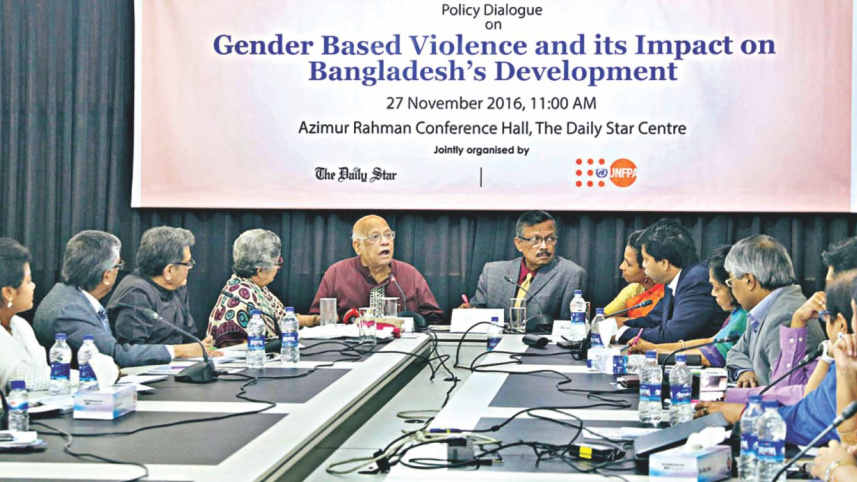
Speakers at a dialogue yesterday urged the government to repeal the provision in the proposed Child Marriage Restraint Act that would allow marriages of girls below 18 under special circumstances.
They said it would encourage child marriage.

The cabinet okayed the draft law on Thursday.
Speakers also stressed the need for launching a social movement to change the mindset of the people to stop gender-based violence against women in the country.
They were addressing “Policy Dialogue on Gender Based Violence and Its Impact on Bangladesh's Development” organised jointly by The Daily Star and the UNFPA at The Daily Star Centre in the city.
National Human Rights Commission Chairman Kazi Reazul Hoque said the country made tremendous progress in many sectors, including women empowerment, but the proposed Child Marriage Restraint Act, if passed with the special provision, would mar the government's achievements.
“If the act is passed, people will take advantage of the provision. I request revisiting the issue,” he said.
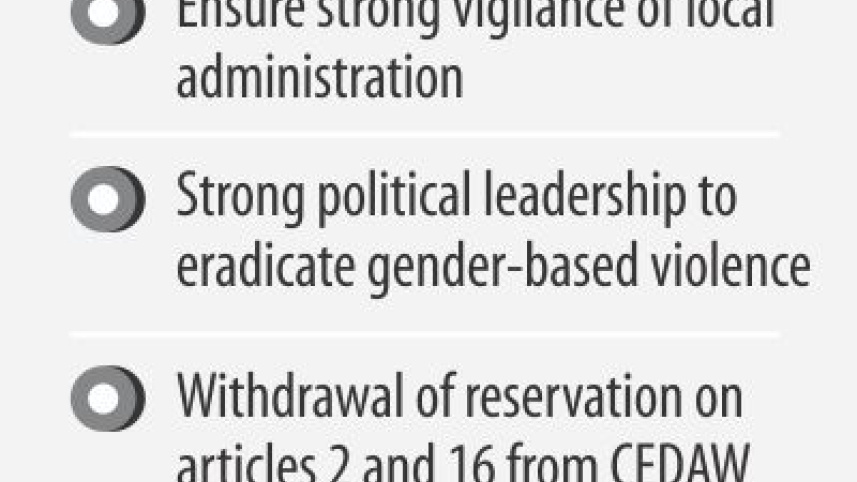
The NHRC chairman urged the government to withdraw its reservation on Articles 16 (C) and 2 of the Convention on the Elimination of All Forms of Discrimination against Women (CEDAW), as those were creating barrier for women empowerment.
Defending the provision in the act, Finance Minister AMA Muhith said consent of both a boy and a girl, their parents and that of a court were needed for the marriage of a girl under 18.
AL lawmaker Habibe Millat said strict rules were being made to stop misuse of the proposed act.
Ranjan Karmakar, executive director of STEPS, a non-government organisation, said the provision was already in the Marriage Registration Act, and that there was no necessity for incorporating it in the proposed Child Marriage Restraint Act.
He suggested that the government eliminates the provision.
Praising the government's success in reducing maternal and infant mortality rate, UNFPA Representative in Bangladesh Argentina Matavel Piccin said those were possible because of the government's strong political will and leadership.
Possibly in five years, violence against women could be significantly reduced if there is strong political will, she noted.
Actor Jeetu Ahsan emphasised the need for ensuring speedy trial. “People want to see what happens to the criminal. If an example can be set, incidents of violence will decrease,” he said.
Sheepa Hafiza, director of Brac's gender justice and diversity programme, gave the keynote presentation.
Quoting data from Bangladesh Bureau of Statistics (BBS), she said about 80 percent women face violence from their husbands.
Sharmin Akter Shakila, a student, said teachers should play a more effective role in imparting social, ethical and moral lessons to male students. This could help eradicate the root cause of rising harassment and violence against girl children.
“Unfortunately, our education system fails to make us learn how to tackle issues of abuses by male students. So, it is very urgent to introduce teachings of ethics,” she observed.
 For all latest news, follow The Daily Star's Google News channel.
 Muntaka Khan, another student, alleged that when girls are stalked, they hesitate to go to law enforcers as the police do not take the issue seriously.
Advocate Nina Goswami, senior deputy director (Legal Aid unit) of Ain O Salish Kendra (ASK), said the government in the last two years had several meetings with rights organisations over keeping the special provision in the proposed act. But each time the organisations expressed worries over the provision's inclusion.
“We are concerned about possible dangers in the society if the government doesn't cancel the special provision in the proposed Child Marriage Restraint Act. Many guardians might take advantages of the provision ... .” she observed.
Disagreeing with a recent survey report “The difficult path to equality for women police in Bangladesh” published by Commonwealth Human Rights Initiative (CHRI), Additional Superintended of Police Rawshan Sadia Afroze said the findings of the report that 10 percent female police face sexual harassment were not substantiated.
“Every month, we organise awareness meetings with female police members on the harassment issue. We are doing better,” Rawshan, also deputy director (academic) at Police Staff College, said.
Farida Yeasmin, deputy police commissioner of Dhaka Metropolitan Police's Woman Support and Investigation Division, said victims of different forms of violence face severe problems in the society and many of them suffer from psychological trauma.
“Trial processes take long time due to medical and police reports ... We need to stand against all forms of violence,” she added.
Lawmaker Quazi Rosy and The Daily Star Editor Mahfuz Anam, among others, spoke at the programme moderated by Salehuddin Ahmed, adjunct professor of Brac University.
Comments