


BB worried as remittance slides, default loans rise
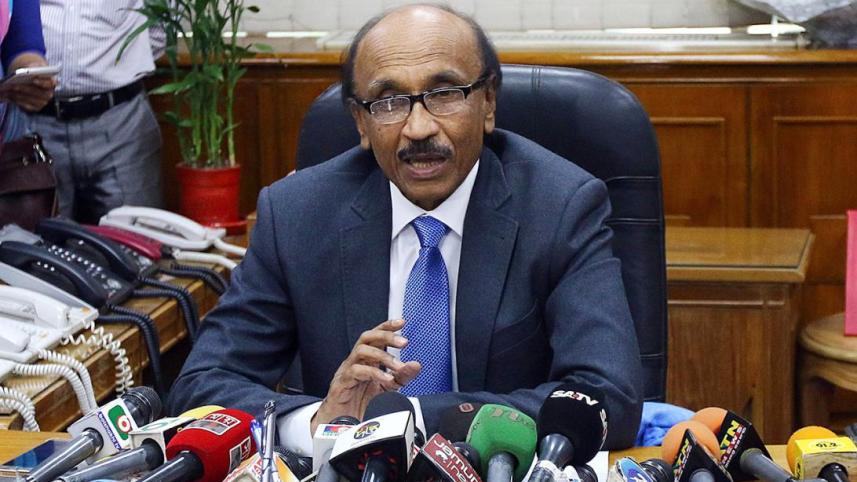
Bangladesh Bank Governor Fazle Kabir yesterday expressed concern over the falling inward remittance and rising default loans in the banking sector, which is detrimental to the country's target to achieve a higher economic growth.
“The inflow of foreign remittance is coming down at a time when all the economic indicators are looking good and that's a concern for us,” he said.

Kabir was talking to reporters at an orientation on banking for journalists at the central bank headquarters. The Economic Reporters' Forum and the BB jointly organised the programme.
The governor said in the first seven months of the current fiscal year, remittances declined by 16 percent compared to the same period a year ago.
Bangladeshi expatriates sent home $7.17 billion from July '16 to January '17, down from $8.63 billion in the same period of the last fiscal year, according to BB data.
On the other hand, manpower export increased by 36 percent to 757,731 in last year from 555,881 in 2015, according to the Bureau of Manpower, Employment and Training.
“We are carrying out a detailed survey by our research teams to find the reasons for the decline in remittances,” he told journalists, adding that two teams would visit Saudi Arabia, some Gulf countries, Singapore and Malaysia to know the reasons for the declining remittances.
The teams would also work at the beneficiary level, he added.
Kabir said the central bank was also examining the allegations of use of mobile financial service by the expatriates as a non-banking channel for sending remittances home.
He said the BB would take measures to discourage expatriates from sending money through non-banking channels.
About default loans, the governor said the trend was becoming a big challenge for the banking industry as a whole.
Although the industry's average default loan was 10.34 percent, it was around 25 percent for the state banks. Even a public bank has default loans three times higher than the industry's average rate and another one has over two and a half times higher than the average rate, he pointed out.
The governor said banks are key stakeholders to help the country attain 8 percent GDP growth from around 7 percent now. State-owned banks are important because they participate in different social activities without taking extra charges or commission from clients, he noted.
“It would be difficult to attain a higher economic growth if the rate of default loans remains high,” Kabir told journalists.
Earlier on Sunday, the governor blamed six state-owned banks for hefty bad loans which pushed up the lending rate. The six banks are Sonali, Janata, Agrani, Rupali, BASIC and BDBL.
The default loan of six banks stood at 25.16 percent as of September last year. Of them, Sonali Bank has 27.07 percent followed by Janata 14.40 percent, Agrani 25.62 percent, Rupali 18.71 percent, BASIC 52.94 percent and BDBL 58.27 percent, according to central bank data.
 For all latest news, follow The Daily Star's Google News channel.
Comments