


A red line already crossed in Syria
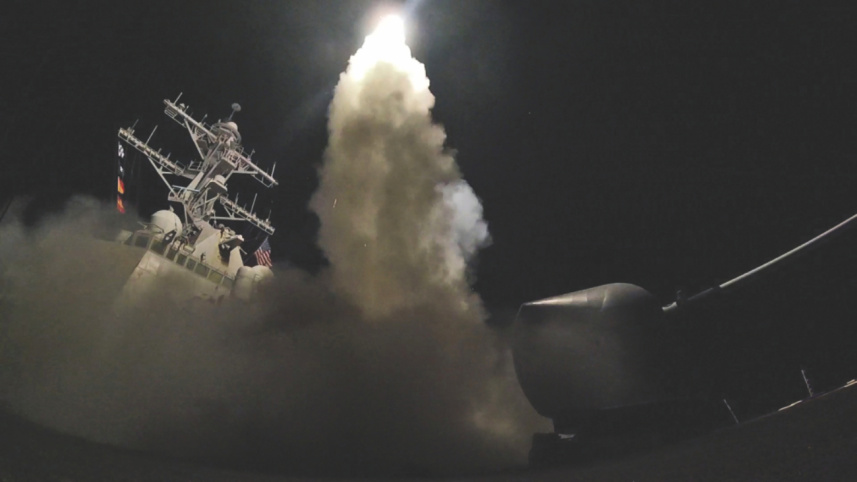
President Donald Trump's decision to strike the Syrian regime in retaliation for a chemical attack comes four years after his predecessor Barack Obama faced a similar challenge from Damascus -- and chose to back down.
There was no doubt among the international community on August 21, 2013: Obama's "red line" had just been crossed in Syria with a chemical weapons attack outside Damascus that was almost certainly the work of Bashar al-Assad's regime.

Two years earlier, Obama had vowed that the use of such weapons would "change my calculus" to justify military intervention in Syria. Britain and France agreed, embracing the president's rhetoric.
So when the massacre took place in Ghouta, an eastern suburb of the Syrian capital where US intelligence said some 1,400 were killed by a sarin gas attack, all eyes turned toward Washington.
Two days later, Obama said he was ready to strike.
But to surprise in the United States and around the world, he said he would put any decision over military action in Syria to a vote in Congress, essentially ruling out any immediate attack.
In the end, Obama's White House would never directly intervene militarily against the Assad regime, anxious to maintain the region's crumbling geopolitical and military balance.
Washington instead agreed to a last-minute deal with Damascus brokered by Moscow to dismantle Syria's chemical weapons arsenal and ship it to Russia starting in October 2013.
Under the aegis of the United Nations Organization for the Prohibition of Chemical Weapons (OPCW) -- awarded the Nobel Peace Prize that year -- the operation theoretically ended the Syrian government's ability to use chemical weapons against its own citizens or anyone else.
Obama's controversial decision precipitated an avalanche of criticism in the United States and abroad for his paralysis over Syria.
On Tuesday, following a new suspected chemical weapons attack that killed least 86 Syrian civilians -- including 27 children -- that Washington attributed to Assad's regime, Trump said his predecessor bore some responsibility.
"These heinous acts are a consequence of the past administration's weakness and irresolution," he said in a statement.
On Thursday, Trump ordered a massive military strike against Syria in retaliation for the attack that Washington said involved a sarin-like nerve agent.
Fifty-nine precision-guided missiles hit Shayrat Airfield in Syria, where the United States believes Tuesday's deadly attack was launched, targeting aircraft and runways at the base.
For his part, Obama said before stepping down in January that he was "proud" of his decision to refrain from military action in Syria.
After Tuesday's suspected attack on the Syrian town of Khan Sheikhun, Trump was standing in Obama's shoes from almost four years ago -- and he decided to step in a different direction.
 For all latest news, follow The Daily Star's Google News channel.
Comments