


Battle on amid vaccine hope

The world yesterday marked one year since the coronavirus threat was declared a pandemic, with vaccinations offering hope but much of humanity still enduring highly restricted lives and no clear path back to normality.
 For all latest news, follow The Daily Star's Google News channel.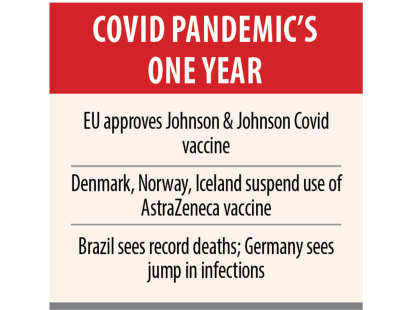
The enormity of the continuing global challenge was reflected in a stark warning by the International Council of Nurses that an exodus is looming of healthcare workers traumatised by the pandemic.
At least 3,000 nurses have been killed by Covid-19, the global nurses' federation said.
While restrictions are easing in many parts of the world, hotspots persist such as Brazil, which on Wednesday reported a record 2,286 deaths in a single day as more contagious new variants fuel a surge there.
Germany yesterday recorded a sharp rise in coronavirus infections, as disease control agency chief Robert Wieler warned that a third wave of the pandemic has begun in Europe's biggest economy.
New infections over the last 24 hours shot up to 14,356, a level not seen since February 4, latest data from disease control agency Robert Koch Institute showed.
On the economic front, the US Congress passed one of its biggest stimulus efforts ever -- a $1.9 trillion package that President Joe Biden said would give struggling American families a "fighting chance".
Since first emerging in China at the end of 2019, the coronavirus has killed more than 2.6 million people and forced unprecedented curbs on movement that eviscerated economies.
The World Health Organization officially declared Covid-19 a pandemic on March 11 last year as infection numbers were beginning to explode across Asia and Europe.
Global aviation came to a standstill and governments imposed deeply unpopular restrictions, forcing billions of fearful people into some form of lockdown.
A year on, at unprecedented pace, several vaccines have been made and are being rolled out, giving hope to mankind. More than 300 million vaccine doses have been administered in 140 countries, according to AFP.
But the vaccination hasn't been without controversy.
Denmark, Norway and Iceland yesterday temporarily suspended the use of AstraZeneca's vaccine over concerns about patients developing post-jab blood clots, as the manufacturer and Europe's medicines watchdog insisted the vaccine was safe.
As of March 9, 22 cases of blood clots had been reported among more than three million people vaccinated in the European Economic Area, the European Medicines Agency said.
The European Union's medical regulator yesterday authorised the J&J vaccine, which has already been approved by Canada and the US.
Comments