Long before fake news and algorithms, this 1986 film saw how truth could be shaped and weaponised

Not all films emerge from their moment only to outgrow it. Fewer still, read, decades later, like dispatches from tomorrow.
New Delhi Times (1986), directed by Ramesh Sharma and written by Gulzar, belongs to this category.

What begins as a procedural about a murdered politician quietly mutates into a searing autopsy of democratic institutions, where truth is both currency and casualty.
At its centre stands a newspaper -- ostensibly a custodian of public interest, yet perilously susceptible to the same contagions it seeks to expose.
The film is a slow-burning inquest into the fragile scaffolding of truth in a democracy that professes transparency yet thrives on obfuscation.
Shashi Kapoor, as Vikas Pande, is an editor whose professional rectitude becomes both his armour and his undoing. He does not perform the role so much as inhabit it, imbuing Pande with a restrained intensity that simmers beneath the surface.
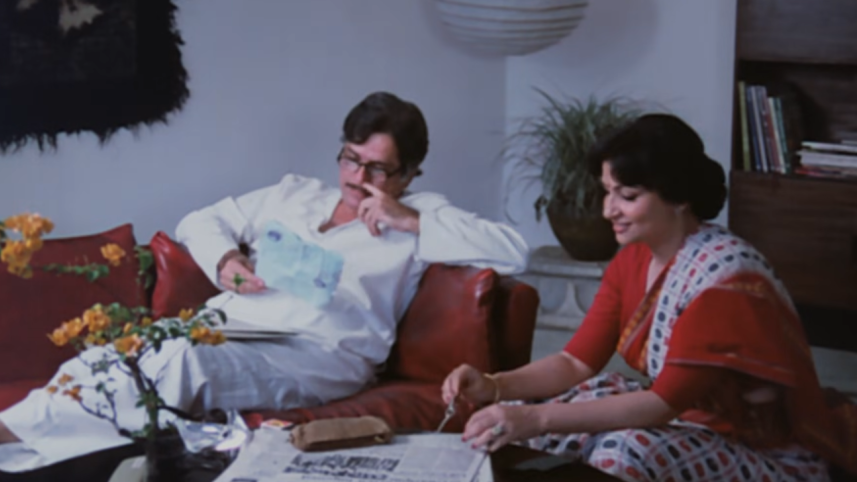
Sharmila Tagore, as Nisha, lends gravitas and emotional acuity, crafting a domestic counterpoint to the political tempest.
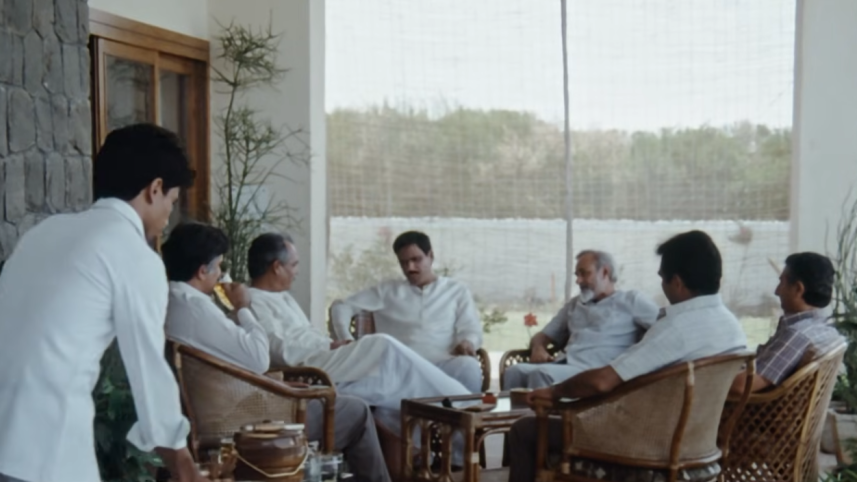
The film’s narrative is deceptively straightforward -- a political murder, a web of intrigue, and a journalist’s pursuit of the truth.
Yet, beneath this skeletal plot lies a dense musculature of ethical quandaries and institutional decay.
The film’s most arresting quality is its dissection of the symbiotic, often parasitic, relationship between politics and the press. It does not caricature power; it anatomises it.
In The New Delhi Times, truth is not an absolute but a contested terrain, negotiated through influence, intimidation and selective disclosure.
Vikas Pande’s journey is not a heroic ascent but a gradual descent into the murky underbelly of statecraft. Each revelation corrodes his certainty, each lead implicates him further in a system he believed he could outmanoeuvre.
Journalism, here, is not a profession; it is a perilous calling that exacts multifaceted toll.
Kapoor imbues the character with a quiet gravitas -- less crusader, more conscientious sentinel. He is not drawn to heroism; he is cornered into it.
As a murder investigation unfolds, what begins as routine reportage hardens into something far more combustible.
Pande’s journey is not the triumphant arc of a whistleblower but the slow, unsettling realisation that truth is rarely pure and never simple.
His newsroom becomes a crucible where facts are sifted, reframed, and occasionally weaponised.
Sharmila Tagore lends the narrative a measured emotional intelligence -- her presence acting as a counterpoint to the escalating chaos. She is neither ornamental nor incidental; she embodies the personal cost of public battles.
In a film dominated by institutional critique, her character restores a sense of human stakes, reminding us that behind every headline lies a life disrupted.
Meanwhile, Om Puri and Kulbhushan Kharbanda inhabit the murkier terrains of power with unnerving authenticity. Their performances do not declaim villainy; they insinuate it.
 For all latest news, follow The Daily Star's Google News channel.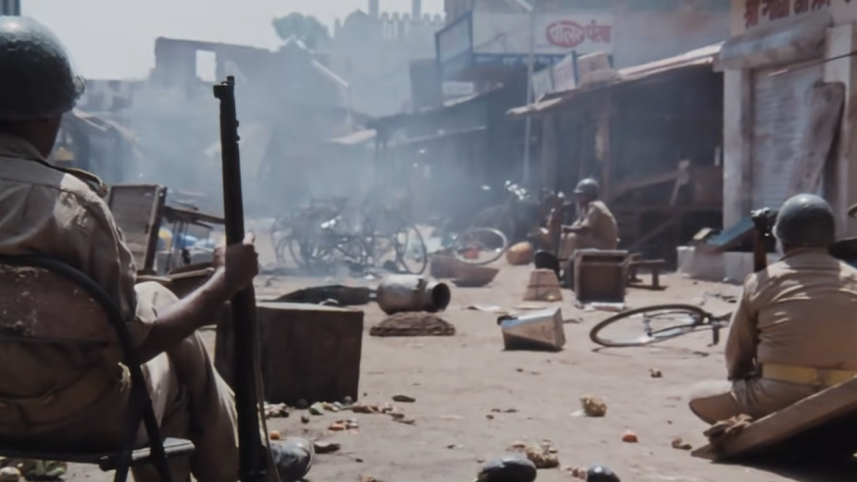
The menace here is bureaucratic, procedural, almost banal -- which renders it all the more chilling.
The plot is deceptively straightforward: a journalist traces a political killing to a member of parliament, only for the trail to ascend into more rarefied and dangerous altitudes.
Yet, the film resists the seduction of tidy conclusions. Each revelation complicates rather than clarifies.
Riots erupt, not merely as spontaneous combustion but as curated chaos -- disturbances that conveniently blur accountability.
The machinery of suppression whirs into motion. Stories are buried, narratives are engineered, and the line between reportage and propaganda grows perilously thin.
What distinguishes New Delhi Times is its refusal to sanctify the press. It interrogates, instead, the ethics of mediation itself.
Who frames the truth? Who benefits from its telling? And perhaps most disquietingly -- can truth survive the very systems designed to disseminate it?
At its core, the film is a study in symbiosis -- the uneasy dance between politicians and the media.

Each feeds off the other, each manipulates the other, and both, at times, collude in a shared fiction.
This is not corruption in its crude, transactional form; it is something more insidious. It is the corrosion of intent, the gradual normalisation of compromise.
The newsroom, far from being an ivory tower, is revealed as a porous space where influence seeps in, often imperceptibly.
Despite being four decades old, the movie poses with chill of recognition.
The anxieties it articulated in 1986 -- political interference, media pliability, orchestrated unrest -- have not merely persisted; they have metastasised in 2026.
In an age of algorithmic amplification and information warfare, the film’s concerns feel almost quaint in their analogue simplicity, yet eerily prophetic in their essence.
Replace the printing press with digital platforms, the editorial meeting with a trending dashboard, and the questions remain stubbornly intact.
If anything, the stakes have intensified.
The velocity of misinformation, the commodification of outrage, the blurring of journalism and spectacle all echo the film’s central thesis.
Truth, once mediated, is always vulnerable.
There is a moment, subtle yet seismic, when the protagonist realises that uncovering the truth is only half the battle; ensuring its integrity is the other.
It is here that New Delhi Times transcends its narrative and becomes meditation.
For in every era, the question lingers -- who tells the story of power, and at what cost?
The film offers no easy solace. Only a mirror.

Interviews / Tufan Chakma’s Erasmus Mundus Joint Master’s in Animation journey

Why parents should think twice before giving kids smartphones
More than 100 companies urge coordinated defence against AI-powered cyber threats

NASA launches Roman Space Telescope to probe dark matter and distant worlds

GTA VI: Here's everything we know after the big Netflix preview

Tribute / The Dolly Parton we will remember

The versatile appeal of focaccia bread

Apple sets September 9 date for next iPhone launch event

Profile / Chef Infiter Islam on bread, flavour and experimentation