


The blue-hair narrative and the art of meaning
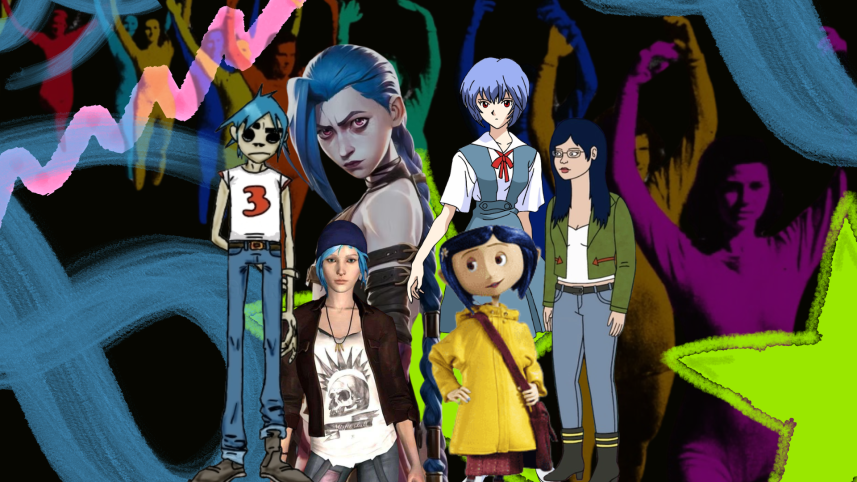
TV Girl’s “Blue Hair”, a famous track from the album Death of a Party Girl, is a simple and ambiguous song. Carried by a dreamy, melancholic melody, the song turns to blue hair as a cryptic literary tool to grapple with identity and an intimate connection that is fading. The girl in the song doesn’t just dye her hair; she builds a version of herself around it. But that version is fragile and ephemeral.
“What seemed so blue in the sunlight by night was a pale green."

This line from the song quietly speaks to something larger: the volatile nature of blue hair as a metaphor, as well as the ethos of blue-haired characters across media who are similarly in flux.
It acknowledges that blue is an unusual hair colour that has mastered the art of meaning. Ever-evolving with rich symbolism that speaks many different stories, yet never fixed in essence. Blue thrives in multivalence, shifting through sorrow, grief, chaos, rebellion, and disconnection.
This spectacle finds a clear expression in Coraline Jones and her iconic blue hair. Coraline's blue exists in a world of sombre tones, signifying the stark contrast between her innate vibrancy and a world drained of colour that shapes the film's atmosphere. Her striking colour against the dullness renders her unfitting, but the blue marks her emotional vulnerability stemming from isolation. Her vulnerabilities connect her to the “Other World”. The other world breathes colour; the rooms feel alive, and her blue hair in the middle of it makes sense. The environment of saturated blues, deep purples, and glowing skies has the belonging Coraline lacks in reality.
In Life Is Strange, Chloe Price’s blue hair is born from something louder. Her electric blue hair is not incidental but dyed and deliberately maintained. Her haircut against the mundane Arcadia Bay is worn as a mark of rebellion. Chloe’s blue hair is defensive but heavy with the weight of her past. Chloe exists in a constant state of instability, and her unnatural blue hair becomes a visible, rebelling assertion of control within this frailty. Yet more importantly, it externalises her grief following the death of her father, the disappearance of her best friend, and abandonment by those closest to her.
The blue hair of Diane Nguyen from BoJack Horseman is complex and quietly insidious. Diane understands the world too well: its injustices, hypocrisies, and emptiness. She feels powerless to meaningfully change it, leading to depression and disillusionment and made worse by her belief that her trauma must amount to something “useful” to justify its existence. Diane’s blue hair is a visual maestro of subtle, internal chaos, much like the questions she cannot answer about herself, her past or her purpose.
Rei Ayanami from Neon Genesis Evangelion and 2-D from Gorillaz wear blue hair that echoes in the vacant spot left behind after the erosion of self. Rei exists on the periphery of emotion with an eerie indifference because she was never allowed to form a stable identity. Her pale blue hair is drained of warmth. It reflects a tragic life in a liminal state, caught between human emotions and artificial purpose. 2-D’s blue hair signals a detachment shaped by repeated physical and psychological damage, which has left him disoriented. The blue is passive, almost accidental, as 2-D hazily drifts through the world with no control.
Lastly, a quintessential for blue-haired depictions: Jinx from Arcane. Jinx’s hair is all anarchic power. The unique, stylised braids, the electric blue, are an overwhelming force of nature that serves as an integral part of her characterisation. Within Zaun, her blue hair becomes a language of collective resistance against Piltover's oppression. Her hair, like powder, was an innocent blue and shorter with the messiness of a carefree child. As Jinx, it became a wild, ominous blue, deliberately long and architectural to show the weight of a fractured psyche spiralling. In the alternative timeline where she was spared trauma, it remains light, short, and unburdened.
Blue resists a singular interpretation. Narrowing down the layers of blue diminishes this exact "other-ness" that makes it brilliant. Blue hair is never just one thing but an intricate window into the nuclear core of the wearers’ stories and identities. It’s a visual storyline that reveals what the characters cannot articulate. Like the girl in the song, what seems so vividly blue is never fixed but slips between fluid meanings and connects us to these characters.
Aleena is a struggling 9th grader who loves robots and revolutions. Send her your esoteric online archives at aleenayusra33@gmail.com.
 For all latest news, follow The Daily Star's Google News channel.
Comments