


Voices of the Youth
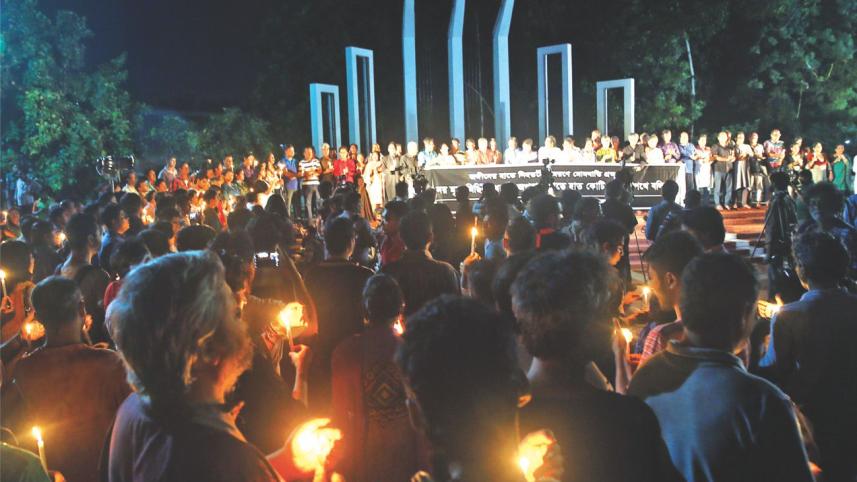
I once read an article about how our generation falls victim to a modern phenomenon called “Facebook Image Crafting”. This involves presenting only the good parts of your life on social media so that people secretly aspire to be as good looking and successful as you are. Today we grow up under an unrealistic pressure to excel in our professional and personal lives. Often, we fail to meet the expectations of society, our parents, or ourselves, and when we do, we crumble. We become vulnerable to a point where our entire life seems like an empty void. We become desperate to find a greater purpose for life. Desperate to find a cause we can believe in and rally for. And that is where religious extremists tap in. They “enlighten” these lost souls about this amazing cause, the “Jihad” that not only gives their life a purpose, but also promises the greatest reward of all, the Jannah. Perhaps, the recent phenomenon, not only in Bangladesh, but across the world is a wake up call for us to redefine what expectations we communicate to our youth. Should we ask them to focus only on their grades, wealth, and career, or should we encourage them to live for a cause such as alleviating poverty, fighting global warming, making the world a better place? Perhaps, if we guided our youth to channel their energy into a bigger cause, they would be spared the need to seek solace and purpose in religious extremism.
Anonymous
Co-founder of an online Startup
The Bangladesh we grew up in was always so warm- so accepting of each others' beliefs and so generous in sharing each others' happiness. So what went wrong? How did we accumulate so much hate and negativity?
 For all latest news, follow The Daily Star's Google News channel.
 In search of answers for these questions, I called the one person I bombard with all my problems and queries: my mother. While I went on a rant on how I hate the evil Islamists manipulators who are trying to make puppets out of our youth, my mother immediately declared that I had tunnel vision and I needed to see the more pressing social aspects to this problem. The first thing she told me was that our society has become way more pessimistic and bitter than it ever was before. She told me that instead of judging people and finding things to bring them down, we need to start complimenting each other. She also told me and I quote-'we need to stop discouraging people'. People with ambitions have started to draw a lot of negative remarks from society. Thirdly she claimed 'We need to start treating all children like we treat our own. We need to love them like our own'. Watching someone or someone else's child achieve good things in life should make us happy; not negative and judgmental. She told me we need to cut back on all of these negative habits that are lethal for our society and make a better environment for our children where they feel more protected than they do right now. A society from which they will learn to love- not to hate. A society that makes us all responsible for each others' lives. It is needed more now, during these trying times for humanity, than ever before.
Anonymous
Health Advisor, Priceline Pharmacy Australia
It is very appalling that these days extremist outfits have started recruiting from high profile schools, colleges and universities whereas earlier recruits were mostly supplied from madrasas. Moreover, university teachers, professionals and members of wealthy and influential families have fallen into traps of such terrorist schemes. It is frightening that these people who enjoy more acceptance and influence over a large part of our society have turned into weapons of destruction. I think these people are becoming easy targets of the terrorist groups because many of them have very little knowledge about rich Bengali culture of diversity, folklore heritage, Islamic tolerance, shared histories and traditions of thousands years. Taking chance of their detachments or deviation, terrorists brainwash these people with revisionist narratives of heavenly rewards and fantasies of martyrdom. As a consequence, they learn to hate Jews, Christians, Hindus, Buddhists and other non-Muslims. My suggestion to tackle this growing menace is to develop strong security architecture and efficient counterterrorism policy. Besides, we need to understand diverse social relationships among communities to promote interfaith dialogues and communal harmony. On the other hand, we should remove hateful expressions from academic literature and misinterpretations of Holy Scriptures while the textbooks should incorporate alternative literature on tolerance, diversity and pluralism.
Rakibul Hasan
Youth Activist, researcher and Women Deliver Fellow
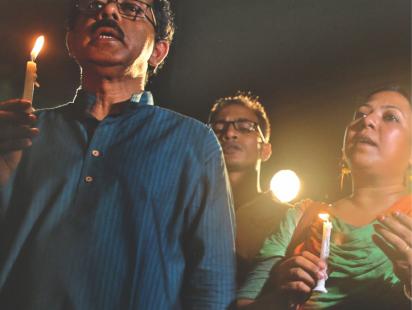
The news of Gulshan attack came to me as an utter horror. I trembled with fear and the idea of peace became alienated to me. Now, after about two weeks of the attack, as I have had more time to think about the situation, the fear has spread even more. I do not feel safe on the roads that I walk every day, the restaurants I visit every morning or with the classmates who I meet in university every week. The awful trait of stereotyping has started to grow on me. I do not know who is innocent and who may share the same ideology that drove the terrorists that day. It is so, because I realise that such an attack is not a rogue case, but a result of the deeply rooted socio-cultural aspects of the youths in Dhaka. It is not today that the misunderstanding of religion and blind faith has been injected into us. Rather, the elements that play a part in instigating radical extremism, such as manipulative pseudo religious contents and the practice of teaching pseudo religion in both Bangla and English medium educational institutes have existed from long ago. Because of this, even though the attack in Gulshan was the first time that Bangladesh has seen such an intricate assault, we have already witnessed a similar attempt in Sholakia on Eid day and I cannot assure myself that more incidents will not take place in near future. While it is unavoidable to live without fear and caution, I do not think we are crippled just yet. I believe that with informed actions and responsible decisions, the terror in Bangladesh can be halted before it fosters to be an epidemic.
Anonymous
Student and freelance photographer
Private University in Dhaka
They say 20 people died. But I say, in some corner, a part of us died too. The turbulence of the atrocious act hit us too. Hence, now more than ever, we need to stay united. We need to foster the peace; we need to generate kindness, tolerance and nobility among ourselves. What we hear, see and feel should make each of us a better person who knows the importance of respecting every other person, despite their religion, gender, colour. Lastly, we need to keep dreaming the Bangladeshi dream. We need to remember our responsibility for making our homeland better.
Anonymous
Third year Student of Asian University For Women
Statistically 10 percent of the best brains of this nation leave this country. There is no scope for creators, thinkers, innovators and this expands to even artists. A society enriches through diversity and mixing of minds. Our endeavor is to provide access to resources and opportunities to young innovators who can create solutions to nation's challenges. Eventually transform these ideas to social enterprises. These entrepreneurs will not be taking business as usual but will create a new paradigm of minds who will seek greater social equity through their work.
Bangladesh has performed great in developing human development index. We however need a strong vibrant middle class who will stand up for the virtues of an inclusive society. I see us there in next decade.
Talent itself is never enough. From education system to voicing opinion – we have never been given the platform to engage and nurture us. We do not have such a platform as yet, but we have to co-create it. We need to be heard and not by screaming, but by dialogues and acceptance.
Saif Kamal
Founder, Toru
The main causes of this attack are manifold— these kinds of political murders have been happening for months now. Whose lifestyles or thoughts varied from the norm received threats and were killed in public— there was no step from the government or the police to strengthen security or give support to those who faced such danger. Added to that, a culture of corruption and regressive state policies (chastising anyone who shares his or her thoughts, making writing about homosexuality illegal etc.) persists— we have the perfect climate for such crimes to take place, because then we get to think that we can get away by conducting these crimes, and we do! This is clearly not even close to the “secular democracy” that our constitution boasts of. As a society, we must practice more tolerance and acceptance of different views, when it comes to different matters such as religion, gender, lifestyle, etc. Educationists must revise how religion is taught in the classroom. There is only rote learning, but no analysis, for which young people might fall prey to dominant oppressive ideologies. Different interpretations of religion must be welcomed in class, along with critical reading of religious texts, in order to create an intellectual space among youths and teachers, and not have one authoritative interpretation to grow a sense of respect and mutual understanding that can foster nurturing spaces for dialogue and critical thinking. This approach has to be applicable in all realms of communications actually, among parents and children, siblings, friends, etc. Any war or police crackdown won't root out militant or fundamentalist ideologies, but an intellectual culture would, so that fascism of any kind can be resisted.
The damages of the aftermath of any terrorist attack are greater than the actual terrorist attacks. About Bangladesh, given the neo-liberal, capitalist nation that we are gradually emerging as, our approach to deal with terrorism has also begun to resemble other neo-liberal states such as India, USA… we are turning out to be a police state, with rigid surveillance tactics, which adds to the shrinking of democratic spaces. In such climate, it's easier for the State to regulate, profile and police any citizen, and accuse, jail and vanish anyone for that matter. Thus we need to ask who is the State really benefiting, who is it really working for? We MUST address these issues along with safety and security for the general people.
Anonymous
Researcher at an NGO, Dhaka
For me it was very hard to believe that Bangladeshi youths could conduct such savage terrorist attack. It is the result of extreme radicalisation of our youth which happened due to their isolation from Bangladeshi society and culture. If we see the life history of these youths, it becomes very clear that most of them were frustrated at one point of their lives, they were seeking meaning of their lives and they had very little connection with the realities of the Bangladeshi society. These youths can easily find seductive messages of terrorist groups through the internet that promise them of the status of martyrdom, luxury in heaven and revolution in the world. This is how many youths, who mostly are from affluent families, are getting involved with hardcore terrorist activities. I believe mobilisation of youth through community activities is the best solution to this problem of radicalisation. Youth organisations for community activities should be formed and patronised so that young people can play active role in the social development. Thus they will be able to realise what should be their contribution to the development of their motherland. Nowadays young people are very career oriented and restless. Giving them the opportunity to work for different parts of the society should be the strategy to make them patriotic citizens of the country.”
Mohammad Mamun Mia
President, United Nations Youth and Students Association of Bangladesh
We are in a system where difficult conversations are avoided, academic curriculum is archaic and the workplace is confusing. We don't have very good role models. We latch onto cricketers or social media commentary to provide us with direction in all avenues – from religion to workplace etiquette. It is a struggle to break out of what is prevalent and explain to young people about a different reality. We try to bring together young people from madrasa, Bengali medium schools and English medium schools to have a conversation and work together. We try to engage the young professional with the fourth-year university student. Our goal through this process is to develop a more tolerant, inclusive country, essentially a better country.
I think it will be pretentious to believe we have all the solutions. I think youth organisations in Bangladesh also need to look more closely into what they are offering, not only in terms of activities but also in terms of incentives. Why does someone choose to volunteer versus someone who does not? Are our success stories people who would be successes irrespective of our involvement? Are some people excluded from the kind of conversations we preach in our groups? Do we actively intervene to ensure there is diversity in our staff and volunteers, or do we take it as it comes? These are uncomfortable questions, but pertinent if youth organisations are to play an instrumental role in supporting young people in Bangladesh.
Every country in the world undergoes a period of chaos before it establishes itself on a trajectory of consistent growth. Bangladesh has experienced remarkable growth in development, in women's rights, in healthcare, in bringing more girls in the classroom. However, Bangladesh still struggles politically, religiously and economically. In the next decade, I think our struggles will become more adverse, only to ensure we overcome our existing limitations and become better. I am an optimist in that regard, however I am cautious that the journey will not be easy.
Sabhanaz Rashid Diya
Founder and President
One Degree Initiative Foundation
We were so busy blaming madrasas, or other Islamic parties, that it created an opportunity for the extremists to target the affluent, who we never thought of giving any attention to. To shock and shake the nation, extremists chose the perfect target group. I don't think every one of those youths had the urge to do this; it was created in their mind slowly and gradually. According to me, two things happened simultaneously; one is lack of personal time with their families, and then radical thought positioning in their minds by the extremists. It takes time to build this level of isolation from society and the past. It's like transforming one's personality into a completely different one. I think the lack of openness with the family to talk about views- religious or not, their thinking and mindsets, their logic, these lackings fuelled the recruitment. These kids that turned into monsters did not share their new experiences, new transformations or new 'friends' with their families, making it easier to poison their minds, without parental interference.
It all comes down to democracy—the solution. Even if we don't have it in the country; we can have democracy in our homes. Parents shouldn't be imposing their ideas on children; rather they should be open to hear out what they are thinking and help them make decisions together. We need to create a world around them where we show our respect to each and every human, regardless of the religion, race, and gender. It's never too late to start such practices. Make the children participate in social activities that will flourish their hearts and souls- charity, animal welfare, rehabilitation programmes. If the extremists can poison them with radical thinking, then why can't we influence them with the positives in life? Equal treatment, respect and love need to be shown to each and every living being. Children learn from us, it's our duty we show them the right path. We need to talk about positive things, try to spread the good deeds with the people around us.
Anonymous
Executive at a corporate company
Dhaka
Comments