


The South China Sea Imbroglio
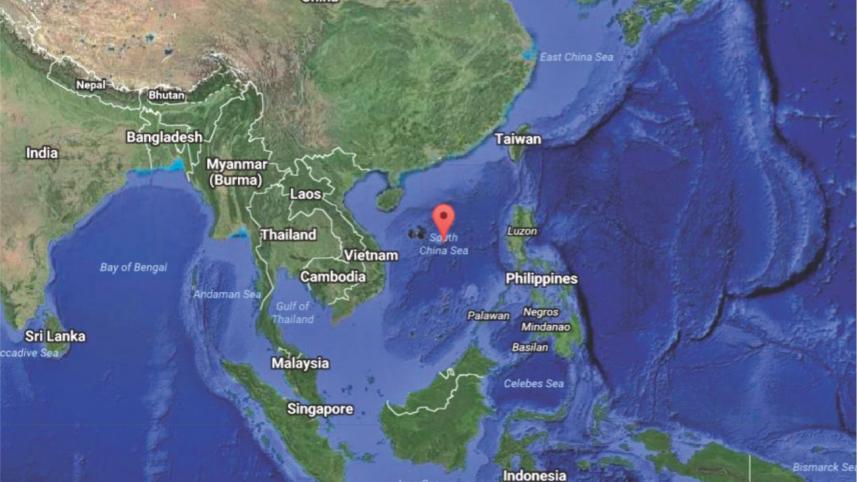
The prevailing tensions over South China Sea are the result of its prevailing aggressive-imperialist-expansionist foreign policy orientation in the entire Asia-Pacific or rechristened Indo-Pacific region for many years past, because riding over the crest of its own creation, Beijing had extended its claim over the entire South China Sea, few years ago, as its maritime territory while citing some historical evidences of it's choice. But that claim was rejected by a five member panel from the Permanent Court of Arbitration in The Hague, Netherlands on July 12, 2016, while deciding on Philippines' complaint lodged in 2013 for arbitration on grounds of alleged Chinese infringement into Manila's Exclusive Economic Zone, under clauses of violation of the United Nations Treaty governing “Laws of the Sea”, to which China is also a signatory. Unfortunately, this legal defeat has made Beijing more aggressive as it has started encircling the Asia-Pacific with huge and awesome strategic built-up by its fierce naval weapons. It is also having meaningful tensions with powerful regional navies like Japan, Australia and particularly with that of America. In Southeast Asia, China is already engaged in several disputes over sovereignty of islands in South China Sea.
The US has been carefully monitoring all these developments since long past as it has its precious economic stakes in this region particularly owning its strategic relations with most of the Southeast Asian countries and major powers in the region. Further, it has to ensure safe and uninterrupted passage of maritime trade and commerce passing through different sea-lanes around South China Sea region, connecting East Asia with West Asia and beyond, which might have been adversely affected had Beijing's claim passed through Court scrutiny. As America is aware that the future of the world politics lies in the East because global geopolitics has moved towards East from its traditional Euro-Atlantic centre of power after two and a half century, it did conclude a significant military agreement with Australia in 2011, following its “Asia-Pivot” programme, having a covert agenda to contain China's imperialist-militarist aggressions in the Asia-Pacific region with a view to provide an effective security cover in the region and also to re-establish that the US is still a global power and maintains its dominance and hegemony all over the world, against a likely projected scenario of China replacing the US hegemony by the end of mid-21st century. A scholar, Martin Jacques has also predicted in his book When China Rules the World, that China would surpass the US and would become a dominant global leader with none to challenge its hegemony. Obviously, the US has to washout all such confusions about its sagging global power image and that has motivated Washington to display its full might in South China Sea in the event of a war.

Obviously, if armed clashes begin between the two, it may result into a major regional war including regional powerful navies, like Australia, Japan, South Korea and also the NATO allies, besides Southeast Asian and South Asian states. Its further advancement will, ultimately, result into Third World War, which in all likelihood will be a nuclear holocaust upon the mother earth as all the likely belligerents are nuclear powers today.
Against this backdrop, while China must abide by the decision of the Hague Arbitration and the US ought to observe restraint- as both America and the then USSR did in 1962 during tumultuous years of fierce Cold War- both of them must seek a diplomatic solution with the help of the United Nations, representing global aspirations.
The writer is Associate Professor, Political Science, MDPG College, India.
 For all latest news, follow The Daily Star's Google News channel.
Comments