


The Pangolin
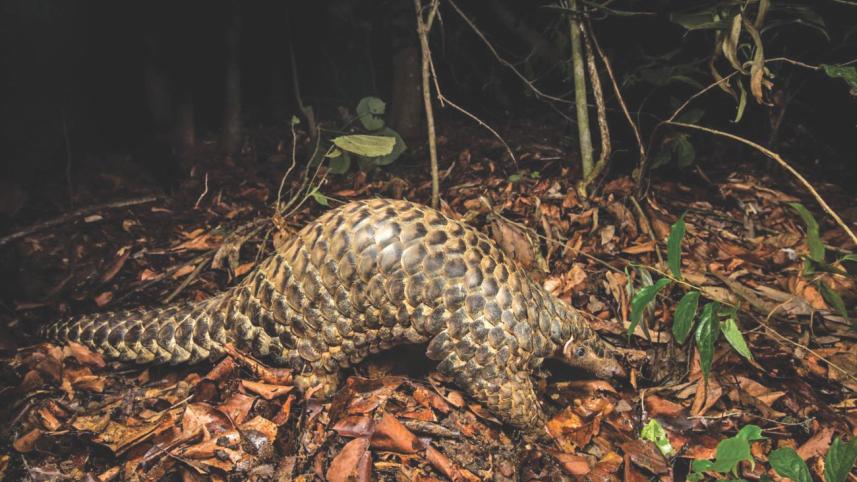
Photo courtesy: scott trageser wildlife photography
The Pangolin (banrui) is an armored, toothless mammal of the Manis family Manidae, of the order Pholidota. Pangolins are not closely related to any other living mammals, and their ancestry is not known. There are seven species of pangolins worldwide, three in Asia. Bangladesh has all three species of the Asian Pangolins. Also known as Scaly Anteater, it is a critically endangered species in Bangladesh. The body colour is dark brown. The body and tail are stout and the tail is prehensile. Bristle-like hairs are scanty on the under surface of the body, but a few grow between the scales. The snout is narrow and pointed. It has a long sticky tongue; eyes and ears are small. The foreclaws are about twice the length of the hind claws. The length, of the head and body, is between 60-75 cm; the tail is about 45 cm long. The body is low and close to the ground and is covered with large, triangular, overlapping horny scales on the back, the sides, the outer sides of the limbs, and the entire tail. It is a nocturnal animal and spends the day curled up in burrows 200-600 cm deep, dug by itself or in shelters among rocks. A single young is born, and rarely two, during the first half of the year. They live in the deciduous 'sal' and mixed evergreen forests of the eastern and northern districts. Habitat loss is the main threat to this species. It is also found in Pakistan, India and Sri Lanka.

Source: Banglapedia
 For all latest news, follow The Daily Star's Google News channel.
Comments