


The need for social work
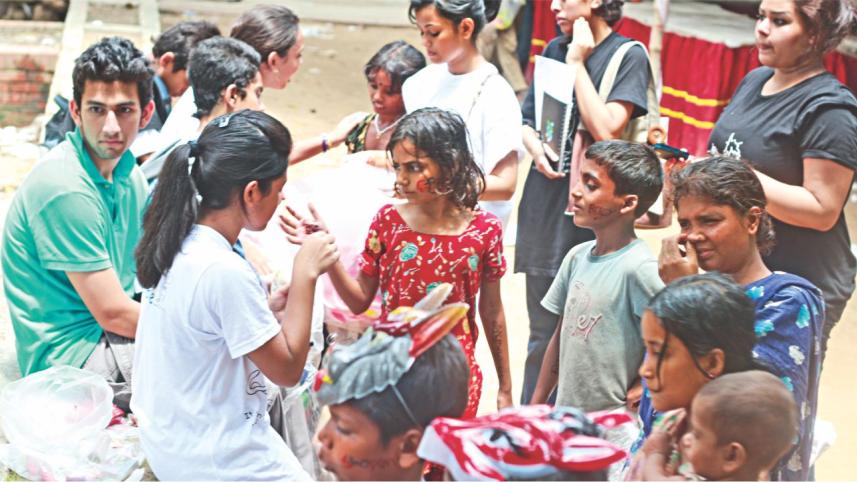
Photos: Md Ata Islam Khan Mojlish
A city buzzing with energy. Noise, everywhere you go.Thousands of people within every square mile in almost all areas of the city. Buses, cars, CNGs, rickshaws, trucks. Microphones serenading the prayer time, summoning the pious. Children running around the streets, dodging vehicles. The most striking image, though, is that of the beggars.

Even though people living in poverty in Bangladesh decreased from 63 million to 47 million (2000 to 2010), a reduction of 26 percent, hardcore poverty remains widespread. The government alone does not possess the resources needed to eradicate poverty, although they play the biggest role in providing a more equitable society. So the question then becomes, what is the next best alternative to fighting poverty putting aside government intervention?
Social work has historically been extremely effective in alleviating poverty and is perhaps citizens' strongest weapon against tackling poverty (aside from government policies, etc). Aristotle, the great Greek philosopher, firmly believed that the city state comes into being for the sake of life, but exists for the sake of the good life. If we go by the words of the ancient philosopher, then the future of our city and country becomes tangled in an existential dilemma. There is at least 47 million among us living in conditions that can hardly be described as the 'good life'. So, what does this say about our city's or country's existence which has ironically become a focal point in the global discussion about 'development'? Yes, scarcity rules the roost, and this is the source of most problems arising in third world countries such as ours. But with large-scale projects of social work, we can impact the manner in which people react to the poverty issue.
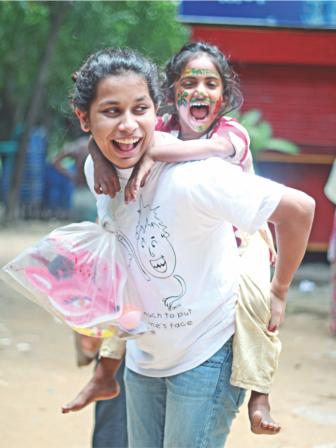
Promoting the significance of social work can bring communities closer and bring about change in the way people think about each other's well-being. Social work helps develop the thought process and instills attributes such as compassion and empathy -- two of the numerous traits that make a good character. There exists numerous individuals in this country who perform acts of kindness via voluntary work but they do not always get noticed by the general public. The media needs to play a bigger role in highlighting such activities, inspiring more people, especially the youth, to engage in social work. Educational institutions such as schools, colleges, universities should consider making social work mandatory as part of extracurricular activities or course credit.
Although many social initiatives are already being taken, more must be done at the grassroots levels. For instance, consider a project that gives free schooling to the children of those working in the RMG sector--the 'backbone' of our economy. How timely and fitting that would be. Isn't it time we give back to these workers, whose labour rights are questionable at best, and who are basically holding our economy together?
Amidst the current state of affairs in the country, some positive initiatives such as the above would be welcomed with open arms. If social work can successfully take hold on a wide scale and perhaps even be popularised in the process, it could lead to some drastic changes in the trajectory of Bangladesh's future. People can be uplifted from poverty and provided with opportunities which they could only have dreamt of.
We would want future generations to get to know a beautiful Bangladesh, which is not only rich in culture and history but which evolved to be more egalitarian than its neighbours; not a Bangladesh which gave up when faced with adversities. What must be challenged is the way most of us look down on the sorry state of the country. With glaring poverty a defining issue in the conversation about our development, we should, on an individual level, seriously consider contributing to the fight against poverty, be it through social work or some other avenue.
 For all latest news, follow The Daily Star's Google News channel.
Comments