


The Killing Machine
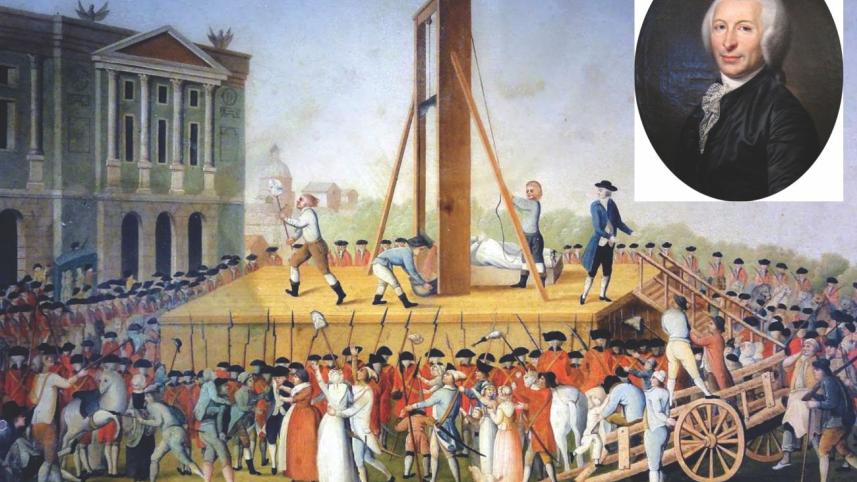
Guillotine is one of the most renowned devices of execution, which became a symbol of judicial execution in France. For its widespread use in the French revolution, when thousands of French aristocrats lost their lives under the sharp blade of Guillotine, this device became a worldwide phenomenon. However, this deadly killing machine was named after a doctor who did not even invent it, rather he was a strong advocate for banning death penalty. Joseph-Ignace Guillotine (1738-1814) was a French doctor who used to write essays to ban capital punishment in France. In one of his essays in 1789, Guillotine suggested a device to make execution as painless as possible, if death penalty cannot be avoided at any cost. The then French government liked the idea and the first prototype of the painless execution device was designed by another scientist called Antoine Louis. The beheading machine consisted of a pulley system and a pedestal. In the pedestal the condemned man's head used to be kept. By operating the pulley, a sharp 4 kg blade used to fall on the neck to chop off the head within the fractions of a second. Mysteriously, this deadly device was named after Joseph Guillotine instead of its actual designer Anotine Louis. After the French revolution, beheading of condemned people by guillotine became a popular source of public entertainment. For example, King Louise XVI and Queen Marry Antoinette were beheaded publicly by Guillotine. After the death of Joseph Guillotine, his family was so embarrassed by his connection with this beheading machine that they asked the French government to change the name of this device. However, the then French government refused the plea, and the family members changed their family name instead. Guillotine continued to be used in France until 1982 when death penalty was abolished by law. The last victim of Guillotine was a woman named Hamida Djandoubi, who was executed in 1977.

 For all latest news, follow The Daily Star's Google News channel.
Comments