


OPPORTUNITIES FOR THE DIFFERENTLY-ABLED
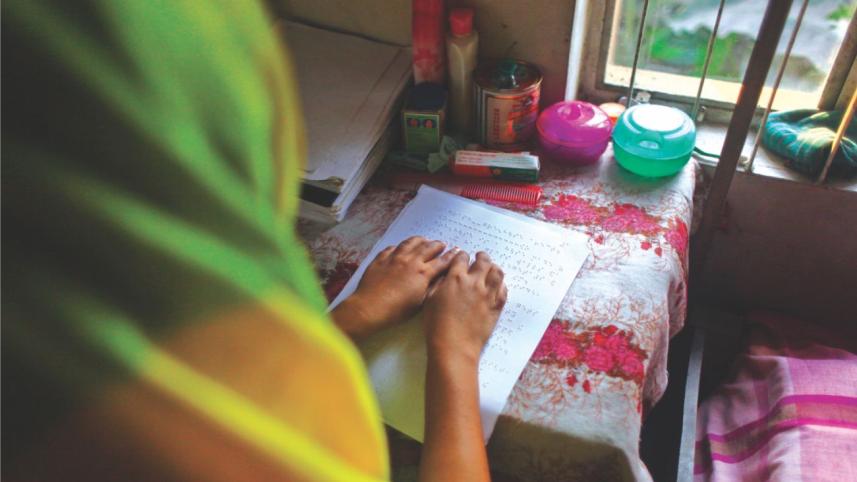
Photo: Kazi Tahsin Agaz Apurbo
Mehedi Hasan, a visually impaired youth lost his sight at the age of four. However, due to his strong determination and relentless support from the family, Mehedi has achieved a Bachelor's degree from Dhaka University's Department of Political Science in 2014. Last year, when his father passed away, Mehedi, the eldest among four children, take over the responsibility to run the entire family. “Although I am a university graduate with a very good result, I was rejected to apply for many jobs due to my blindness. Bangladeshi organisations are very reluctant to employ physically challenged people in appropriate positions,” shares Mehedi at the ECMY Career Expo organised by the Physically Challenged Development Foundation (PDF) at The Daily Star in Dhaka.

Mehedi's struggle to get a job to support his family might come to an end after attending the career expo as one of the participant employers asked for Mehedi's curriculum vitae as soon as Mehedi finished his heart touching story. Nonetheless, in our country, Mehedi's story is shared by all the educated physically challenged people. After overcoming thousands of obstacles during their time as students, those who are physically challenged face even more obstacles and discrimination to get proper jobs after completing their education. To address these issues, PDF initiated a project last year called Enhancing Capacity and Mainstreaming Youths with Disability (ECMY). Under this project, this youth led voluntary organisation trained 100 young men and women with disabilities and organised this career expo to manage suitable jobs for them.
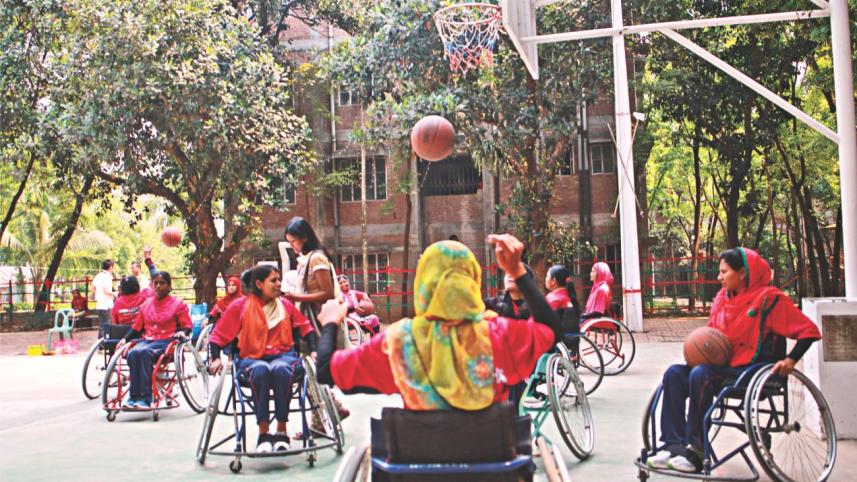
The training covers a wide range of topics such as computer operation training, training on office management, spoken English courses and even sports training were provided to the trainee youths,” says Mamunur Rashid, Vice President of PDF. “We have arranged training for them according to their will and requirements,” he adds.
From PDF, Shirin Akhtar received training on using computer software that can convert text to speech. “The software is called JAWS. Since I am a student with visual impairment, it is very helpful for me to learn all the functions of this software. In our institutions, we have to use Braille books which are very outdated and full of errors,” says Shirin, a fourth year student of Kabi Nazrul Government College in Dhaka.
After learning the functions of this software I will install it in my computer and I will be able access all our textbooks and a lot of supporting material through this programme as this will read out the texts for me. It will also help me a lot to get a job because with this software I can operate computer as fluently as any other person,” says an enthusiastic Shirin.
This initiative has changed the lives of a hundred young men and women. However, compared to the crisis we have been facing, this initiative will only be successful if it can be done in a large scale. At present, it has been found that 1.4 percent of Bangladesh's total population are physically challenged. If such large amounts of people remain uneducated and unemployed, the loss of human potential and resources of our nation will be irrecoverable.
In many areas of Bangladesh and in our society physically challenged people are often treated as burdens. This malpractice has to be stopped and their capacity must be recognised and it is possible if we can take initiatives like ECMY and if our mass media share these differently-able people's success stories,” says Dr Sheikh Mahmud Ali, a retired bureaucrat and a discussant of the career expo.
To break out from such stigma, PDF' initiative to ensure employment for the physically challenged people can be an example for us.
 For all latest news, follow The Daily Star's Google News channel.
Comments