


Why Messi’s Jordan free-kick wasn’t as savable as it seemed

Social media was characteristically quick to play the jury after Lionel Messi’s 80th-minute free-kick capped Argentina’s 3-1 win over Jordan in Dallas on Sunday (Bangladesh time).
As the slow-motion replays rolled in, the armchair experts appeared to have reached a swift, unified verdict: a more competent goalkeeper would have saved it.

It looked low. It looked slow. It looked within reach.
It was, however, a complete illusion. What the keyboard warriors missed in their rush to judgment was a masterclass in split-second psychological warfare and pure human biomechanics.
Jordan’s goalkeeper Yazeed Abulaila fell hook, line, and sinker for football's most fatal sin: assumption.
Anticipating Messi’s textbook strike -- whipped high over the wall into the top corner -- the keeper gambled. He pre-meditated his movement, shifting his standing position from centre-right toward the middle to get a head start on the expected trajectory.
But Messi, possessing a supreme ability to improvise in the final microsecond of his stride, spotted the twitch and sold the shot-stopper a dummy. He adjusted his shape instantly, hitting a low, curling strike into the exact pocket the keeper had just vacated.
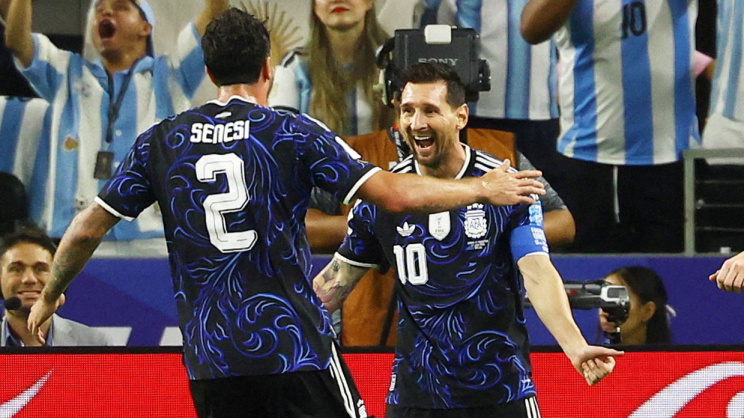
With that flash of genius, Messi became only the fourth man to net two World Cup goals via a free-kick, equalling Brazil’s Rivellino (1970 and 1974), France’s Bernard Genghini (1982) and David Beckham who scored twice in 1998 and 2006 for England.
The biomechanical reality
When a goalkeeper is already fully committed or caught on the wrong foot, shifting weight to cover even a foot-long distance the other way is a physical impossibility.
Slow-motion footage conveniently strips away the brutal reality of real-time reaction limits, making a biological dead-end look like child’s play to the digital gallery.
The online critique that a better keeper stops the shot fundamentally barks up the wrong tree. If the Jordan shot-stopper had stayed home and refused to gamble, Messi would not have shot low -- he simply would have opted for the top-corner solution instead.
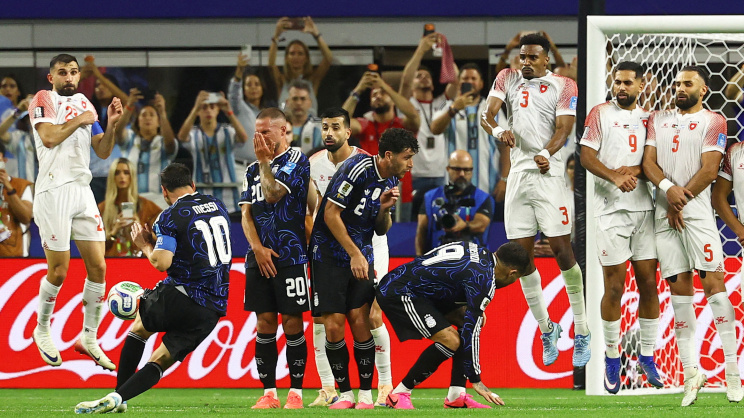
The Dallas cameo, which made Messi the first player to score in seven successive World Cup matches -- would have been 10 matches had he not missed a penalty against Poland in 2022 -- offered a familiar, stark warning as Argentina heads to the Round of 32 to face Cape Verde on Friday night.
Trying to outsmart the great No. 10, or fueling his temper, is an exercise in total futility. At the end of the day, one cannot outsmart him; opponents can only hope against hope that he underperforms.
 For all latest news, follow The Daily Star's Google News channel.
Comments