


When Senegal danced the world awake

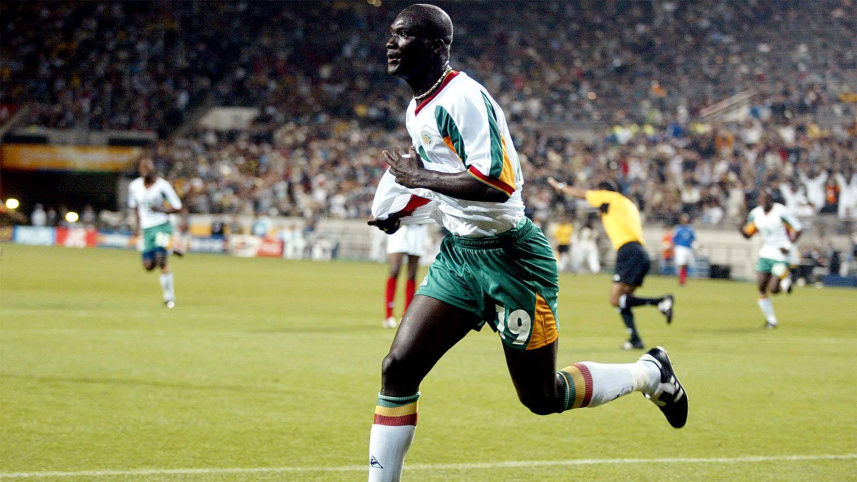
What unfolded on that green carpet that day may, in the record books, be reduced to a few numbers. But for those who witnessed it, it remains etched in a far deeper dimension. Like a line from a poem that suddenly lodges in your throat, or a familiar tune that brings back the scent of a long-lost afternoon -- just like that.
When Papa Bouba Diop took off his jersey, the sixty thousand spectators at the Seoul Municipal Stadium seemed, for a moment, unable to grasp what they were seeing. Then realization dawned. They rose to their feet. And in that very moment, a small nation on the western edge of the world -- one many might struggle to locate on a map -- felt, perhaps for the first time, that it too could stand tall at the very center of the earth.

The year was 2002. The last day of May. South Korea and Japan were hosting the FIFA World Cup -- football’s grandest festival -- for the first time in Asia. And on opening day, in the very first match of Group A, two teams took the field whose gap was not merely geographical, but steeped in history.
On one side, France national football team -- the most formidable force in football at the time. World champions in 1998 on home soil, European champions in 2000. Their ranks boasted Zinedine Zidane, a name that transcended the definition of “footballer” -- he was a philosophy, an aesthetic, a rhythm in motion. Alongside him, Thierry Henry, a rare blend of speed and intelligence. Robert Pires, Patrick Vieira, Marcel Desailly, Lilian Thuram -- each name a living tale.
On the other side, Senegal national football team. Making their World Cup debut. No familiar names for European commentators to roll off their tongues. Most of their players plied their trade in various French clubs. For this very reason, many dubbed the match “France vs France B” -- a label carrying far more condescension than humor.
The night before the match, sleep eluded Dakar. People stayed awake in front of TVs and radios. Some prayed. Others consoled themselves, saying, “No regrets if we lose -- just play well.” In Europe’s betting houses, not a single wager favored Senegal. Naturally so -- statistics, rankings, experience, history all pointed one way: France would win. Easily.
But football does not bow to statistics.
From the outset, Senegal made it clear -- they had not come to surrender. They did not shrink into defense; instead, they unsettled the French backline time and again. Their French coach, Bruno Metsu, who had embraced Senegal as his own, built the team not just on talent, but on belief. “Before they are footballers, they are human. And as humans, they are unique,” he would say.
That belief took form on the pitch.
30th minute. The ball came in from the left. Diop received it just outside the French box. He moved forward, shifted slightly right, unbalancing defenders. Then lifted his left foot.
The moment the ball hit the net, an uncanny silence fell over the stadium -- for half a second. Then everything erupted. Senegal’s supporters, who had traveled thousands of miles, embraced each other. Some wept.
And Diop?
He did not sprint. He did not shout. He stopped. Took off his jersey. Spread his arms to the sky. Then came the dance -- Senegalese folk rhythm, hips swaying, feet moving freely. No choreography, no pretense -- just raw joy bursting from within, impossible to contain.
His teammates joined him. They danced too. That day, a piece of Africa celebrated on Seoul’s soil -- a celebration where victory was not measured by goals alone, but by how deeply it touched the soul.
France’s goalkeeper Fabien Barthez stood stunned by his net. Had Zinedine Zidane been on the field, perhaps things might have changed -- but injury kept him out. Thierry Henry tried, dribbled, searched for space. But Senegal’s defense -- Aliou Cisse, Ferdinand Coly, and Diop -- stood like a wall of steel.
Ninety minutes passed. Senegal 1-0 France.
Their journey did not end there. They beat Denmark, drew with Uruguay, and advanced to the knockouts. In the Round of 16, they defeated Sweden in extra time. In the quarterfinals, they fought valiantly against Turkey, but their dream ended with Ilhan Mansiz’s golden goal.
Yet what happened endured.
Diop later spoke of that goal. When the ball hit the net, he thought of his mother, his village, his childhood -- playing barefoot on dusty fields. In that moment, removing his jersey was the only thing he could do. And the dance? It wasn’t learned. It came from within -- like something that emerges when words are no longer enough.
 For all latest news, follow The Daily Star's Google News channel.
Comments