


From traffic signals to the World Cup

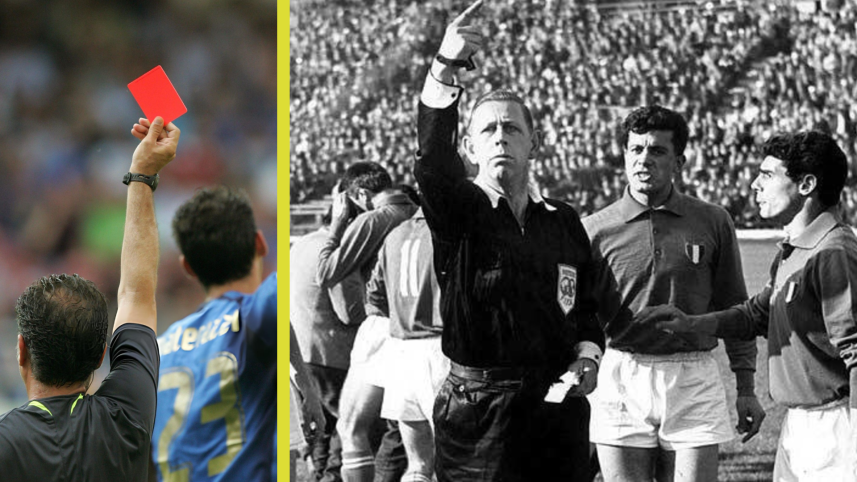
The sight of a referee pulling out a yellow or red card from his pocket has become one of football’s most familiar images. Yet there was a time when no such visible signal existed to caution or punish players during a match. Referees relied solely on verbal warnings or ordered players off the field. But differences in language often led to utter confusion. Surprisingly, the solution to that problem came from traffic signals.
Inspired by the yellow and red lights on the road, football adopted its revolutionary coloured-card system -- one that eventually stitched language and signalling into a single universal thread on the pitch.

Yellow and red cards were first introduced at the 1970 World Cup in Mexico. As the system quickly gained widespread popularity, it spread beyond football and was adopted in many other sports. Yet for decades before that -- from the first World Cup in 1930 onwards -- there had been no established practice of disciplining footballers through coloured cards.
Kenneth Aston’s revolutionary idea
This revolutionary innovation was the brainchild of English referee Ken Aston. A schoolteacher by profession, he thoroughly enjoyed officiating matches with whistle in hand. In 1936 he qualified as a professional referee. After nearly three decades of an eventful career, he retired in 1963 following the honour of officiating the prestigious FA Cup Final. Though he left the pitch, his contribution to maintaining discipline in football proved unforgettable.
By the early 1960s, football was no longer defined only by the magic of feet -- it had also become increasingly aggressive. Tempers among players were running so high that referees often struggled to maintain control of matches. The 90-minute contests frequently drifted away from football into shoving, punches and outright brawls. Scenes on the pitch often resembled rehearsals for battle rather than sport.
At times the violence escalated to alarming levels. Some players were seriously injured and had to be taken straight to hospital in ambulances. Incidents like these forced the game’s authorities to consider new ways of maintaining order.
Recalling his famous “Eureka” moment in an interview published on FIFA’s website before his death in 2001, Aston said: “I was driving down Kensington High Street when the traffic lights turned red. I thought, ‘Yellow means caution, and red means stop’ -- in other words, you’re off the field!”
The ‘Battle of Santiago’
One of the toughest tests of Aston’s refereeing career came during the notorious group-stage clash between hosts Chile and Italy at the 1962 FIFA World Cup -- a match that went down in history as the Battle of Santiago. In front of nearly 66,000 spectators, the football pitch that day truly resembled a battlefield.
Even before the match, tensions had been inflamed by two Italian journalists who published highly insulting articles about Chile. One described the capital Santiago as “a sad reflection of the underdeveloped world, plagued by every possible social ill”. The reports sparked outrage among Chileans. The situation became so volatile that the journalists were forced to leave the country within hours and return to Italy. Diplomatic relations between the two nations were also strained.
When the Italian players entered the pitch on June 2, they attempted to calm the crowd by throwing white flowers toward the stands. Chilean supporters rejected the gesture outright. From the outset, football took a back seat as personal vendettas between players dominated the match. Kicks and punches flew throughout the 90 minutes.
Amid the chaos, Aston sent off two Italian players during the first half alone.
Chile eventually won 2–0 to advance to the quarter-finals. For Chileans, the victory symbolised far more than football -- it felt like a matter of national pride. Years later, Aston remarked: “I wasn’t refereeing a football match. I was acting as the umpire of a military exercise.”
Confusion over Kreitlein’s decision and Rattín’s glare
Although the “Battle of Santiago” secured its place in football folklore, the decisive push toward introducing the card system came during the quarter-final of the 1966 FIFA World Cup in England.
The match between hosts England and Argentina at Wembley Stadium on July 23 descended into intense controversy as confusion surrounded several refereeing decisions.
By then Aston had hung up his whistle but remained deeply involved with football administration. He served on FIFA’s Referees’ Committee from 1964 to 1972 and chaired it from 1966 to 1970. During the 1966, 1970 and 1974 World Cups, he oversaw the referees responsible for officiating the tournament.
In that heated quarter-final, aggressive body language and constant arguments from players repeatedly disrupted play. In the 35th minute, Argentine captain Antonio Rattín was sent off for protesting against the referee’s decision. The German referee Rudolf Kreitlein later gave an unusual explanation for the dismissal.
According to him, “I didn’t like the way Rattín looked at me.”
 For all latest news, follow The Daily Star's Google News channel.
 A heated exchange followed in the centre of the pitch. The bizarre part was that Kreitlein did not speak Spanish, while Rattín knew no German. The match had to be halted for nearly 10 minutes until a translator arrived. When Rattín eventually left the pitch -- hurling insults and gestures -- both the crowd and commentators were left utterly bewildered. The fallout continued beyond the match, with Rattín later banned for four games by the disciplinary committee.
In the same controversial match, Kreitlein had also cautioned England’s famous brothers Bobby Charlton and Jack Charlton. Yet his signals or words failed to make the situation clear. The brothers never realised they had been formally warned and risked being sent off if they offended again. The confusion became so severe that England’s coach Alf Ramsey later sought clarification from FIFA.
At the time, referees recorded cautions in small notebooks kept in their pockets. They would jot down the player’s name and offence. But because of language barriers, players and spectators often struggled to understand what was happening. It was rarely clear who had been warned or why.
Inspiration from traffic lights
After the chaos at Wembley, Aston began thinking seriously about how such confusion could be avoided in the future. One day, while driving home from Wembley to his house in Lancaster Gate, he noticed the yellow and red lights at a traffic signal -- and suddenly that idea struck him.
When he returned home, Aston shared the concept with his wife Hilda. After listening, she stepped out of the room and returned shortly afterwards carrying two coloured cards made from ordinary art paper -- one yellow and one red. She had cut them to a size that would fit neatly into a referee’s pocket.
Those two simple pieces of paper marked the beginning of a new era in football. The remarkably simple invention proved to be a magical solution. In the end, a pair of coloured cards broke down the barriers of language on the pitch and gave referees a clear, universal way to enforce authority.
Comments