


From the smell of gunpowder to the scent of grass: A football revolution on a bloodstained map

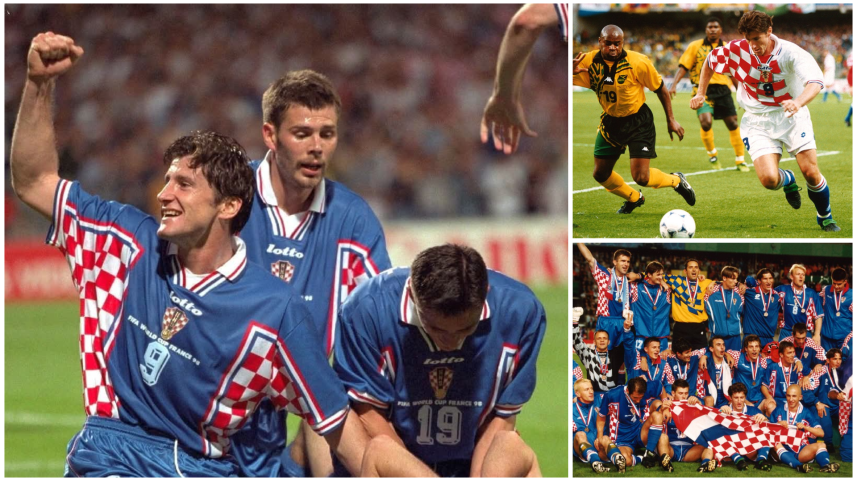
The early 1990s. The skies over the Balkans were no longer blue, but choked with black smoke from relentless airstrikes. Sirens would halt games mid-play, and footballers’ boots were replaced by the heavy gear of soldiers. Croatia was no longer just a defined line on a map -- it had become the name of a blood-soaked struggle.
From 1991 to 1995, for nearly five long years, Croats wrestled with death itself. Just three years after that desperate fight for survival as an independent nation ended, what unfolded on the green fields of France was far more than a game. Through the brilliance of Davor Suker, Zvonimir Boban, Robert Prosinecki, Slaven Bilic, Igor Stimac and Drazen Ladic, the World Cup became a manifesto of identity for an unbreakable nation.

The process of breaking away from the socialist federation of Yugoslavia was anything but smooth for Croatia. When Zagreb declared independence in 1991, an uneven war began -- on one side, the powerful Serbian-controlled Yugoslav People’s Army (JNA), and on the other, the newly formed Croatian forces fighting for freedom.
The war claimed around 20,000 lives and displaced nearly 300,000 people. Today’s football icon Luka Modric was just a child then -- learning to dribble in the parking lots of refugee camps while listening to the roar of artillery. From that soil, soaked in the smell of gunpowder, emerged a group of footballers who introduced the world to a new name in 1998 -- Croatia.
These revolutionaries were not just players on a pitch; many had been soldiers on the battlefield. Forward Petar Krpan fought on the frontlines at just 17. Behind this struggle lay a long history of deprivation and repression.
On May 13, 1990, during a match between Dinamo Zagreb and Red Star Belgrade at Maksimir Stadium, riots broke out between Croat and Serb supporters. In a moment that would become symbolic, Boban kicked a police officer to protect a Zagreb supporter. That single act ignited the fire of independence in Croatian hearts. Overnight, Boban transformed from a footballer into a national hero. His belief in football as a vehicle for national identity was unshakable. In a later FIFA interview, he said, “If we talk about building national identity through sport, Croatia should be number one in the world.”
The fairytale of 1998 was no accident. Its spark was lit at Euro 1996, where the football world first witnessed the indomitable force of the red-and-white checkered jersey. On English soil, Croatia announced its arrival by thrashing defending champions Denmark 3-0, signalling the rise of a new sun in the Balkans. Though they exited in the quarterfinals after a controversial defeat to Germany, that loss became fuel for future revenge.
Coach Miroslav Blazevic assembled a formidable squad. Ladic guarded the goal, while Bilic and Stimac formed an impenetrable defensive wall. In midfield, Prosinecki’s dribbling wizardry and Boban’s creativity left opponents bewildered. Prosinecki, a magical talent, had previously scored in a World Cup for Yugoslavia. Scoring for the newborn Croatia, however, was a fight for existence.
Leading the attack, Suker’s left foot was as precise as an artist’s brushstroke. He displayed incredible consistency, scoring in every match of the World Cup except one (against Argentina in the group stage). Jamaica, Japan, Romania, Germany, the Netherlands -- none were spared. With six goals, he won the Golden Boot, and each strike felt like solace for a displaced nation. Watching his calm finishing, it was hard to imagine Croatia had burned in the fires of war just years earlier. Whenever Suker entered the box with the ball, an entire nation held its breath in prayer.
The true revolution on the pitch came on the historic night of July 4. In the quarterfinal, Croatia faced the mighty Germany. At a time when 4-4-2 dominated world football, Blazevic chose a different path -- deploying a 3-5-2 formation.
Robert Jarni and Mario Stanić, operating as wing-backs, tore apart the German defence. The modern-day revival of the 3-5-2 owes much to the foundations laid that night. The atmosphere in Croatia’s dressing room before the match was dramatic -- Blazevic tore up his tactical notes and roared at his players. As he later recalled: “I told them -- forget tactics. Today, you go out and fight for Croatia’s flag and for those who gave their lives for the country.”
The result was extraordinary. Croatia demolished former world champions Germany 3-0, announcing the proud arrival of a new nation on the global stage. Though they fell 2-1 to hosts France in the semifinals, they did not break. Had it not been for Lilian Thuram’s miraculous brace, Croatia might well have reached the final. Still, securing third place with a 2-1 win over the Netherlands in their debut World Cup was nothing short of conquering the world.
Croatia’s achievement was far greater than any scoreline. For those who had spent years in refugee camps, this success was oxygen for survival. People who had fled the ruins of Vukovar celebrated in the streets of Zagreb and Rijeka. Football became a language of protest -- a song of liberation.
Bilic, a key member of that golden generation, later explained their indomitable spirit with a poignant reflection: “We were not just playing for ourselves or for Croatia. We were playing for those who lost their lives in the war.”
The DNA of modern Croatian success -- seen in players like Luka Modric, Ivan Rakitic, and Mario Mandzukic -- was forged upon that war-torn foundation and shaped by the triumph of 1998. Reaching the World Cup final in 2018 and the semifinals again in 2022 were extensions of that legacy. Though the smell of gunpowder has faded, the story of a footballing revolution lingers in the scent of the grass, inspiring every Croatian player. That golden generation proved one enduring truth: a nation may be small on the map, but if its dreams rise as high as the Himalayas, conquering the world is never impossible.
 For all latest news, follow The Daily Star's Google News channel.
Comments