


A golden generation without a crown

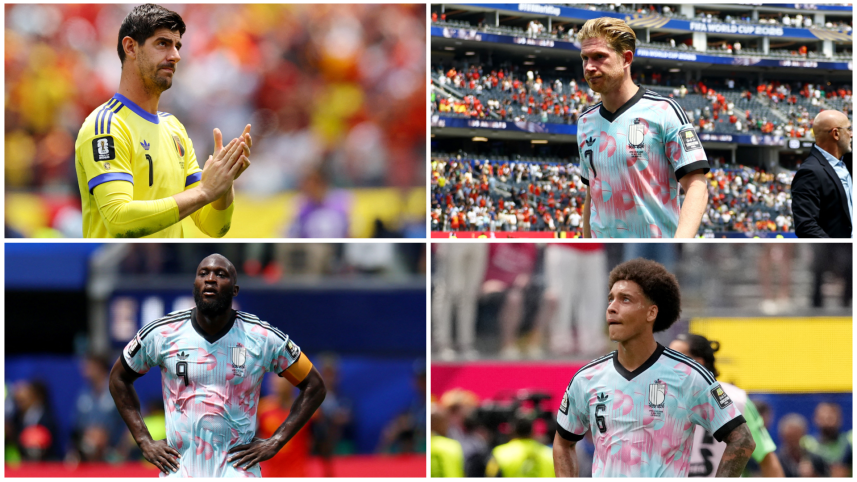
"I really can't stand it when my four leaders are called 'veterans'. It is ugly. It is awful," Belgium coach Rudi Garcia had said a few days ago during the FIFA World Cup 2026.
But following Belgium's 2-1 defeat to an in-form Spain in the quarterfinals in Los Angeles on Saturday, the conversation Garcia had hoped to avoid is bound to resurface.

And not without reason.
Back at the 2018 World Cup in Russia, Thibaut Courtois (34), Romelu Lukaku (33), Kevin De Bruyne (34) and Axel Witsel (37) -- all of whom were also part of this edition -- formed the backbone of what came to be known as Belgium's 'golden generation', alongside the likes of Eden Hazard, Vincent Kompany, Yannick Carrasco, Marouane Fellaini and Mousa Dembele.
Hazard's career gradually faded after his move to Real Madrid as injuries repeatedly derailed him, while Kompany has since carved out a successful managerial career, guiding Bayern Munich to another trophy-laden season. The others have, one by one, drifted away from the national team.
Yet despite boasting arguably the finest squad in the country's history, this generation leaves behind an uncomfortable record. Belgium remain the only nation to spend more than 1,500 consecutive days at the top of the FIFA rankings -- from 2018 to 2022 -- without winning a major trophy, earning the unwanted label of "champions of friendlies".
Saturday's defeat also ensures Belgium's third-place finish in Russia eight years ago will remain the nation's best-ever World Cup performance for at least another four years. And with most of the remaining members of that celebrated generation unlikely to still be around by the next World Cup, this tournament increasingly felt like one last opportunity to change that legacy.
There was scepticism surrounding the Red Devils from the very beginning of the tournament. With nine players over the age of 30, several of them well into their mid-30s, questions were raised over whether time had finally caught up with a side that had once ruled world football -- at least in the FIFA rankings.
Garcia's men, however, gradually answered those doubts.
After opening with consecutive draws against Egypt and Iran, Belgium roared back with a commanding 5-1 victory over New Zealand to finish as group winners.
Their defining moment came in the Round of 32 against Senegal. The Lions of Teranga seemed to have their claws around the Red Devils' necks until the 85th minute, before Romelu Lukaku and skipper Youri Tielemans broke free in the closing stages. Lukaku once again scored after coming off the bench, while captain Youri Tielemans netted a late brace to complete a remarkable turnaround and send Belgium into the Round of 16.
They followed that with perhaps their most complete performance of the tournament, brushing aside co-hosts the United States 4-1. And suddenly, the criticism surrounding Belgium's ageing core seemed premature, with Garcia finally finding a way to maximise the experience of his veteran stars.
In the big tournaments, almost always we have done well. We're very proud of of everything we did till now. Obviously we get a lot of criticism like 'The golden generation never won anything, and so on.' But we are Belgium. We're not England. We're not Spain. We're not France. We are a small country of not even 12 million people that in big tournaments is showing amazing things.
Then came Spain.
Against one of the pre-tournament favourites, Belgium's task became even harder before a ball had been kicked. Captain Tielemans suffered a hamstring injury during the warm-up, forcing Garcia into a late tactical reshuffle against a side that had justified its billing throughout the competition.
Belgium's problems deepened in the 70th minute when first-choice goalkeeper Courtois was forced off through injury, handing Senne Lammens only his third international appearance.
Even then, Belgium remained in the contest.
Spain controlled possession and created the better chances, but Belgium stayed within touching distance until the 88th minute, when substitute Mikel Merino once again proved decisive. Lammens could only spill the ball into Merino's path, allowing the Spanish super-sub to score the winner -- a cruel moment that inevitably sparked thoughts of what might have been had Courtois, arguably the world's best goalkeeper at the moment, remained on the pitch.
There was still one final chance.
Lukaku lurked inside the penalty area waiting for a late cross that never quite reached him, denying the striker an opportunity to add to the three goals he had scored off the bench during the tournament and perhaps write one last defining chapter in Belgium's World Cup story.
 For all latest news, follow The Daily Star's Google News channel.
 Instead, the final whistle marked what is likely to be the end of an era.
Whether judged by the trophies they failed to win or the heights they managed to reach, Belgium's golden generation transformed the country's standing in world football. They spent years among the game's elite, produced some of the finest players Belgium has ever seen, and came closer than any of their predecessors to lifting football's biggest prizes.
But as another World Cup ends in heartbreak, so too does the road for a generation that promised so much, yet leaves the international stage without the major trophy its talent seemed destined to claim.
Comments