


From a black-and-white TV to the World Cup stands
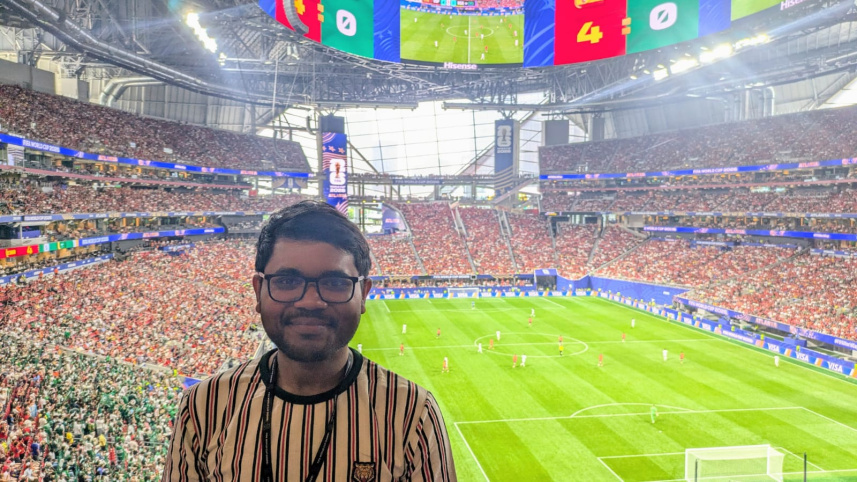
In 2010, as a village boy in Barishal, I watched the World Cup on a black-and-white television. Last week, I was inside a stadium watching a World Cup match live, with almost 70,000 people around me. It still feels unreal how I got from one to the other, but let me try to tell some of the story.
2006 was when I first started to properly understand what the World Cup was. But 2010 was the tournament that truly captured my friends and me. We were passionate teenagers who had just completed our S.S.C. exams and had plenty of free time. Like every other part of Bangladesh, our little village was no different during the World Cup, with fans competing over whose team's flag was the biggest. We were a strong Brazil-supporting group, so we made our own flag, wrote all our names on it, and hung it on the rooftop of the central hospital in the village.

Although the colours faded over the years, we kept the same flag up in both 2014 and 2018.
Those June–July nights in 2010 had their own routine.
We used to gather at the central bazaar in the middle of the night. Load-shedding was a regular occurrence, so we pooled money from everyone who wanted to watch and hired a battery as a backup power source for the black-and-white television. (I'm not sure about now, but colour televisions couldn't run on battery power back then.) Whatever money was left after paying for the battery, we spent on cooking khichuri, which we ate together as a group after the matches. Some nights, that feast felt just as important as the football.
Fast forward to 2022. I moved to the United States, and the World Cup season was one of the things I missed most about Bangladesh. The Qatar World Cup came and went, and I watched it alone. It wasn't the same.
But for this 2026 World Cup, I had to do something different. Luckily, this time I was living in one of the host countries.
Getting a ticket for the 2026 World Cup was a challenge in itself. Of course, I wanted to watch a Brazil match, but ticket prices for Brazil or Argentina games required a very different kind of bank balance from mine. So I spent almost an entire day on FIFA's website and eventually managed to get a ticket for Spain versus Saudi Arabia in Atlanta - about an eight-hour drive from where I live - at a price that was at least manageable.
I was happy with that. Spain were among the favourites, and Saudi Arabia were not a team to be taken lightly (our Argentina-supporting friends know that better than anyone from the 2022 World Cup).
As it turned out, Saudi Arabia did not repeat that particular miracle. Spain won comfortably. But it did not bother me much because, as I discovered, experiencing a World Cup match is about far more than simply watching 90 minutes of football.
Since moving to the United States, I have watched several Major League Soccer matches in stadiums, including one featuring Messi, which was genuinely special.
But a World Cup match is on an entirely different level, and I say that without exaggeration.
Even before entering the stadium, the fan festival outside had already set the tone. People stood in long queues to take photos with the World Cup ball, collect freebies, and buy last-minute jerseys. Everyone was simply soaking up the atmosphere.
Inside the stadium, Yamal was everywhere. Almost every Spain supporter seemed to be wearing his shirt. When his name appeared in the starting line-up, the crowd erupted. (The Atlanta World Cup organisers had clearly anticipated this, painting a giant mural of him on a nearby skyscraper.) The kid behind me shouted "Lamine!" roughly every 90 seconds throughout the first half, and the stadium roared every time he touched the ball.
Yamal was excellent, and Spain were a joy to watch. But, as I said, the moments that have stayed with me happened beyond the football itself.
I'll start with the Saudi fans.
Their team conceded goals at regular intervals, yet they never looked tired or discouraged. They kept chanting for their players right until the end. Sitting directly in front of me were one Spain supporter and one Saudi Arabia supporter who had clearly struck up a friendship soon after kick-off. After Saudi Arabia conceded their second goal, the Spain fan reached over and patted the Saudi fan on the shoulder. The two eventually left together as though they had known each other for years.
Supporters from both teams also united in booing the hydration breaks, as neither side seemed to appreciate the interruptions.
After the match, everyone drifted back to the fan festival and had no intention of leaving until the organisers announced that it had closed for the day. Outside, I saw fans of both teams sitting together in small groups, discussing the match and even exchanging jerseys.
You do not often see all this at a regular football match: the passion, the melting pot of languages, cultures and fandoms, and the warmth between complete strangers. I think much of it comes from the fact that everyone in that stadium has sacrificed something to be there.
 For all latest news, follow The Daily Star's Google News channel.
 While sitting in those stands, and even afterwards, I kept thinking about those nights in my village: the black-and-white television, renting the backup battery, the Brazil flag with all our names on it, and the simple khichuri at two in the morning. Amid all that fun, we used to see the World Cup as something from a completely different world, something that existed on the other side of the screen, and that only the lucky few ever got to experience in person.
Like so many Bangladeshis, I always dreamed of being one of them, and it is still hard for me to believe that my lifelong dream finally came true.
I don't know whether I will make it to another World Cup match in the future. But this Spain versus Saudi Arabia group-stage match at the 2026 FIFA World Cup in Atlanta will always be my first, my most special, and one of the defining memories of my life, alongside those nights in 2010.
(The writer is originally from Bangladesh and is currently pursuing a Ph.D. in the United States.)
Comments