


Why Day 1 is becoming a graveyard for Test batters in Australia

Test cricket in Australia has produced an unusual number of wicket-filled opening days in recent years, with Mackay the latest venue to join the list.
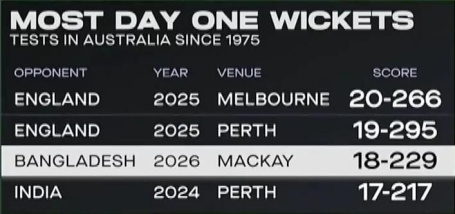
Seventeen wickets fell for 217 runs on the opening day of the 2024 Perth Test between Australia and India. During the 2025-26 Ashes, 19 wickets fell for 295 runs in Perth before all 20 wickets tumbled for 266 runs in Melbourne.

Now Mackay has produced 18.
17, 19, 20, 18.
Four extraordinary first days in Australian Tests in less than two years.
There is some history behind the trend. In Brisbane in 2022, 15 wickets fell on the opening day of the Test between Australia and South Africa. The match was over inside two days, with South Africa bowled out for 152 and Australia reaching 145 for five on the first day.
So, why are wickets falling at such a rate?
The obvious factor is the conditions. Australian pitches can offer pace, bounce and seam movement, while grass, moisture and overhead conditions can make the new ball particularly difficult to face.
Perth brings its trademark pace and bounce into the equation, while Mackay showed that the trend is not limited to Australia's traditional Test venues. The Great Barrier Reef Arena offered enough movement to keep the fast bowlers interested throughout the day.
Bangladesh felt the full force of it first.
After scoring 426 in the first innings of the Darwin Test, the Tigers were dismantled for 64 in Mackay. Mitchell Starc needed only 22 deliveries to complete his five-wicket haul and finished with 6-12.
Starc had dismantled Bangladesh's batting in the morning, but Shoriful ensured Australia paid a price of their own before stumps.
Returning from the hamstring injury that ruled him out of the first Test, Shoriful removed Travis Head and Marnus Labuschagne in his first over before returning late in the day to claim four more wickets.
He finished with 6-35, his maiden Test six-for, as Australia slipped to 165 for eight.

There may also be a batting dimension.
Modern Test batters are increasingly comfortable scoring quickly and putting pressure back on bowlers. But when the ball is moving sharply, those instincts can become a liability. Leaving the ball, playing late and defending with soft hands become far more important when conditions are difficult.
That does not necessarily mean Australian pitches have fundamentally changed, nor does the recent sequence prove that curators are deliberately producing bowler-friendly surfaces.
But the numbers are becoming difficult to ignore.
Australia has produced opening days of 17, 19, 20 and 18 wickets across four Tests since 2024, while the 15-wicket Brisbane Test in 2022 provides another reminder of the volatility that can emerge when conditions favour the seamers.
 For all latest news, follow The Daily Star's Google News channel.
Comments