


Who is Rubel? Understated at home, never forgotten by Morgan’s England

On numbers alone, he was a decent fast bowler: 193 wickets between 2009 and 2021, enough to remain relevant without dominating. Yet his career was defined less by consistency and more by sharp, sudden and occasionally chaotic impact.
His story began with a cinematic edge. A boy from Bagerhat, discovered through a pace-hunting programme, clocking speeds that caught selectors’ attention. Bangladesh, long reliant on medium pace and spin, suddenly had raw pace with a slinging, almost whiplash action -- a unique phenomenon in Bangladesh cricket till date.

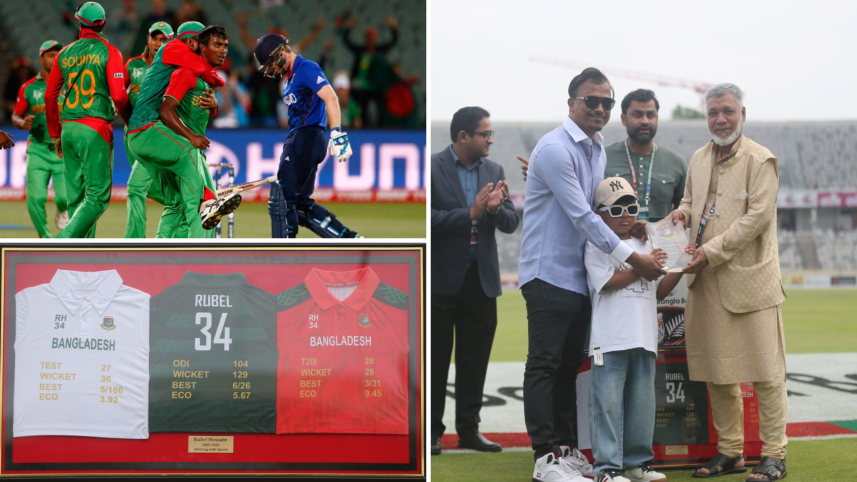
“The man behind who I am today is my respected coach Sarwar Imran sir, who picked me from the pacer hunt and showed me the path forward. I will remain grateful to him for the rest of my life,” Rubel said on Monday at the Sher-e-Bangla National Cricket Stadium in Mirpur, where the Bangladesh Cricket Board (BCB) honoured him before the second ODI against New Zealand.
“It’s something that makes me very proud and happy. I sincerely thank the BCB and Tamim Iqbal for arranging such a beautiful tribute."
He was not the first fast bowler the country had produced, but he felt different: quicker, more aggressive, less restrained. In many ways, he became Bangladesh’s prototype limited-overs pacer: hit the deck, bowl fast, return at the death when nerves fray. If Mustafizur Rahman was the craftsman with cutters, Rubel was the blunt instrument -- less subtle, more force.
The 2015 ICC World Cup in Adelaide served as his professional zenith. His spell against England -- removing Ian Bell and Eoin Morgan, then returning to claim Stuart Broad and James Anderson -- propelled Bangladesh into the quarterfinals. This victory proved a catalyst for England, prompting a fundamental internal overhaul that influenced their eventual 2019 World Cup title.
The narrative, however, carried complications. Just before that World Cup, Rubel was arrested under the Women and Children Repression Prevention Act; his participation hung in doubt. Granted bail, he travelled to Australia and delivered that performance. The contrast between events off the field and what followed on it remained difficult to ignore, even as the case later faded from headlines.
There were further disruptions: issues with the board, central contract exclusions, questions over discipline and rehabilitation. His career often felt uneven, like a bowler searching for rhythm. On the field, the contrast persisted: effective in ODIs and T20Is -- a hat-trick against New Zealand, a six-wicket haul among Bangladesh’s best, reverse swing in his armoury. In Tests, an average above 70 and long barren spells pointed to a mismatch with the format.
Captains, however, frequently trusted him in the role of a "firefighter." When a match slipped into a high-pressure scenario, Rubel was often the choice, capable of shifting the game. That offers the clearest understanding of him. He was a pacer of brief bursts rather than sustained spells.
As his career fades after a prolonged absence, attention often turns to what could have been: greater consistency, a smoother trajectory. Yet his imprint lies elsewhere. In Bangladesh’s memory -- and in England’s uneasy recollection -- remains the image: Rubel charging in, stumps broken, teammates converging.
At the end of the career, few cricketers leave behind and impression like that.
RUBEL’S INT’L CAREER STATS
Tests
Matches: 27
Wickets: 36
Average: 76.77
Best Bowling: 5/166
5-wicket hauls: 1
ODIs
Matches: 104
Wickets: 129
 For all latest news, follow The Daily Star's Google News channel.
 Average: 34.31
Best Bowling: 6/26
5-wicket hauls: 1
Hat-tricks: 1
T20Is
Matches: 28
Wickets: 28
Average: 32.57
Best Bowling: 3/28
Overall
Total wickets: 193
Format span: 2009–2021
Comments