


Afif’s struggle mirrors Bangladesh’s woes

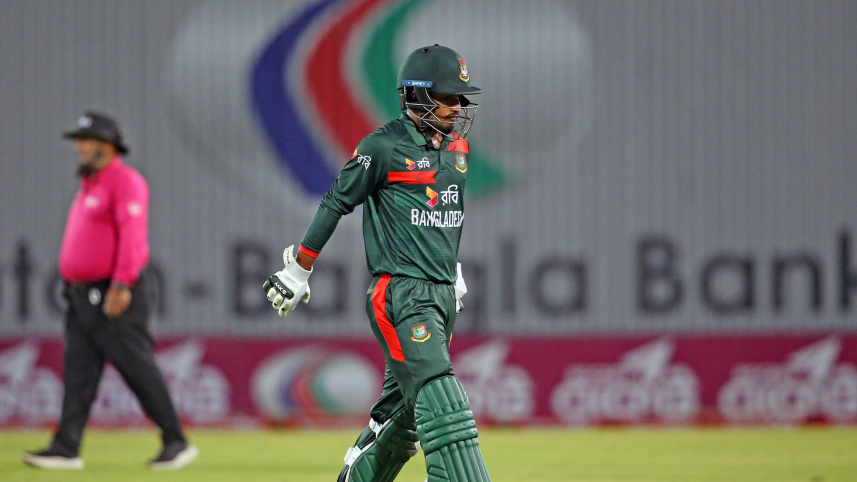
There was a striking similarity between the starts of New Zealand and Bangladesh in the opening ODI of the three-match series in Mirpur on Friday, but the contrasting approaches that followed ultimately defined the outcome.
At the centre were Bangladesh’s Afif Hossain, who once again failed to fulfil the finisher’s role entrusted to him, and New Zealand’s Dean Foxcroft, who excelled at reading and adapting to the conditions.

Opting to bat, New Zealand lost their fourth wicket at 131 in 27.5 overs, bringing Foxcroft to the crease. Playing only his second ODI, the 27-year-old showed composure beyond his experience. Having toured Bangladesh with South Africa’s age-level side during the 2016 ICC U-19 World Cup and with New Zealand ‘A’ last year, he appeared well-acquainted with the conditions.
Foxcroft struck a measured 59 off 58 balls, rotating the strike smartly and reading the situation astutely to guide his side to a competitive 247 for eight -- a total that always looked challenging for Bangladesh, who have won just one of their last eight ODI chases.
Bangladesh’s innings began in a remarkably similar fashion. They too lost their fourth wicket around the same phase -- at 132 in 27.2 overs -- setting the stage for Afif. Despite the quick dismissals of set batters Saif Hassan and Litton Das, the hosts remained well-positioned, with Tawhid Hridoy at the crease and skipper Mehidy Hasan Miraz still to come.
At that point, Bangladesh needed 116 runs from 136 deliveries -- a manageable equation. However, this is where the parallels ended.
Instead of maintaining momentum, the middle order allowed pressure to build. Afif and Hridoy struggled for boundaries, managing just one during their 52-run stand, while dot balls pushed the required rate beyond six. Afif eventually fell for a sluggish 27 off 49 balls, holing out to long-on in a desperate attempt to break free, leaving the chase in disarray.
While the match situation was similar for both Foxcroft and Afif, their responses were vastly different. Foxcroft seized his opportunity with clarity and intent; Afif failed to adapt, raising further questions about his role.
The 26-year-old, recalled after a 16-month absence during the recent home series against Pakistan, has yet to justify his return. He did not bat in the first ODI, scored 14 in the second, and remained unbeaten on five in the third after being pushed down to number seven.
However, is Afif solely to blame?
The issue appears deeper. Bangladesh’s team management has persistently tried to mould him into a finisher, despite his domestic success coming higher up the order. His recent century in the Bangladesh Cricket League came at number four -- a position he has also occupied regularly in domestic T20s, including the Bangladesh Premier League.
In contrast, his ODI record tells a different story: of his 33 innings, 27 have come at number six or lower, with only six in the top five. This mismatch between role and natural position has hindered his consistency at the international level.
Bangladesh’s persistence with this experiment has yielded little success, and Friday’s failure once again highlighted the risks of forcing players into unsuitable roles. If the approach remains unchanged, Afif’s career may continue to drift, with the team’s broader batting concerns unresolved.
 For all latest news, follow The Daily Star's Google News channel.
Comments