How far can devotion take us? Radhe Jaggi’s BHAKTA explores the sacred
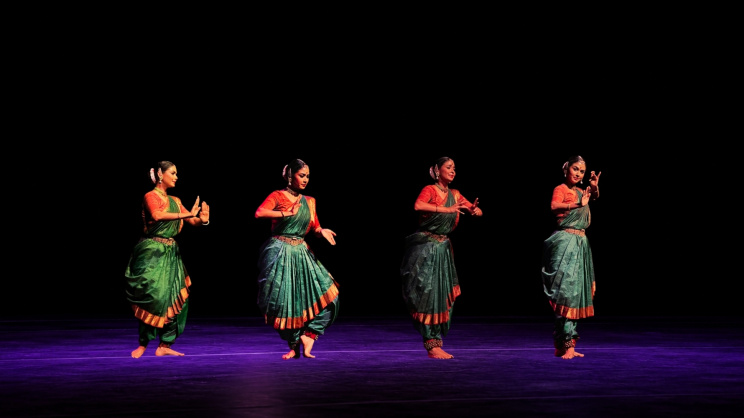
Five compositions. One dancer. And, for an evening, an entire theatre drawn into the many faces of devotion. On 5 September 2026, at Riverside Studios in London, I had the privilege of witnessing BHAKTA, the only UK performance this year by Bharatanatyam artiste Radhe Jaggi. The official programme describes BHAKTA as a blending of old and new choreographies exploring the many ways devotion can manifest, whether disciplined or unruly, within family life, in pursuit of the divine, or alone on a long journey.
For readers encountering her name for the first time, Radhe Jaggi is an Indian Bharatanatyam artiste, a disciple of the acclaimed dancer and choreographer Leela Samson, and an alumna of the Kalakshetra Foundation in Chennai. Her artistic journey began with performances in temples across Tamil Nadu and later expanded to international stages. She also leads Project Samskriti, an initiative dedicated to reviving and sharing India's classical arts. Radhe is also the daughter of Indian yogi and spiritual teacher Sadhguru, but on the Riverside stage, it was her own artistic identity, shaped by training, lineage, discipline and expression, that commanded attention.
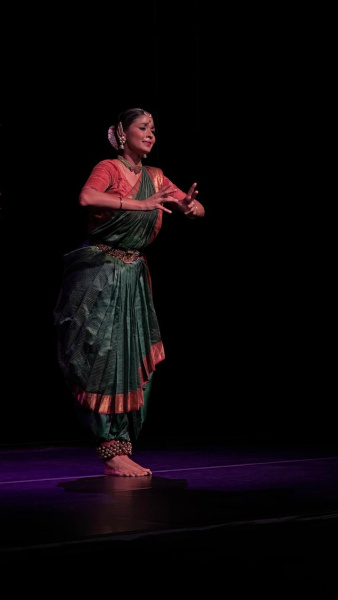
I went expecting an evening of Bharatanatyam. I came away contemplating a much larger question: What does it actually mean to be a bhakta? How completely can a human being devote oneself to the divine, to a guru, to love, to a path, or to life itself?
What struck me first was Radhe's ability to hold the stage alone. Across the five compositions I witnessed, each work opened its own emotional world and, at times, introduced multiple characters. Yet there was no cast of performers appearing to embody them. Radhe moved from one character to another through the vocabulary of Bharatanatyam: gesture, gaze, posture, rhythm, expression and abhinaya. A change in the eyes, a turn of the head, the architecture of a hand or the quality of a stance could transform the person before us.
For me, this was not simply imitation. It was embodiment. The stage never felt empty. One dancer seemed capable of populating it with an entire world.
Before each piece, Radhe also spoke to the audience. Those introductions became part of the experience for me. Her voice, the movement of her hands, the immediacy of her expression and the way she unfolded a story created an instant intimacy. The usual distance between performer and spectator seemed to soften. At moments, it felt as though the audience had entered her story and she had entered the audience, creating a shared field of attention before the dance had even begun.
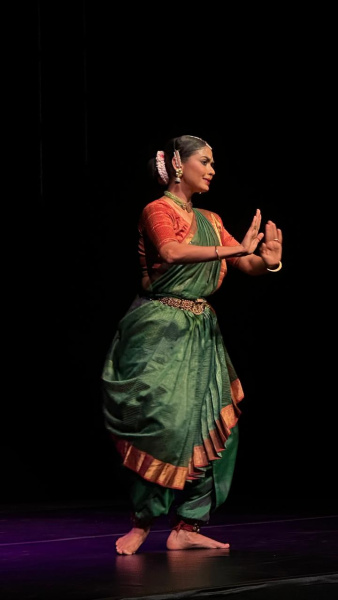
The five compositions
The programme unfolded through five works: Amba Neelambari, choreographed by Leela Samson; Auchitya, choreographed by Radhe Jaggi, a meditation on death whose title means "appropriateness"; Dari Juchuchunadi, a traditional piece attributed to the hereditary dancer Mylapore Gowri Ammal; Alakh Niranjan, the work about the wandering saint, choreographed by Radhe Jaggi; and Madhuvanti Tillana, choreographed by Leela Samson.
Knowing these titles makes the architecture of the evening even clearer: inherited repertoire stood beside contemporary choreography; the lineage of a guru beside the creative voice of a disciple; narrative and abhinaya beside rhythmic movement. Different in mood and subject, the five compositions nevertheless gathered under the larger idea of BHAKTA, with devotion expressed through many human possibilities.
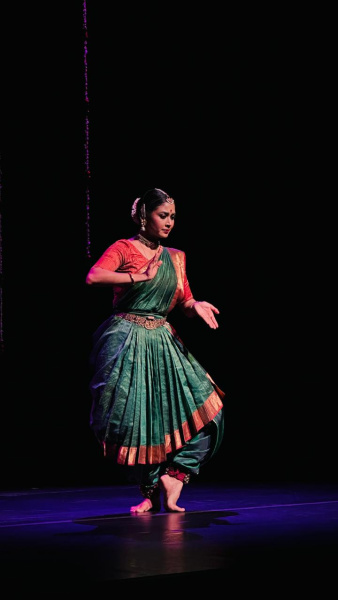
Alakh Niranjan: Devotion at its most uncompromising
Of all the works, Alakh Niranjan pierced me most deeply. The story centres on a wandering ascetic whose extraordinary eyes captivate a woman when he arrives seeking alms. She has a household, a husband and children, yet the image of the sannyasi, particularly his eyes, remains with her. What begins as admiration turns into longing.
When the ascetic understands that his eyes have become the object of her attachment, the story takes its devastating turn: he gives up the very eyes she had praised. Watching Radhe move between the woman's fascination, longing and anguish and the sannyasi's uncompromising devotion was overwhelming. As Alakh Niranjan filled the space, tears ran down my face. Even the following morning, recounting the scene, I could feel goosebumps returning.
How far can a bhakta go?
Perhaps the story reached me so strongly because devotion is not an abstract idea in my own life. As a Classical Hatha Yoga teacher trained in Sadhguru's tradition, I have experienced devotion as something capable of reorganising a human life. It can give tremendous strength; it can dissolve boundaries we once thought immovable; it can ask us to surrender something that reason alone might never have offered.
Alakh Niranjan therefore did more than move me emotionally. It confronted me with the beauty and extremity of surrender. The sannyasi gives his eyes; every human life has its own forms of giving, losing, choosing and surrendering. The performance left the question alive rather than answering it for me: when devotion becomes total, what remains of the person who began the journey?
Lineage, inheritance and a living art
The five compositions also illuminated Radhe's relationship to artistic lineage. Two works, Amba Neelambari and Madhuvanti Tillana, carry the choreography of her guru, Leela Samson. Dari Juchuchunadi reaches into the inherited Bharatanatyam repertoire through its attribution to Mylapore Gowri Ammal, while Auchitya and Alakh Niranjan bear Radhe's own choreographic voice. The programme therefore did not present tradition as something frozen: it showed transmission, interpretation and creation living beside one another.
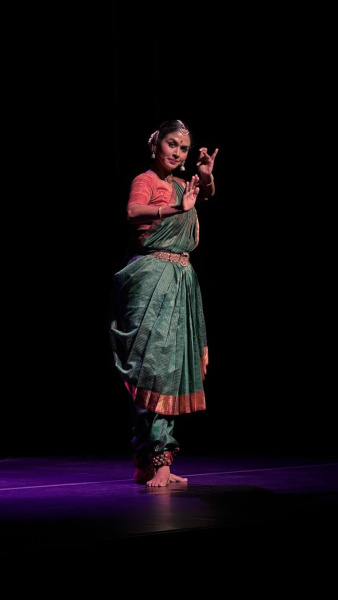
Her dance carries rigorous classical training, but what stayed with me was not technique in isolation. It was the marriage of precision and feeling: strength without heaviness, grace without fragility, and theatrical command without losing the intimacy of a solo performer. The scale of the experience felt comparable, in its discipline and impact, to major international theatre, while remaining unmistakably rooted in Indian classical dance.
An evening held by more than the stage
The theatre was full, and the evening extended beyond the performance itself. As someone familiar with the culture of Isha through my own training, I recognised something in the way guests were received: not a stiff formality, but an effort to make people feel personally welcomed. The volunteers who helped make the evening possible were part of that atmosphere. Their attention, warmth and hospitality contributed quietly to the sense that this was not simply an event being processed, but an experience being held.
Riverside Studios provided the London home for the performance. The venue is operated by the Anil Agarwal Riverside Studios Trust, offering a contemporary theatre setting for an art form whose roots reach deeply into India's classical traditions.
A small exchange after BHAKTA
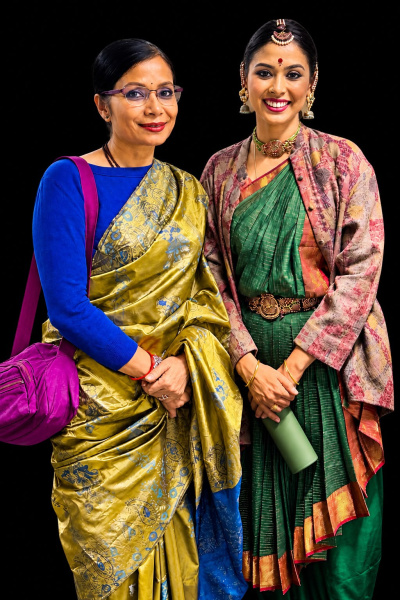
After the performance, during the hospitality for guests, I had the opportunity to speak briefly with Radhe. I introduced myself as a Classical Hatha Yoga teacher and told her, quite simply, "Sadhguru is my Guru."
She laughed and replied: "He is my Guru too."
It was a small, warm exchange, but after an evening devoted to exploring the meaning of a bhakta, it felt unexpectedly fitting. Radhe is Sadhguru's daughter; in that moment, however, she answered as a disciple acknowledging her own relationship with a guru.
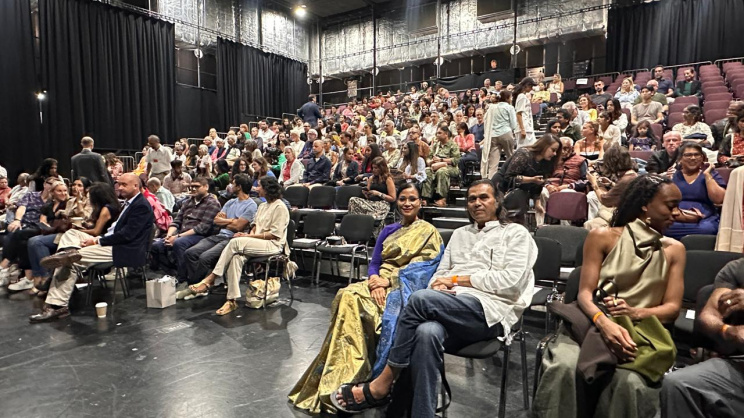
I had struggled to obtain a ticket for the performance and, until quite late, was not certain that I would be able to attend. Somehow, the opportunity opened up. By the end of the evening, what felt fortunate was not simply having entered the theatre, but having witnessed an artist use one body, one classical language and five distinct compositions to lead a full audience into an ancient human question.
What is devotion?
Perhaps BHAKTA's most enduring achievement is that it does not confine devotion to religion. Devotion may be quiet or fierce, joyful or painful, playful or uncompromising. It may be directed towards the divine, a teacher, another human being, a responsibility or a path.
For those minutes inside Riverside Studios, Radhe Jaggi did not merely demonstrate Bharatanatyam. She made devotion visible: sometimes tender, sometimes unsettling, sometimes beautiful enough to bring tears.
And when the lights came up, the question remained with me:
How deeply are we capable of giving ourselves to that which we truly hold sacred?
Ruma Chowdhury is a classical Hatha Yoga teacher and founder of Prachina Yoga & Wellness in London.
Send your articles for Slow Reads to slowreads@thedailystar.net. Check out our submission guidelines for details.
The moral hierarchy of pleasure: Who controls women’s bodies?
Inherited Memories / My grandmother’s world: Partition, Shia traditions and memories of Old Dhaka

The taste of childhood: Bengali food, family and memory

Along the Kapotaksha, in search of Madhusudan’s river

Where did gold come from?

Do we understand the children we try to teach?

AI is here. Can Bangladesh’s education system adapt?

Why are we in such a hurry to live?

Why I chose teaching over a corporate career