Career breaks: A systemic flaw for 96 million women
People often say, “She chose to take a break.” And while choice plays a part, for many women, it feels more like being pushed out of a system that was not built for us. My break was not a sudden whim. It was the result of trying to juggle an impossible number of tasks, eventually realising the traditional workplace simply did not fit my new reality. After eight years in the professional sector, I decided to step away to meet my family commitments. In truth, I was not stepping into a void; I was joining a massive group of women.
Studies show that an estimated 96 million skilled women between 30 and 54 are on career breaks worldwide. What is striking is that this is not just about entry-level jobs — roughly 55 million of these women have experience at the mid-manager level or above. We are the “hidden workforce.” This loss of female talent is not just a series of personal choices; it points to a much larger flaw in how the working world operates. My break was planned around my son’s birth and relocating to be with my family. I leaned fully into motherhood, pouring my energy into being nurturing, accommodating, and holding the family together.
The Fog of the Gap
Those early days were a blur of deep exhaustion mixed with the pure joy of holding my baby. But as weeks turned into months, my time at home started to feel isolating and suffocating. I felt invisible and guilty. A nagging question kept repeating in my head: “Am I falling behind?” My world had turned completely upside down. I was so focused on keeping this tiny human alive and happy that I forgot the things that used to define me. I was fully living as a mother — the ultimate caregiver — but I felt completely disconnected from the professional woman I used to be. The isolation was heavy.
My return has been both professional and personal. I stopped trying to hide my identity as a mother to fit back into the professional world. The system might still be inflexible, and the broader employment landscape might still struggle to understand the “hidden workforce,” but employers must look beyond gaps and recognise potential. My realisation was not about changing the whole system overnight. It was simply understanding that I had not lost myself during my time away. I had just grown into a broader, more capable version of myself, one who no longer needs to apologise for the path she took.
Re-entry: Finding My Armour
The thought of going back to work brought a whole new wave of anxiety. I was terrified of the gap on my CV. The reality for mothers returning to work is tough: studies indicate a 32% drop in women holding managerial roles after having children, with many forced to take junior roles just to secure a flexible schedule. I quickly observed that women’s career breaks are often perceived differently. There is a persistent bias in traditional work practices, where a candidate’s capabilities are frequently overshadowed by the gap in their employment history.
So, when I finally discovered BRAC’s BRIDGE Returnship Programme and landed an interview for a six-month contract role, I had to dig deep. I saw this as an opportunity to showcase my skills and rebuild my professional trajectory. But I also needed armour. I thought of “Crow,” the tough inner voice in Murakami’s novel Kafka on the Shore that pushes the main character to be strong.
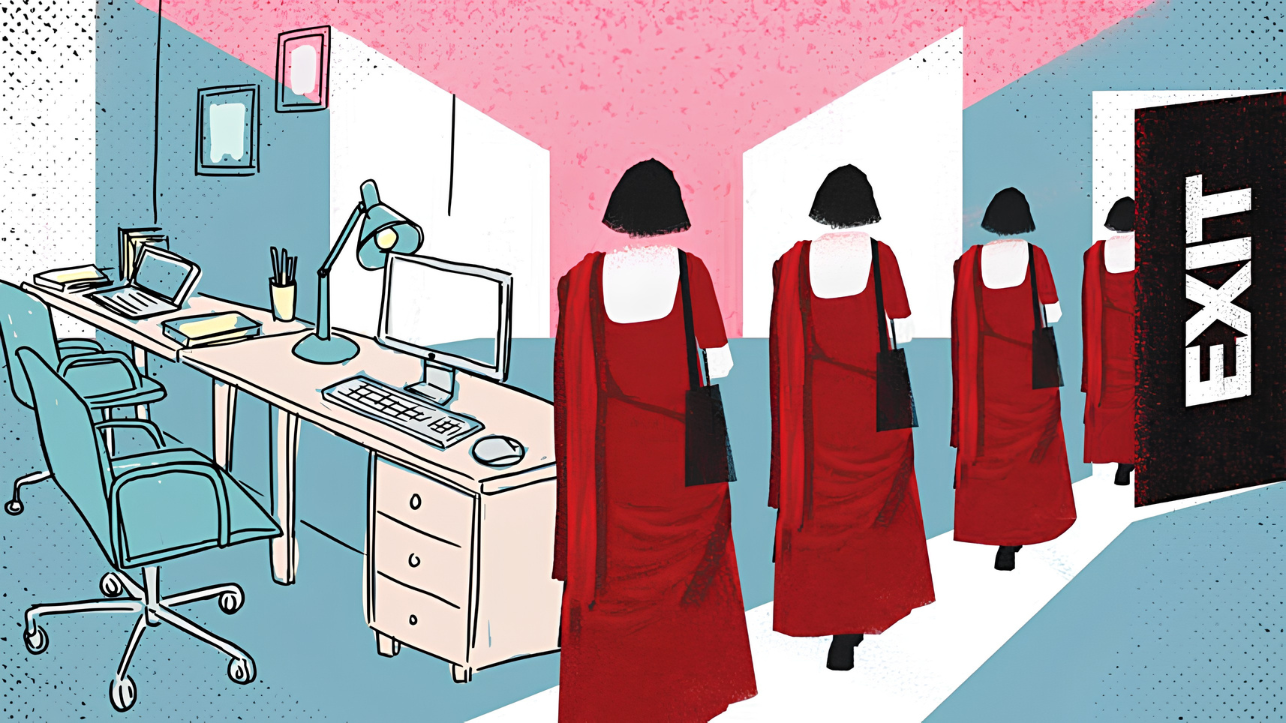
I still remember one of the questions from the interview: “What is the last book you read?” My mind, which used to easily manage crisis response plans and project briefs, went completely blank. I mumbled a vague answer. On the ride home, it hit me: Kafka on the Shore. The irony was painful. I had forgotten a book about a boy running away to find himself, right when I was struggling to find my own professional footing again. The self-doubt was overwhelming. I did not know how to merge the nurturing mother I had become with the confident professional the office expected.
A Slow, Gritty Climb
I fumbled the interview, yet I still got the job. It was a lifeline, but the six-month contract was a ticking clock to prove my worth. I felt so happy to have a daycare at the office, but the move was far from simple. In my second month, my spouse had to undergo a major operation, and immediately afterwards my son fell ill with a high fever. Suddenly, juggling work and home commitments felt like a battle. There were days I cried softly at the office. But I also remember the compassion of colleagues and other participants in the programme who had been in my shoes. They did not simply sympathise; they understood and supported me. It was not a smooth journey to get back on track; it was a difficult climb. I realised true resilience is not just about individual grit, a concept that often unfairly places the burden solely on women.
Studies show that an estimated 96 million skilled women between 30 and 54 are on career breaks worldwide. What is striking is that this is not just about entry-level jobs — roughly 55 million of these women have experience at the mid-manager level or above. We are the “hidden workforce.” This loss of female talent is not just a series of personal choices; it points to a much larger flaw in how the working world operates. My break was planned around my son’s birth and relocating to be with my family. I leaned fully into motherhood, pouring my energy into being nurturing, accommodating, and holding the family together.
A Change in Perception
I often think back to a woman I met at a skill development centre in a refugee camp. She was heavily pregnant and walked across steep, rough terrain to get to work every day. Wanting to help, I offered to make sure she received her daily wage even if she stayed home to rest, unconsciously acting out my own “saviour” complex. Her response completely shifted my perspective. “I do not want to sit at home,” she told me. “When I come here, I feel happy and safe. I love working and sewing new bags; it makes me feel better.” She was not working just because she had to; she was working because it was a part of who she was.
My return has been both professional and personal. I stopped trying to hide my identity as a mother to fit back into the professional world. The system might still be inflexible, and the broader employment landscape might still struggle to understand the “hidden workforce,” but employers must look beyond gaps and recognise potential. My realisation was not about changing the whole system overnight. It was simply understanding that I had not lost myself during my time away. I had just grown into a broader, more capable version of myself, one who no longer needs to apologise for the path she took.
Farah Mahboob is a Deputy Manager at the Social Innovation Lab (SIL), BRAC, and an architect and innovation specialist with expertise in climate innovation, disaster management, and humanitarian project design.
Send your articles for Slow Reads to slowreads@thedailystar.net. Check out our submission guidelines for details.
Why Dhaka cannot simply ban the rickshaw
The elephants had to be rescued again. Where is the accountability?
‘Situation under control’, but at whose expense?
The untold side of Bangladesh's climate migration
Dhaka's unbearable heat: Who suffers the most?
Enforced disappearance in Bangladesh / Who investigates the state?

Gibbons, kingfishers and the changing world of Adampur Reserved Forest
More than refugees: How Rohingya youth are reclaiming their story
Behind every cup / The mental toll on women tea workers