


Is Cuba next for Trump?
After the US attacks on Iran began, US Senator Lindsey Graham told Fox News, “Cuba’s Next.”
There is a popular metaphor in Cuba, to describe its challenges in 2026: Cubans say that Cuba is a pregnant, barefoot woman whom her husband isolates. The depiction imagines Cuba as a pregnant woman, carrying the burden of a potential new future, but barefoot and struggling with poverty, while her husband, symbolising the government and historically US government’s restrictive policies, isolates her. On January 29th, Trump gave executive orders to enforce tariffs on any country selling fuel to Cuba. The Cuban government of Miguel Díaz-Canel then announced the activation of the “Zero Option” — an emergency protocol conceived during the 1990s Special Period for a scenario without any oil supply.
The zero option is activated when a government is on the brink of absolute economic collapse. In the current moment of complete blockade from other nations, economist Emilio Morales warned that “the Cuban regime won’t survive until next summer." The complete blockade implies that external forces have cut off oil supply entirely, not due to scarcity. President Trump of the United States has called Cuba “a failed nation,” and refused to rule out military action. He has warned the country to make a deal before it is too late.
Following the events of the US takeover in Venezuela and the arrest of its president back on January 11, 2026, Cuba lost its major oil supplier. President Trump has threatened that if any country supplies Cuba, they may face sanctions. Even before activating the “Zero Option," there were 12-18 hours of blackouts in Cuba. Cuba today is able to generate less than half of the electricity its population needs. The government faced mass protests in 2021 as the anger from electricity and food shortages skyrocketed. Trump has crippled the Cuban economy by also targeting its source of foreign currency: the tourism industry. Last year, Cubans had just 1.8 million visitors, down from 4.7 million in 2018. Now fuel shortages have led airlines to cancel flights. The silent policy change by the Cuban communist government, known as “Zero Option,” merely recognised the emergency and established that the situation would not improve. “Zero Option” is not a policy paper; it is a survival protocol. When activated, it triggers coordinated cutbacks across every sector of a nation simultaneously.
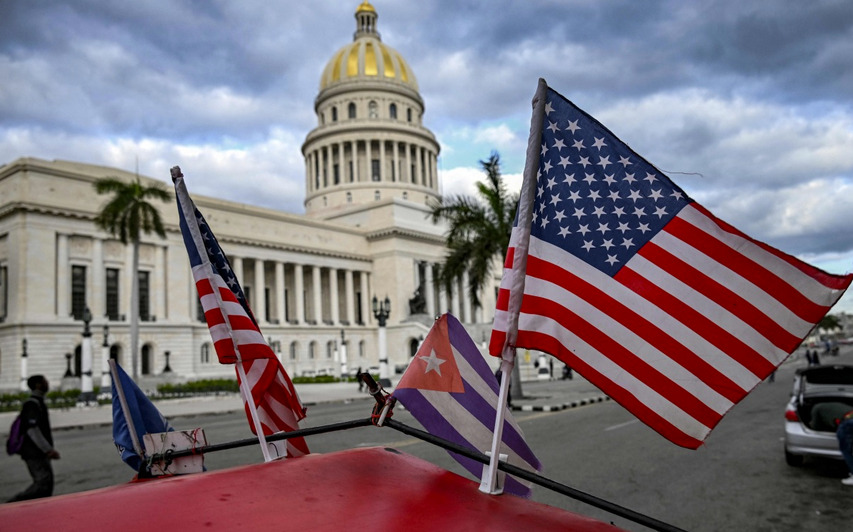
Cuba is a one-party country with the Communist Party as the sole legal political party. Despite facing external economic repression, the party focuses on protecting its sovereignty, and maintaining socialist gains from the 1959 revolution which was led by Fidel Castro. Since 1960, a US embargo has been paralysing Cuban lives. In the pages of Cuban history, one can find the US fiddling with Cuba’s internal politics in every other page. Before the socialist revolution, experts such as Murray Rothbard have pointed out that the US “virtually” installed “the dictator Batista in Cuba,” who transformed the nation to a police state till 1959. The Fidel Castro government nationalised foreign enterprises, taking over US-controlled refineries, and signed a deal with the Soviet Union to purchase oil. During the Cold War, the US responded harshly, started imposing trade barriers on Cuba. In response, Cuba started nationalising more and more US companies in Cuba and marginalising the influence of the US lobby in the tourism industry and local casinos. The United States imposed the largest trade embargo, which to this day suffocates Cuba. In 1962, the US and Soviet Union came closest to a nuclear conflict in Cuba, after the US failed to overthrow the Fidel Castro regime and Soviet premier Nikita Khrushchev reached a secret agreement with Fidel Castro to place Soviet nuclear missiles in Cuba to deter any future invasion attempt. Since then, Cuba has been tied to Moscow for its export and aid.
Different governments came into power in the US for the past decades. Some tried to improve the condition in Cuba, but all have been made null and void by President Trump, who has vowed to remove the present Cuban government. Cuba has sought help from its longest-standing ally-Russia. Although a Russian tanker carrying crude head set sail for Cuba late February, it is only a drop in the ocean for a nation in economic breakdown.
Cuba is an import-dependent country. Various estimates place the most basic need of food imports at 70 to 80 percent of total consumption in the country. For the economy to thrive, it needs foreign currency. The pandemic pushed the foreign currency reserve to the brink as it hit the tourism industry, and food became scarcer and more expensive. The situation worsened quickly, and Cuba had to ask the UN for food support for kids under seven. The 2021 protests in Havana were brutally countered by the government, and over 1000 people were arrested. In the last two years, over 400,000 Cubans have moved to the US. The current US blockade on Cuba has amplified the ongoing protests, although the narrative of the government is less resistant than before. Back in 1991, Cuba faced a similar crisis when the Soviet oil shipment stopped due to the Soviet Union's collapse. Back at that time, Cuba had a more stable food distribution network, infrastructure, and people living in better conditions under Soviet subsidies. But in 2026, there is no stable distribution system, decaying infrastructure, and people have been suffering for a long period of time. The government and economy needs to rely on geopolitical relations. The country is in major crisis, with hospitals only open for emergency cases. The people of Cuba have been suffering for a long time, and the current blockade may even be the cause of the complete exodus of the Cuban people. In December last year, Cuban Americans in Miami, Florida, rallied and protested against the Cuban government. They regretted how Cubans in their own country are denied basic rights like freedom of speech. They demanded equal human rights for the Cuban people. The Cuban people are now dangling between the US-Cuba blame game. While both the US and Cuba have points that are valid, it is the Cuban people who are paying the price. Without any assistance from close countries, Cuba will soon turn into a failed state, marking another victory for the US to dictate alongside Venezuela.
President Trump raised the prospect of a "friendly takeover" of Cuba. However, the Cuban government has yet to publicly confirm any high-level talks with the US. The current US military attack on Iran and the assassination of their leader, Ali Khamenei, has injected fear in the minds of Cuban people. They are afraid the Trump administration may pursue forced regime change regardless of diplomatic negotiation. Some Cubans say they can't think about outside threats because they struggle to survive daily. Many believe that many Cubans are waiting for the US to come and overthrow the 67-year old Communist government. Cubans are not looking for any war now, but they want their sufferings to end.
Debi Karmakar is a Research Associate at the Centre for Governance Studies.
Send your articles for Slow Reads to slowreads@thedailystar.net. Check out our submission guidelines for details.
The Indo-Pacific at a crossroads: What it means for Bangladesh
Could the Teesta redraw the map of India-Bangladesh diplomacy?
Iran’s China moment? From isolation to regional hegemony
Makkah Pact: The geopolitics beyond Islamic solidarity
Myanmar’s deteriorating crisis and the political future of the Rohingya
Bangladesh between India and China: The dilemma of defence diversification
What Bangladesh should ask before joining the Makkah Pact
Nepal’s difficult passage: Political change meets ecological crisis
BRICS at 20: Why the New Delhi Summit matters to the Global South
