Tagore’s radical vision for rural Bengal

Rabindranath Tagore has had an all-pervasive influence on Bengal and the Bengalis. There is hardly any aspect of our life and society that has not found a place in his thought, writings, or speeches. This influence is not only due to his multifaceted genius, but also to his deep love and compassion for this land—its soil, society, people, and life. Tagore wrote extensively on Bengali society, its religion, education, nationalism, and other subjects, proving that he was not merely a pure aesthetic poet; he was a socially conscious, educated, and farsighted modern individual.
It is important to note that Tagore’s direct engagement with the nature, structure, and dynamics of Bengal’s society came at a time when he was charged with the management of his family’s estates in Shilaidaha and Shahzadpur in East Bengal, where he spent a considerable period. It was during this time that he became familiar with the region’s rural society, agriculture, and rural poverty. Therefore, East Bengal and its way of life played a unique role in shaping, transforming, and maturing his social awareness, economic ideas, and overall intellectual outlook.
At the midpoint of his life, he selected Santiniketan and the village of Surul as his ashram and workplace. For forty years, he worked tirelessly there on education, culture, and social organisation. Rabindranath said, “Revitalising the village is the main work of my life.” In pursuing this task, he carefully developed a long-term, sustainable plan.
A historical analysis of Indian society shows that self-sufficient village communities were at its core. This system had two fundamental features: first, individuals fulfilled each other’s mutual needs; and second, the relationship between village leaders and villagers was based on a structure of kinship, protection, and loyalty. From this structure emerged several characteristics: first, although there were economic exchanges between people, these were overshadowed by the bonds of kinship; second, the relationship between rulers and the ruled was not exploitative, but rather one in which rulers protected the interests of the people, and the people remained loyal to them; third, wealth alone did not determine leadership, nor did it play a dominant role in defining social relationships. Tagore regarded this form of Indian society as ideal and desirable, and his social thought emphasised the necessary steps to achieve such a social structure.
From this perspective, several key aspects of Tagore’s social thinking emerge. In his view, the true essence of the country lies in the village, and the foundation of rural society is based on kinship and neighbourly relations. He believed that if this structure were destroyed, the essence of human relationships could not be preserved elsewhere. There are relationships between people based on necessity or economic exchange, where one person serves as a means to another’s end. But there is another type of relationship that goes beyond mere necessity, offering something more. It is on this second type of relationship that Tagore based his understanding of Indian society, which is fundamentally rural.
With this belief, he returned to the village, chose the rural environment as his field of work, and established institutions such as Santiniketan and Sreeniketan. At the midpoint of his life, he selected Santiniketan and the village of Surul as his ashram and workplace. For forty years, he worked tirelessly there on education, culture, and social organisation. Rabindranath said, “Revitalising the village is the main work of my life.” In pursuing this task, he carefully developed a long-term, sustainable plan.
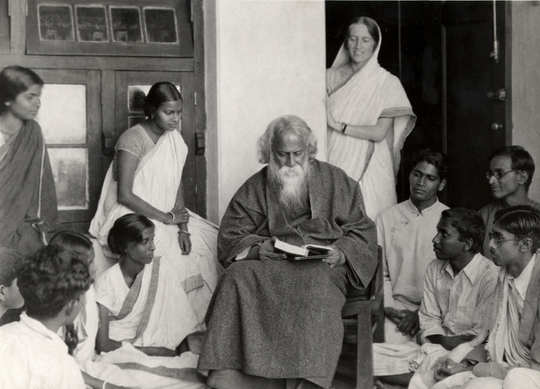
In earlier times, the wealthy, landlords, and village leaders did not abandon the villages; they lived within them. They had socially and morally recognised their responsibilities. Though not everyone fulfilled these obligations equally, the wealth of the affluent was often used for social service through various forms of giving. In return, they received respect and loyalty from the common people—not because of their wealth, but because of their actions. Within society itself existed mechanisms that ensured its preservation and nourishment.
This was Tagore’s view of the dynamism of rural society. He also believed that throughout Indian history, the state and society were distinct entities, with a distance between political authority and social organisation. The state never fully engulfed society. There were wars over kingdoms, the rise and fall of dynasties, shifts in capitals, and the dominance of various internal and external powers. But these were all superficial changes; they did not fundamentally alter the structure and relationships of Indian society, especially the rural one. Within the historical changes in the organisation and relationships of this rural social structure, Rabindranath sought the causes of the gradual underdevelopment and decay of rural Bengal and Indian society. He identified three fundamental causes, which were not isolated but closely interconnected.
However, within a short time, he realised that the ideal relationship he envisioned between leaders and followers would require landlords or village heads to be truly virtuous, moral, and generous—almost superhuman—which was unrealistic except perhaps in rare cases like himself. He also gradually came to understand that the presence of wealthy patrons and their charity would only keep rural society stagnant in a state of complacency and low-level subsistence equilibrium. Such charity could neither remove rural poverty nor create dynamic development. Rather, it would weaken villagers’ belief in their own ability to shape their lives and prevent them from relying on their collective strength.
In this context, Rabindranath pointed to one particular path for rural advancement: the strategy of a cooperative approach. He believed it was everyone’s duty to spread the idea that the means of survival of rural people lay in their own hands, and that cooperative principles could make this truth widely understood. In fact, Rabindranath interpreted the concept of cooperation in a broad sense. With a touch of irony, he wrote, “While in other countries cooperative movements are creating new social structures at the grassroots, in our country they hardly go beyond lending small sums of money.”
For Rabindranath, the path of cooperation was the path of truth, which he viewed from two angles. First, cooperation can foster self-reliance, self-confidence, and a sense of dignity among people—qualities essential for any development. Once people believe in their own strength, even those who are individually weak can unite their efforts and move forward collectively. Second, cooperation can help build the kind of kinship- and neighbourhood-based society that he envisioned. On one hand, it enables collaboration in economic activities such as production and exchange; on the other hand, it helps overcome social fragmentation and strengthen human relationships. Whether in agriculture, health, recreation, or problem-solving, cooperation can create a shared space of unity. Rabindranath regarded cooperation as a fundamental principle of humanity, because it is through cooperation that humans have become truly human. He believed that in knowledge, emotion, and action, cooperation leads to a sense of unity, and it is through unity that all forms of prosperity are created.
Therefore, he identified cooperation as the only effective means to eliminate rural poverty and to enable villagers to stand independently on a stronger social foundation. However, he did not see cooperation merely as a practice, but as an ideology—one that could give rise to many forms of action, depending on the context and the purpose. His goal was to build a self-reliant, community-based rural society through cooperation, and the framework he proposed for such a cooperative system had several fundamental features:
(a) All villages in the country must be developed in such a way that they can meet all their own needs. Several villages will together form a unit or a council.
(b) The head of each council will organise all activities and arrangements for meeting deficits in the main village, making the council self-sufficient so that these units can function as pillars of self-governance.
(c) Each council must take the necessary steps to establish its own school, industrial training centre, grain bank, cooperative storehouse, and financial institutions. Each council will also have a common hall where, in Rabindranath’s words, “everyone will find a place to gather for work and recreation, and there the appointed leaders will settle village disputes and cases through arbitration.”
(d) Landholders and peasants must unite, and in agriculture, all members of a council or a village should combine their lands and cultivate them collectively. This would allow the use of modern machinery, increase productivity, and make the production process more cost-efficient.
(e) In the industrial sector, cooperative methods should be used to establish industries, supply raw materials, manage production, market goods, and distribute profits. Only those industries should be established in rural areas that promote the overall well-being of rural people.
(f) It must be ensured that villagers’ homes are clean and pleasant, their health is protected, and their way of life is dignified and humane.
In relation to this entire plan, several questions naturally arise—such as the preconditions for its success, the role of urban centres in rural development, the nature of integration with the outside world, and the coexistence of large-scale industry and small-scale production. Rabindranath addressed these complementary questions with rational and practical answers. He identified several prerequisites for the success of his rural development plan.
Rabindranath assigned a specific role to cities within his rural-based social model. The foundation of society would be self-governing villages, whose economic development would be based on science and cooperation. There would be connections between villages and cities, but not a relationship of domination and subordination.
First, he believed it required intellectual courage and compassion for the common people. It also required practical knowledge—not merely bookish learning, but breadth of thought and the ability to understand the mentality of ordinary people. In this context, he remarked that students of economics and ethnology in Indian colleges and universities often wait for European scholars to interpret the customs and institutions of people in their own neighbouring villages. He further observed that in our country, we often live like outsiders, as if the land does not truly belong to us.
Second, success requires reliance on one’s own efforts and a reduction of dependence on others. According to Rabindranath, the educated class and youth must take responsibility for organising village life. For this purpose, a trained workforce must be developed, along with institutions to educate and prepare them. He also emphasised reducing people’s dependence on the government. In his view, ordinary people, including the middle class, were increasingly becoming reliant on the state, which weakened their self-reliance, confidence, and dignity. He wrote that when people come to believe that only the impersonal power of the government can solve their problems, they effectively lose their country. He distinguished between a “state-centred” system and a “society-centred” system, arguing that social development cannot be left to a heartless state machinery.
Third, he stressed three key areas for rural progress: education, agriculture, and technology. Expanding education, improving agriculture, and using better technology could accelerate rural development.
Rabindranath observed that in our country, cities developed through an alliance between state power and commercial power, which trapped villages within the structures of administration and commerce. He described cities as centres of power and villages as centres of life. The sources of urban power are machinery, political authority, and trade. Cities are arenas of competition, where the cooperative spirit of villages finds little encouragement. Over time, cities have exploited villages through their dominance.
However, Rabindranath assigned a specific role to cities within his rural-based social model. The foundation of society would be self-governing villages, whose economic development would be based on science and cooperation. There would be connections between villages and cities, but not a relationship of domination and subordination. Instead, there would be continuous efforts towards a new harmony. In his words, cities, despite their pride, would acknowledge kinship with villages—like the outer and inner sections of a large household: the outer part may have more wealth and grandeur, but the comfort and repose lie within, and the two remain connected by bonds of the heart.
At the same time, he made it clear that he did not wish for a return to backward ruralism. He distinguished between revitalising villages and reviving isolationist “rusticity.” While he emphasised a self-reliant rural society, he also supported openness to the outside world. According to him, this connection should be based on knowledge, science, technology, and philosophy. One of the main purposes of Santiniketan was to create a space for free intellectual exchange between India and the world.

Rabindranath’s visit to Russia had a far-reaching impact on his economic thought. It exposed him to a different economic system and transformed many of his earlier aesthetic assumptions. After this visit, he acknowledged that the desire for material well-being cannot simply be suppressed; rather, it must be fulfilled in a broader, more meaningful way. However, while he became more inclined towards cooperation, he did not become a socialist. He praised aspects of the Soviet system but also criticised its suppression of individual freedom. He distinguished it from fascism by noting that while it oppressed people physically, it did not suppress their minds in the same way. Ultimately, Rabindranath favoured a middle path between capitalism and socialism. He proposed that private property should exist, but excessive individual consumption should be limited, and surplus wealth should be used for the benefit of all—essentially advocating cooperative principles across economic activities.
In reality, Rabindranath could not become a socialist. As a strong believer in individual freedom, aesthetic values, and the primacy of the human spirit over material concerns, he could not accept the complete socialisation of production or the subordination of the individual to collective authority. At most, he could be described as a radical humanist. His vision was that even landlordism should evolve into a system where landlords act as trustees for the people, sharing resources rather than dominating them. Rabindranath’s humanism and his recognition of individual freedom in social thought are very clearly reflected in his novels and short stories. In the novel The Home and the World (Ghare-Baire), when Nikhilesh refuses to prevent the sale of foreign cloth in the marketplace of his estate, his reasons are twofold: first, it would harm the poor peasants, and second, it would interfere with their personal rights. The suffering of poor peasants under the Permanent Settlement is vividly portrayed in the story Shasti, and its impact is also evident in stories such as Megh o Roudra, Ulughorer Bipod, and Haldar Goshti.
In a letter written to Pratima Devi in 1930, Rabindranath said, “Even if I have not fully achieved the goal of my life in Sreeniketan and Santiniketan, I have greatly widened the path of my endeavour.” His economic ideas were central to this life goal of his, and it can be said without hesitation that Santiniketan and Sreeniketan were established as practical fields for the application of his social thinking. Those who see Santiniketan merely as a Brahmacharya ashram, a special educational institution, or a meeting place of Eastern and Western knowledge perceive only a partial picture of it. In fact, Santiniketan can be regarded as a laboratory for the self-reliant, village-based society founded on kinship and neighbourhood ties that Rabindranath envisioned. The same applies to Sreeniketan.
Selim Jahan is the former director of the Human Development Report Office under the United Nations Development Programme and lead author of the Human Development Report.
Send your articles for Slow Reads to slowreads@thedailystar.net. Check out our submission guidelines for details.
Why does Tagore still trouble Bangladesh’s idea of ‘us’?

Can Bangladesh make better use of its zakat money?

Three revolutions that reshaped the world

Paradise lost and found: Rediscovering early modern Bengal

Unbound Mother: The making and remaking of Kaali in Bengal

Do great leaders make history, or does history make them?
Poison and cremation: A forensic history of colonial Bengal

Partition, Bor Porong and the Chakmas’ unfinished struggle for belonging

The young radicals who challenged 19th-century Bengal