Maleka Khan: A guardian of memory
As the car took the last turn, winding along the muddy, aisle-like lane that snaked through emerald paddy fields, the rickety bamboo gate creaked open to reveal a haven of bliss. I stepped down among scattered white petals of nag champa, their intoxicating scent rising to meet me.
We had arrived in Dhanua, a quaint village in Shibpur Upazila, tucked inside Narsingdi. We came to celebrate an exceptional life, to pray for a saint among mortals, to cherish a father figure, and to recall his pristine lessons. Professor Sakhawat Ali Khan, a pioneer in journalism education in Bangladesh, was a longtime teacher at Dhaka University.
Khalu, as I called him, was my friend’s Babu and a father to the generations he helped mould. At eighty-five, he has taken his heavenly abode. Soft-spoken, with sharp humour, his eyes sparkled with brilliance and wisdom. I respected him deeply, but I adored his equally illustrious life partner, Maleka Khan.
Today, my story is about that love and adulation I hold for Maleka Khala—a soft yet steadfast woman to whom Bangladesh remains indebted, and with whom I share a love of plants, jamdanis, and local crafts.
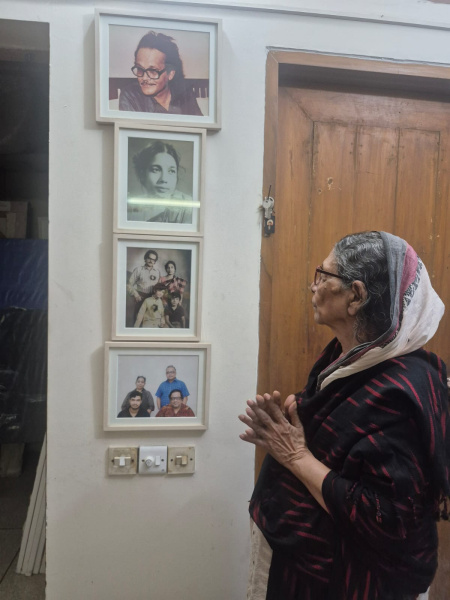
Her sprawling green sanctuary, the ancestral residence of Sakhawat Ali Khan, felt like stepping into a dream. Mahogany trees rose tall around the compound, and at its heart stood a two-roomed house with latticework parapets, louvred windows, wooden doors, and heritage furniture—half-eaten by tree rats, veiled in cobwebs—still bearing witness to time’s passage. Despite its decay, it was protected with love: cinnamon, bay leaves, kamini, Saraswati champa, nag champa, exora, rose bushes, and a towering olive tree glowed in the grove. Beyond the mango orchard, its saplings had been carried from Chapai Nawabganj.
Her land was vast, and her trees stood tall like guardians. At its centre lay a treasure of memory—the Mukti Bahini camp of the Liberation War, 1971.
The Mukti Bahini Camp
In the turbulent spring of 1971, as the Liberation War erupted, Maleka Khan, then Organising Secretary of the Girl Guides Association, became a quiet force of defiance. After the Pakistani military crackdown in March, she left Dhaka for her in-laws’ house in Narsingdi. There, she helped run a camp for freedom fighters and sheltered women and children.
“My Dadi was the daughter of Ghorasal’s zamindar, treated like royalty, so naturally our house had an andar mahal. Hidden within her thicket, her only son and daughter-in-law supported the freedom fighters’ camp. She prepared meals, while my mother sheltered the wives and daughters of close ones. My parents gave medical support, first aid training, supplied blankets, aided communication, and even translated manuals of arms cargoes,” recall the Khan siblings.
The thick canopy of trees became a natural fortress. Camp tents were tucked into shadows. The house itself was small, but its open roof was a target for shelling. To protect it, large branches were cut and laid across the roof, disguising the home beneath.
The birth of the Central Women’s Rehabilitation Organisation
In the 1940s and 1950s, Narinda was a hub of literary and social activity. Families gathered at the home of Rokonuzzaman Khan and Noorjahan Begum, editors of Saogat and Begum. These were informal, warm, and formative gatherings.
“I remember my father carrying breakfast from local shops, and sometimes bread from the Rex Hotel, a rare delicacy,” says Maleka. It was here she first met poet Sufia Kamal, who embraced her with affection, planting the seeds of a lifelong bond.
By 1971, that bond had matured into a partnership in struggle. Sufia Kamal had become a towering figure in Bangladesh’s cultural and political life, and her home was a place of refuge. The war brought unspeakable atrocities, particularly against women, and the Central Women’s Rehabilitation Organisation was born.
“Seven days after independence, the Organisation was formally established with government support. Sufia Kamal was appointed president, and Begum Badrunnesa Ahmed vice-president. Other key figures included Sajeda Chowdhury, Dr Nurunnahar Zahur, and Dr Halima. Together, they formed a committee of twenty women dedicated to recovery,” Maleka recalls.
Her first rescue mission set the tone. Asked to save two young women found unclothed and broken in an army camp, she tore her saree in half to cover them, caressed their heads, and whispered reassurance: “No harm will come to you.” They were brought to safety, marking the beginning of a long journey of rehabilitation.
Shelters were established in abandoned houses in Eskaton, Dhaka. One became a training centre, another a residence. The task of rescuing, nursing, and rehabilitating survivors required not only compassion but courage.
“Music and poetry played a vital role in healing. Josna, my friend and daughter of poet Golam Mostafa, sang songs to survivors, coaxing laughter and tears from those who had been mute for weeks, unable to speak or even stand, their spirits crushed by violence. A single smile or sob was celebrated as a breakthrough. We embraced the women, washed their faces, and reminded them of their humanity,” she recollects.
Recovery was slow. Some regained strength within months; others remained fragile for years. Many feared social stigma and begged workers not to reveal their past. They often returned later, visiting their rescuers, crying in remembrance, and sharing their pain. Reintegration required patience, secrecy, and resilience.
“The Organisation did not count successes in numbers. Each woman was treated as an individual, and her healing was personal. The work was not only about survival but about dignity—restoring a sense of self to those stripped of it,” she reminds us.
Maleka’s legacy
Maleka’s activism never ceased. She argued that survivors should be recognised as freedom fighters, not merely labelled Birangana. She welcomed the government’s 2015 decision to upgrade their status to Mukti Bahini.
She advocated for abortion rights, and following the 1971 war, the government officially designated women who were raped as "war-heroines" (birangona) and, in 1972, specifically allowed abortion for those survivors. However, no permanent legal exemption currently exists for pregnancies resulting from sexual violence in non-wartime scenarios.
She also worked on adoption options for children born of wartime rape, under special legislation, e.g., the Bangladesh Abandoned Children (Special Provisions) Order, 1972, which was historically enacted to allow foreigners to adopt babies born from wartime rape, recognising them as "unwanted" or "abandoned".
She introduced crafts as therapy and livelihood training. For her, crafts, at that particular time in history, were not only about cultural preservation but also a bridge to healing. Craft therapy was a way for survivors to recover emotionally and reclaim dignity through livelihood.
Her indomitable spirit, strengthened by family support, made possible what seemed impossible. The Central Women’s Rehabilitation Organisation became a symbol of Bangladesh’s moral conscience in the aftermath of the war.
Reflection
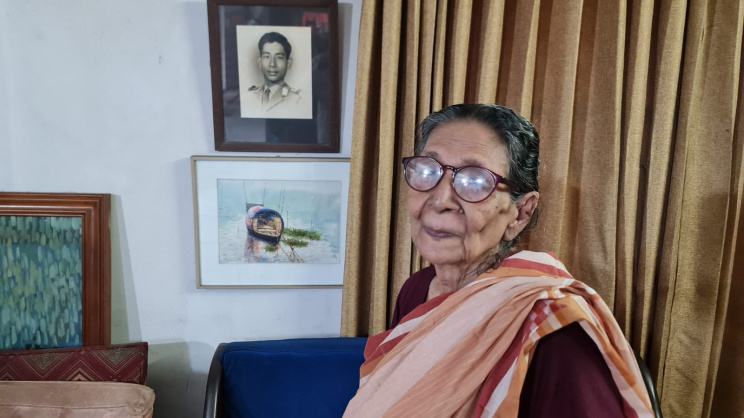
As I sat with Maleka Khala, listening to her frail yet unwavering voice, I realised how much her life had seeped into mine. Her love for trees and crafts mirrored my own, but what I carried away most was her resilience—the quiet strength to nurture beauty even in the shadow of war.
Walking through her sanctuary, past cinnamon leaves and mango trees, I felt the weight of history and the tenderness of survival. Healing, she taught me, is more than tending wounds; it is planting seeds, weaving threads, and safeguarding dignity.
To me, she is more than a guardian of memory; she is a living testament to how compassion can shape a nation’s conscience—something rare today.
RBR is the Editor of My Dhaka at The Daily Star
Send your articles for Slow Reads to slowreads@thedailystar.net. Check out our submission guidelines for details.

157th Birth Anniversary of Mahatma Gandhi / Gandhi’s return to Noakhali
Why does Tagore still trouble Bangladesh’s idea of ‘us’?

Can Bangladesh make better use of its zakat money?
Three revolutions that reshaped the world
Paradise lost and found: Rediscovering early modern Bengal
Unbound Mother: The making and remaking of Kaali in Bengal
Do great leaders make history, or does history make them?
Poison and cremation: A forensic history of colonial Bengal