Kedarnath Majumdar: The forgotten historian of Bengal

Few in Bangladesh today have heard or remember Kedarnath Majumdar. His name appears only in a few scattered footnotes, and even historians rarely mention him. Yet this quiet man from Mymensingh helped shape the way we think about Bengal’s history, literature, and journalism. He wrote tirelessly, edited some of the finest periodicals of his time, and tried to preserve the cultural memory of East Bengal (Bangladesh). But he worked far from Kolkata’s and Dhaka’s literary circles. That distance -- geographical and social -- would eventually erase him from the story he helped record.
Kedarnath was born in 1870 in Kishoreganj to a modest family. His father, Loknath, loved books and built a small library in their village home. His mother, Joydurga Debi, filled his imagination with tales from the Ramayan, Mahabharat and the Puran. The stories and myths from these books shaped him for life. He grew up poor and received little formal education, but his hunger for knowledge was immense.
He began his career as a copyist at the Mymensingh Collectorate, a lowly post secured through his uncle. The pay was meager, yet after long office hours he spent his time reading and writing. He prepared schoolbooks, published maps, and ran a printing press to support his family. Whatever little he earned went into buying books and funding his journals.
The editor from the margins
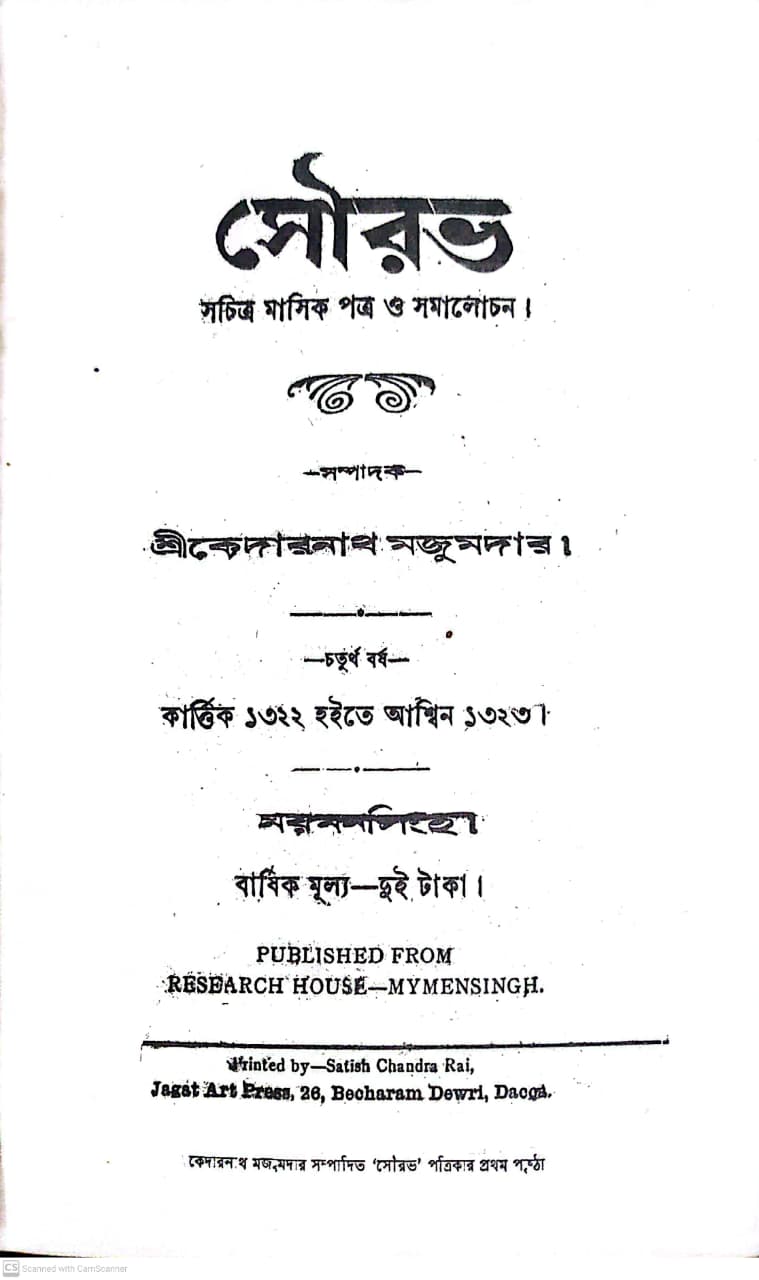
Kedarnath edited at least five periodicals from Mymensingh- Kumar, Basana, Aarti, Shiksha, and Saurav. Of these, Aarti and Sourav were considered first-class monthlies in all Bengal. What makes this achievement remarkable is that he did it from a ‘Mufassal’ (sub-urban) town, without institutional and financial support.
He insisted that Sourav should not be confined to just the borders of Mymensingh. Each issue carried essays on society, religion, and literature alongside debates on national and global ideas. At the time when Bengal was caught between revivalism and reform, Saurav gave space to every voice even those he disagreed with.
One article, Dharme Bipatti (The Perils of Religion), attacked religion as the root of human misery. Kedarnath, who was deeply religious, published it anyway. In an editorial note, he invited reasoned rebuttal: “If someone can logically demonstrate what harm may come to Bengali society if it followed the author’s views, it will be printed in Sourav.” That openness was rare, and it defined him.
While running a literary magazine, he neither liked nor asked established writers to contribute. He found joy in building up writers by awakening the latent talent of the common people and guiding them into the path of perseverance. After publishing the ‘Sourav’ magazine, a club named ‘Sourav Sangha’ was established with the writers from Mymensingh. This club not only help create literature but also helped in creating many literary figures.
A man with a moral compass
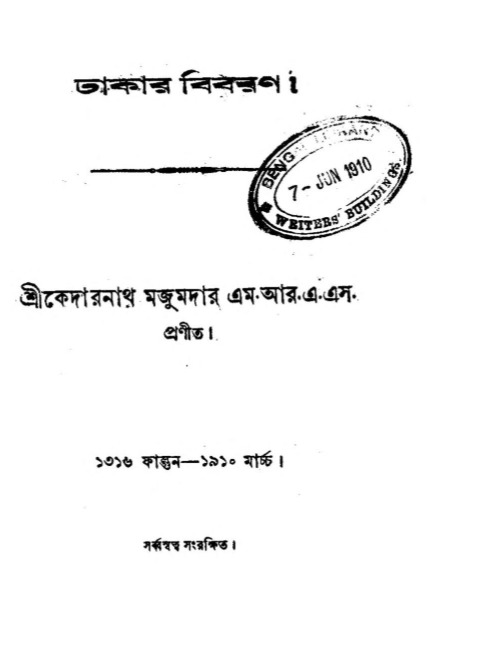
Kedarnath’s interest in history was not academic. He wanted to record the life of the people - their customs, beliefs, and struggles. His Dhakar Bibaran, Faridpurer Bibaran, and Mymensingher Itihas are among the earliest studies of regional history in Bangladesh. They combined meticulous documentation with empathy.
Kedarnath’s pursuits for uncovering history were not book dependent only. He emphasised on travelling, gathering and observing first hand local records. And that’s why soon after finishing school, he set out to travel across India, meeting many literary figures. These encounters broadened his vision and informed his writing. His travelogues appeared in famous periodicals like Bharati, Prayas and Binapani, though they were never compiled into a book.
Kedarnath’s magnum opus, Bangala Samayik Sahitya, traced the history of Bengali periodical literature. The first volume, published at great personal cost, covered the history of publications up to 1870. He had completed the second volume, but poverty prevented its printing. To cover expenses, he sold unbound copies of the first volume to a bookseller, who later went bankrupt. The remaining pages were seized by creditors and eventually vanished. Thus, one of Bengal’s earliest literary histories disappeared before reaching its readers.
A life of quiet endurance
Tragedy followed Kedarnath’s life. When he published Aarti, he named his newborn daughter after the magazine. She died young, and in her grief, he began writing Bangala Samayik Sahitya. Later, he named his son Sourav after another magazine. The boy, too, died in childhood. Kedarnath dedicated the book to both children. Like them, it met a tragic end.
One article, Dharme Bipatti (The Perils of Religion), attacked religion as the root of human misery. Kedarnath, who was deeply religious, published it anyway. In an editorial note, he invited reasoned rebuttal: “If someone can logically demonstrate what harm may come to Bengali society if it followed the author’s views, it will be printed in Sourav.” That openness was rare, and it defined him.
Illness weakened him, but he kept working. He applied to the colonial government for a literary allowance; instead, they sent him a typewriter. When the illness made it impossible to use the machine, he retired from his job. Yet his devotion to writing did not falter. On the day before his death, he was still checking proofs of Ramayaner Samaj.
He died at fifty-six, leaving behind a vast but scattered body of work: essays, poems, novels, textbooks, and historical studies. His stories like Chitra, Shuvodristi, and Samasya once entertained readers but have now vanished. His collected works, preserved in a Mymensingh library, were destroyed during the 1971 war.
The mind that never rested
Those who knew Kedarnath remembered him as a man who could not sit idle. Jatin Sarkar wrote in Jibani Granthamala: A Series of Literary Biographies, “It seems the word ‘rest’ was not in his (Kedarnath Majumdar’s) dictionary.” Even when paralysed, he worked late into the night, composing with his own hands. He had suffered many sorrows in his life, but instead of being consumed by it, he had become more devoted to work, and had let sorrow float away in the stream of creativity. He had truly turned sorrow into strength.
Nalinikanta Bhattasali also recalled receiving two rare coins from Kedarnath: one of Danuj Mardan Dev, from 1340, and another of Sri Sambar Narayan, king of Kuchbihar, from 1417—proof of his fieldwork and scholarly curiosity.
Kedarnath’s library, valued at six or seven thousand takas at the time, held about five hundred handwritten manuscripts and countless early Bengali magazines. To write the novel Ramayaner Samaj, it took Kedarnath quarter of a century, which was not published in his lifetime. Two years after his death, the book was published by his younger brother Narendranath Majumdar. The novelist Charuchandra Bandyopadhyay remarked, “After seeing his collection, I understood how Kedarbabu could write such a research-filled book like Ramayaner Samaj without living in a big city.”
He also built institutions. In 1917, he founded the Jaydurga M. E. School in Mymensingh, naming it after his mother. He spent nearly twenty-five thousand takas establishing it. The school later became known as Jaydurga Institution. However, the institution could not survive in the face of the wave of ‘Non-cooperation Movement’ and slowly disappeared. His dream was to have a literary society in every school, and he helped inspire the formation of several student groups across the district. He never saw financial support for his efforts, still never complained about it either.
The silence that followed
After his death, his brother Narendranath continued editing Sourav for a few years, but the magazine soon closed. Without institutional recognition or preserved archives, Kedarnath’s name faded. His work was overlooked by both colonial historians and later Bengali scholars, perhaps because he lived outside the Dhaka elite.
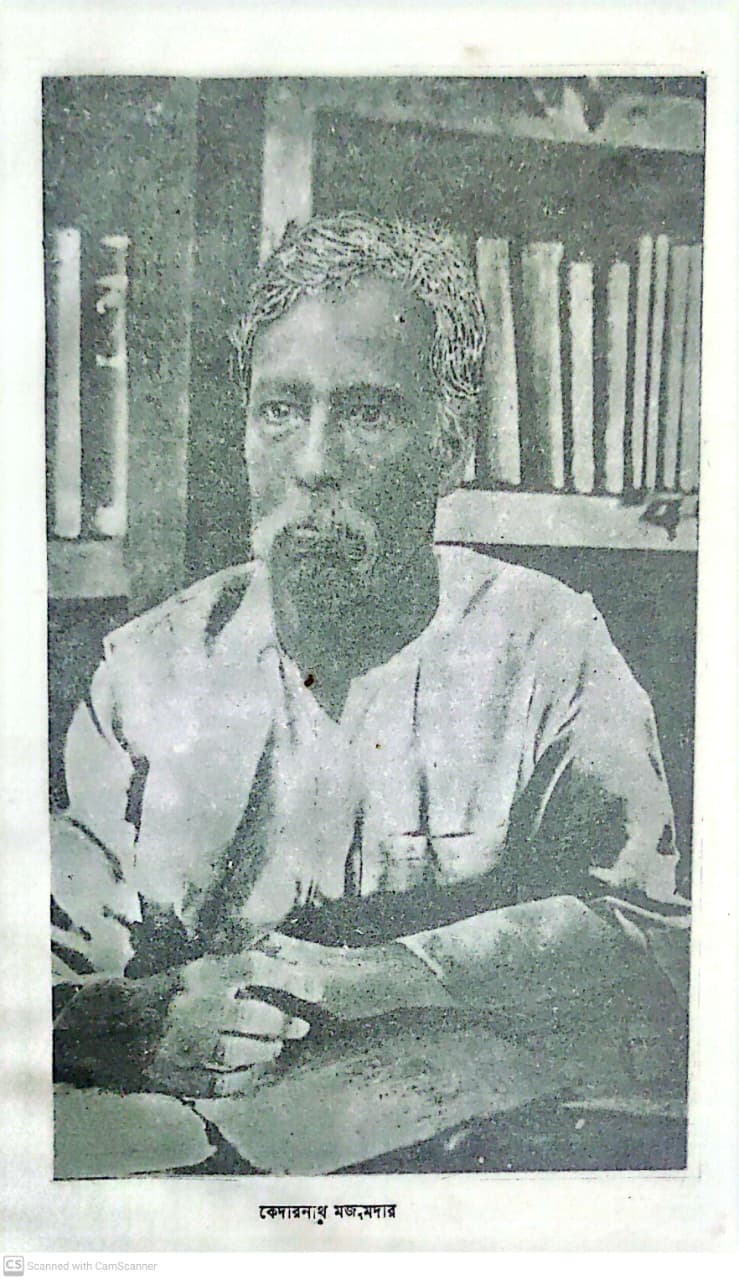
Yet, his life offers a lesson about honesty and perseverance. He worked without patronage, reward, or rest, driven by belief that knowledge should belong to everyone, even those in the provinces, far from the “civilised” centre. In his own words, through Sourav, he tried to “break the boundaries of the capital’s narrowness.”
This year marks the centenary of Kedarnath Majumder’s death, yet the historian who gave so much to Bengal remains largely forgotten. His lack of a university degree, and the fact that he was a historian from Mymensingh, meant that he was easily dismissed as ‘rural’, no matter how prolific he was. His poverty prevented him from publishing many of his works.
Kedarnath’s story is an indictment of how we decide who is to be remembered. It shows the fragile state of our cultural memory and the history that are lost when we only listen to voices from the centre. Kedarnath was hard worker, maybe too much even for his own detriment, who wanted to document the truth of his land and its people. Perhaps remembering him is a small act of justice- to the man who preserved our past.
Ystiaque Ahmed is a journalist at The Daily Star.
Send your articles for Slow Reads to slowreads@thedailystar.net. Check out our submission guidelines for details.
Beyond 1947 / A personal essay
Abul Mansur Ahmad / A global quest in search of a nation

Chand Bibi and the forgotten history of Muslim women’s political resistance
Women’s voices in Nazrul’s Dhumketu
How Milad-un-Nabi shaped Muslim cultural life in colonial Bengal
What Rashomon teaches us about truth and human behaviour
Why Chittagong never became a maritime city
The many worlds of Ghulam Murshid