Did Jinnah lose faith in the Two-Nation Theory after 1947?

The role of the individual in the great episodes of history has long been a subject of intense interest among historians. Muhammad Ali Jinnah, the founder of Pakistan, is especially significant in this regard. He is widely known for articulating the two-nation theory that shaped the idea of Pakistan. Bengali Muslims, in particular, once held him in great admiration—an admiration that endured for some time before gradually giving way to more critical reassessments of his long political career.
The writer and historian Mahbub ul Alam (1898–1981), for example, wrote in his correspondence with Annadasankar Roy shortly after Partition that Jinnah was a figure to whom the people of India needed to pay closer attention. As Alam argued, it was Jinnah who created the people of Pakistan, rather than the people who created their leader, a claim that underscores a markedly top-down vision of Pakistan’s formation.
Abdul Haque (1918–1997), a journalist and writer who participated in the language movement discourse during the early years of Pakistan, offered an important assessment of M. A. Jinnah. His attempt to evaluate Jinnah critically was a fresh departure and required both courage and intellectual merit. He critically assessed Jinnah’s role in an article titled “Muslim Jatiyatabad: Punaniriksa” [Muslim Nationalism: A Reappraisal] (1966), published in the literary journal Samakal under the pseudonym Abu Ahsan. At the time, open discussion of historical facts or ideas was difficult under the dictatorial regime of Ayub Khan.
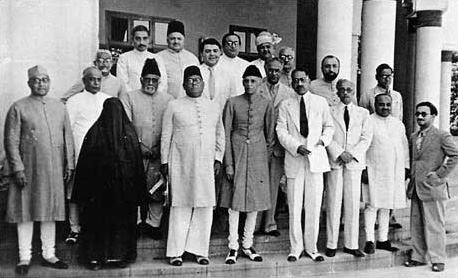
This is a clear manifestation of his two-nation theory grounded in religion. Abdul Haque also draws attention to Jinnah’s choice of the terms “Hindu” and “Muslim” in his writings and speeches before and after Partition, right up to the end of his life. Interestingly, however, just after the creation of Pakistan on August 14, 1947, Jinnah began to speak of Hindus and Muslims as communities rather than as nations.
In his essay, Abdul Haque pointed out that jati was more closely aligned with the idea of a community, language group, gotra or varna, or even inter-religious groupings, rather than with the modern concept of the nation. Indeed, the concept of the nation was a relatively new one in colonial India and was taking shape through dialogues and debates; even in Europe, it emerged as a dominant idea only in the nineteenth century. For instance, when Rabindranath Tagore translated Jean Renan’s famous essay “What is a Nation?”, he retained the term nation in Bengali because there was no exact equivalent in the language at the time—a situation that was similar in other languages of the subcontinent as well. Nevertheless, people began to use the term jati to grasp and explain the idea of the nation.
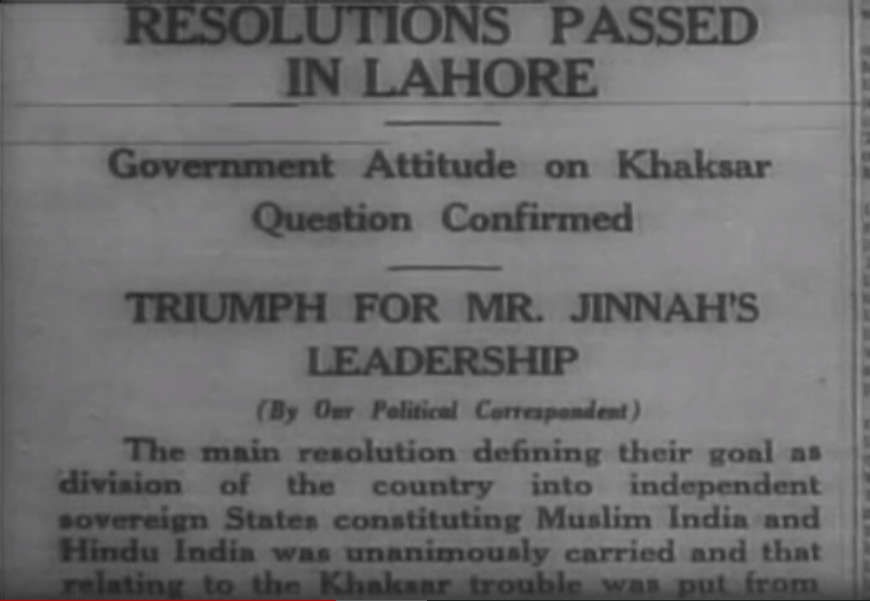
Haque argues that, in elaborating the genealogy of Pakistan, Jinnah first gave formal shape to the idea of Pakistan in the Lahore Resolution of 1940, clearly distinguishing between two nations in India—Hindus and Muslims—through his famous two-nation theory, which he continued to press in political action and public debate until 1947.
For instance, in a letter to Gandhi dated September 17, 1944, Jinnah wrote:
“We maintain and hold that Muslims and Hindus are two major nations by any definition or test of a nation. We are a nation of a hundred million, and, what is more, we are a nation with our own distinctive culture and civilisation, language and literature, art and architecture, names and nomenclature, sense of values and proportion, legal and moral codes, customs and calendar, history and traditions, aptitudes and ambitions—in short, we have our own distinctive outlook on life and of life. By all canons of international law we are a nation.”
This is a clear manifestation of his two-nation theory grounded in religion. Abdul Haque also draws attention to Jinnah’s choice of the terms “Hindu” and “Muslim” in his writings and speeches before and after Partition, right up to the end of his life. Interestingly, however, just after the creation of Pakistan on August 14, 1947, Jinnah began to speak of Hindus and Muslims as communities rather than as nations. Haque highlights what Jinnah said in the Constituent Assembly of Pakistan on August 11, 1947, shortly after being elected its president. Jinnah said,
I cannot emphasise it too much. We should begin to work in that spirit and in course of time all these angularities of the majority and minority communities, the Hindu community and the Muslim community because even as regards Muslims you have Pathans, Panjabis, Shias, Sunnis and so on and among the Hindus you have Brahmins, Vaishnavas Khatris, also Bengalis, Madrasis, and so on-will vanish.
Haque further contends that, even after Pakistan’s establishment as a state, Jinnah deliberately continued to characterise Hindus and Muslims not as nations, thereby revealing the non-enduring logic of the two-nation theory. He further mentions that from March 23, 1940 to the Partition of India in 1947, Jinnah broadly referred to Hindus and Muslims as nations, not as communities, in order to bring all Muslims in undivided India under the umbrella term of a Muslim nation. Later, however, he completely discarded this division or identification as nations. Very few other Pakistani leaders referred to Hindus and Muslims as not constituting nations, and even then only on limited occasions for practical political purposes, and never to the same extent.
For instance, Hussain Suhrawardy (1892–1963) spoke in a booklet published by the government in 1956 in Dhaka, Why Joint Electorate, using the same logic. He says:
“We should keep that in front of us as our ideal, and you will find that in the course of time Hindus would cease to be Hindus and Muslims would cease to be Muslims, not in the religious sense, because that is the personal faith of each individual, but in the political sense as citizens of the state.”
Apart from this, Jinnah and Suhrawardy also referred to people not only as Hindus or Muslims as nations, but also in terms of community or region, and more broadly as citizens of Pakistan. Thus, what is Abdul Haque’s final assessment of Jinnah’s nationalism? He argues that it was a Pakistani nationalism that Jinnah sought to shape after the independence of Pakistan, rather than his earlier two-nation theory. He drew attention to an incident in which, after Partition, some Muslims asked what would happen to the Muslims of India. As Chowdhury Khaliquzzaman (1889–1973) witnessed, he wrote:
“I had never before found Mr. Jinnah so disconcerted as on that occasion, probably because he was realising then quite vividly what was immediately in store for the Muslims...”
Notably, Chowdhury Khaliquzzaman advances an argument that echoes Abdul Haque’s position. Khaliquzzaman writes:
“I believe, as a result of our farewell meeting, Mr. Jinnah took the earliest opportunity to bid goodbye to his two-nation theory in his speech on August 11, 1947 as Governor-General-designate of Pakistan and President of the Constituent Assembly of Pakistan.”
However, what Abdul Haque suggested—distinguishing between Jinnah’s use of “Hindu” and “Muslim” as nations or as communities before and after 1947—may not always appear crucial and may partly stem from the realpolitik of post-independence Pakistan; still, it remains significant. One may, of course, counter Haque’s arguments or challenge the evidence behind his revisionist reading, but his intervention offers important clues that history is not always straightforward. Following the publication of this essay, Muslim Jatiyatabad: Punaniriksa (1966), along with Yuddha O Sampradayikata (1966), two issues of Samakal were confiscated by the government.
Priyam Pritim Paul is currently pursuing a PhD at Ashoka University.
Send your articles for Slow Reads to slowreads@thedailystar.net. Check out our submission guidelines for details.

Part I / From Artificial Intelligence to the Artificial State: Is the Trajectory Inexorable?
157th Birth Anniversary of Mahatma Gandhi / Gandhi’s return to Noakhali
Why does Tagore still trouble Bangladesh’s idea of ‘us’?

Can Bangladesh make better use of its zakat money?
Three revolutions that reshaped the world
Paradise lost and found: Rediscovering early modern Bengal
Unbound Mother: The making and remaking of Kaali in Bengal
Do great leaders make history, or does history make them?
Poison and cremation: A forensic history of colonial Bengal