Why Bangladesh's new government faces an old narrative trap

Every ruling authority in Bangladesh has relied on public narratives to secure trust and obedience. History shows that the most politically convenient narratives are also the most repetitive. As a new government takes office after the July uprising, the real test is whether it will repeat familiar scripts or finally break the cycle.
In Bangladesh, power has rarely been exercised without a story attached to it. Governments have not governed only through policies and institutions, but through narratives that explain who they are, who belongs, and what dangers supposedly lie outside their authority. Scholars of Bangladeshi politics have long noted that legitimacy here is produced as much through narrative framing as through electoral or administrative performance.
Across eras, a striking pattern emerges. At moments of crisis or transition, ruling authorities adopt an "easy" narrative, one that promises stability, order, and national survival. Over time, this narrative often hardens into a justification for restricting dissent. When public expectations outgrow the narrative's credibility, it collapses and is replaced by another, remarkably similar story.
The newly elected BNP government now confronts this same historical rhythm.
Narratives of unity and threat before 1971
Before independence, the Pakistani state framed Bengali linguistic and political demands as threats to national unity and state survival. Order and cohesion were elevated above representation, while dissent was equated with disloyalty. Historical analyses show how this narrative relied heavily on coercion and symbolic exclusion, ultimately losing legitimacy among the majority population.
The counter-narrative that prevailed, centred on linguistic rights, cultural dignity, and political self-determination, succeeded precisely because it aligned with lived experience rather than imposed fear. This became Bangladesh's foundational legitimacy narrative.
Post-independence idealism and the turn to order
After 1971, the Awami League initially governed through the narrative of liberation ideals: nationalism, democracy, secularism, and socialism. However, economic crisis, political violence, and institutional fragility soon created space for a different story. By 1975, the emphasis shifted towards unity, discipline, and order under strong central authority, framed as necessary for national reconstruction.
Political scientists have described this shift as one of the earliest instances where crisis was used to justify concentration of power in Bangladesh, with long-term consequences for democratic norms.
Redefining identity and stability after 1975
Following the assassination of Sheikh Mujibur Rahman, governments under Ziaur Rahman reworked the national narrative. "Bangladeshi nationalism" replaced "Bengali nationalism," reframing identity around territorial sovereignty and a broader religious-cultural register. This was paired with the restoration of multiparty politics, presented as a return to order after chaos.
While this narrative helped stabilise governance in the short term, it also entrenched ideological divisions that continue to shape political competition today.
Islam, order, and legitimacy in the Ershad years
During the Ershad regime, Islamisation became a key narrative tool. Declaring Islam the state religion was framed as restoring moral order and legitimacy to governance. Opposition was depicted as destabilising rather than democratic. Comparative research on authoritarian legitimation shows this as a classic strategy, using religion to compensate for weak electoral legitimacy.
Although the regime fell in 1990, the narrative itself endured, embedded in constitutional arrangements that later governments found difficult to reverse.
Democratic restoration and zero-sum politics
After 1990, electoral democracy returned, but narratives shifted towards mutual delegitimisation. Each major party portrayed the other as a threat to democracy, development, and national integrity. Analysts have repeatedly observed how this period normalised zero-sum politics, where fear of the opponent replaced trust in institutions (International Crisis Group, 2008).
Public confidence in political actors eroded, even as elections continued.
The caretaker interlude and technocratic morality
The 2007–08 caretaker government adopted a reformist narrative centred on anti-corruption and political cleansing. Initially popular, this narrative framed extraordinary authority as necessary to "save" democracy. However, rights groups and political analysts later warned that this period further legitimised the idea that order can override procedure (International Crisis Group, 2008; Human Rights Watch, 2008).
The episode reinforced a recurring lesson: morality narratives gain quick acceptance but weaken democratic expectations over time.
Liberation, development, and fear after 2009
From 2009 to 2024, the Awami League combined liberation legitimacy, war crimes justice, and development performance into a powerful governing narrative. The party positioned itself as the sole guardian of the Liberation War, while critics were often framed as anti-liberation or destabilising forces. Studies on memory politics note how control over historical narrative became a key instrument of political authority during this period.
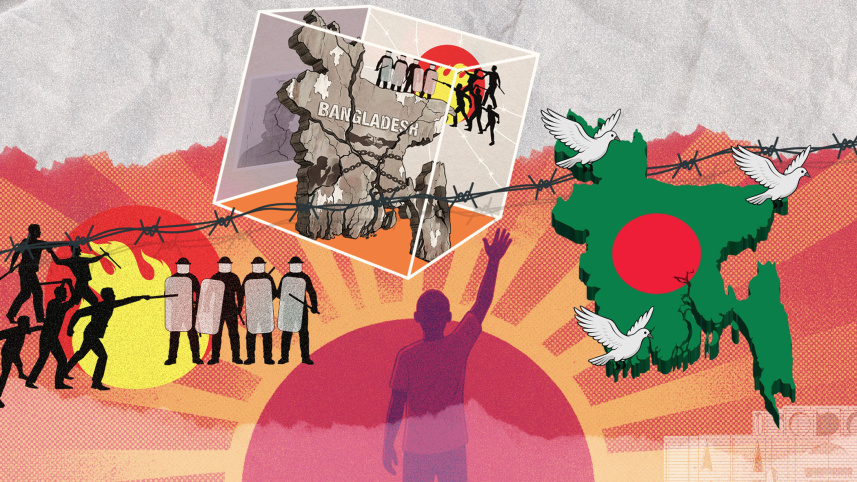
At the same time, digital security laws and legal instruments increasingly acted as narrative enforcers, raising the cost of dissent and contributing to what rights organisations described as a shrinking civic space (ARTICLE 19; Amnesty International).
The easy narrative facing the new government
Against this backdrop, the most accessible narrative for the current BNP government is familiar: restoring order, reviving the economy, and fixing governance after turmoil. This stabilisation script closely resembles the post-1975 narrative of unity and discipline framed as national rescue, the military-era emphasis on order and development as corrective governance, and the caretaker government's reformist claim that extraordinary authority was necessary to cleanse politics and restore stability.
Its appeal lies in its simplicity and inclusiveness. Yet history suggests that when stability becomes the primary justification for authority, dissent is easily reframed as disruption, and fear quietly re-enters political life.
What the July uprising calls for instead
The July uprising articulated a different demand. It was not merely a rejection of a government, but of fear as a governing principle. Surveys, media reporting, and youth testimonies consistently highlighted demands for justice, freedom of expression, and dignified livelihoods (Reuters, 2026; Amnesty International, 2026).
A more sensible narrative for this moment would therefore centre on dignity, rule of law, and institutional restraint. Justice, but without selectivity. Stability, but without intimidation. Development, but without exclusion. Political theory suggests that such procedural legitimacy is harder to sustain but more durable over time.
Bangladesh's history shows that fear-based narratives may consolidate power quickly, but they rarely endure. Whether the new government repeats an old script or attempts a more difficult path will determine not only its political future, but whether the country finally breaks its long cycle of trust followed by fear.
Abu Mohammad Sakil Faizullah, Ph.D. (ABD), is a Public Relations and Mass Communication Researcher at the University of Georgia, Atlanta, USA. He can be reached at sakilfz@gmail.com.
Send your articles for Slow Reads to slowreads@thedailystar.net. Check out our submission guidelines for details.

Can Bangladesh bring its hilsa back?
Can the new strategy achieve Bangladesh’s renewable energy targets?
André Wink speaks / What we get wrong about the Indo-Islamic world
Bengali Muslims and the ghosts of India's citizenship politics

Bangladesh’s solar growth: Will the incentives be enough?

The missing link in Bangladesh's innovation economy
Dhaka’s battery rickshaw problem is economic, not just about traffic
The staircase between our mothers and care
Is Bangladesh prepared for the next food shock?