The lost magic of textbooks and why it matters

For most, the first of January is the start of a new calendar year. But for a Bangladeshi student, it is the day of the "Boi Utshob", the book festival. I remember it vividly: the moment the new stack of NCTB books touched my hands, the very first thing I would do was bury my face in them to inhale the scent of fresh ink and paper. Among that stack, the Bangla literature book always received special treatment. While my mother was happy to see me "start my studies" so early in the year, the truth was far more indulgent. I wasn't studying; I was devouring every story and poem within the first few days, long before the teachers could even assign a chapter or receive any syllabus.
I wasn't the only one. During those early weeks of January, when school routines were still relaxed, our conversations in the playground or back benches often revolved around these stories. We didn't need a class lecture to understand them. We read them with sheer joy, and even if we did not understand the concept, talking about them with friends made them easier to understand. Perhaps it was our first experience of a “book club," though we didn't know the term then.
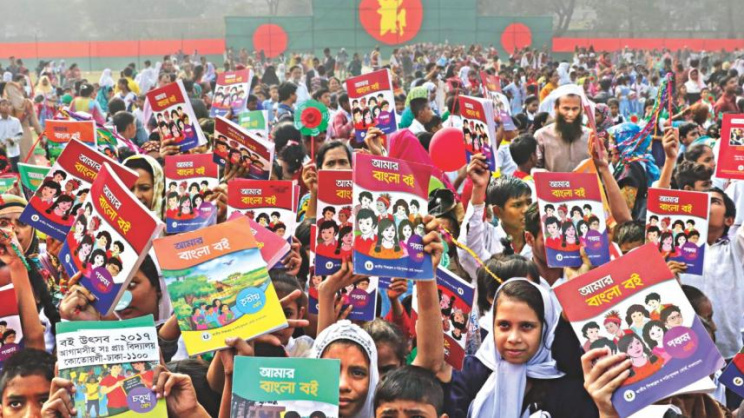
This fascination was particularly strong with Bengali books. When I heard from my professor that she also did the same thing when she got her new books, that feeling clicked instantly. Mohosina Islam, Assistant Professor at the Department of Printing and Publication Studies at the University of Dhaka (DU), discussed how, in her time, Bangla books received special treatment compared to other books. She said, "Like today, in our time too, the syllabus would dictate what needs to be studied for the exam. Even though we maintained that for other books we would often read them in full as soon as we got them, we would often read Bengali books in full as soon as we got them. It wasn't just a habit among those who loved reading books or stories. It was more or less present in everyone." With its enticing curriculum, it would generally hook students into finding out what was in the new book beyond the syllabus.
When stories come to life
I would look into all of the stories, but some are etched so deeply into my memory that they feel like my own lived experiences. I remember a story titled "Mama Barir Pitha." The descriptions were so vivid that I could almost feel and taste the pitha just by reading. That was my first introduction to Chandrapuli, Dudhpuli, and Kheerpuli. When the little girl in the story woke up on a chilly morning, I felt the shiver down my spine; when she sat by the unun (the stove) with her grandmother, I felt the literal warmth of that family bond. That story didn't just describe a winter vacation; it allowed me to carry that warmth with me. Years later, when I visit my own uncle's uncle's home, I find myself subconsciously looking for the scenes I first discovered in those pages.
This story, and many others like it, introduced me to the most evocative words in Bangla literature. I developed a concept of language—words that had their own sound, smell, taste, and texture. It wasn't until Class Seven that I truly understood why this happened. I read an essay by Humayun Azad named "Shobdo theke Kobita," where he discussed the "life of words"—how words carry colour, scent, and taste. That lesson was a revelation. It made me realise that through the power of well-chosen words, I could smell a flower I had never seen or taste a dish I had never tried. It was all happening in the vast playground of my imagination.
Our textbooks should not be mere manuals for passing tests or vessels for shifting political narratives; they should be the keepers of our collective imagination and the guardians of our cultural values.
Mohosina Islam, reflecting on this, says, "When I was in class five, there was a story called 'Buddhimoti' by Sajedul Karim. I still remember reading it; I could imagine it. There was a picture in front of me, just one picture, no colours. By reading the story, I thought about the girl's dress, I listened to the dialogues attentively, and I felt like I was one of them."
There are many stories like this that I can still remember being a part of: Aam aatir bhepu and Pore pawa by Bibhutibhushan Bandapaddhay, Otithir sriti by Sharatchandra Chattapaddhay, Toilo chitrer bhut, Momotadi by Manik Bondopaddhay, Shuva by Rabindranath Tagore, and Manush by Kazi Nazrul Islam. These stories are etched into my mind because they made me visualise the narrative and relate to the characters.
A gateway to great literature
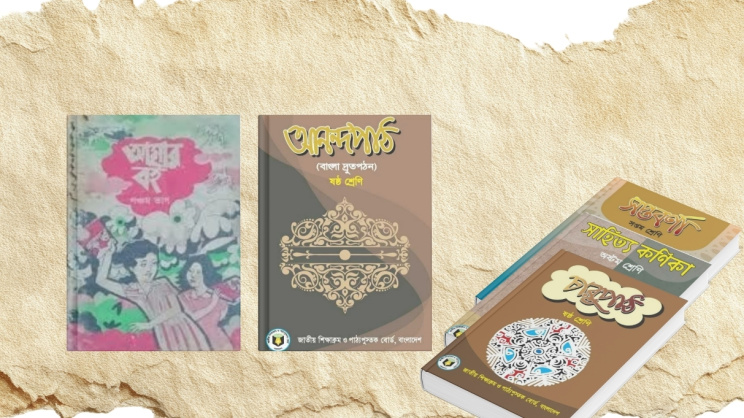
As I grew older, this humble textbook became my gateway to the giants of our literature. From mystery to biography or travelogue, the NCTB book was my first exposure to diverse genres. By reading the first travelogue by Sayed Mujtaba Ali, it dawned upon me that I should read more of his work. Even if I could not buy all of his work that time. Later, I read his books through libraries and the book reading program, and I bought some of them too. My parents bought me other books, but the NCTB Bangla book remained the foundation. It set the stage, providing the vocabulary and the emotional depth that I continue to build upon today.
But when I look at students now, they are far away from the joy of reading. At the beginning of the year, they get busy finding the syllabus and preparing for exams rather than taking a moment to look at the stories or poems. This exam-oriented studying has slowly shifted them away from the joy of reading. Today's students often bypass the original prose of masters altogether. Instead, they jump straight to the ''Creative Question'' solutions found in thin, newsprint supplements that promise high marks with minimal engagement.
Professor Manzoor Ahmed, Emeritus Professor of BRAC University, shares, "Students are no longer reading for the love of reading. It's a problem now. We need to create enthusiasm for reading things beyond just the textbooks." The enthusiasm for reading depends on the selection of subject matter. Professor Manzoor stresses the need to assess the effectiveness of the content: "If we are worried about whether it's effective, we need to run trials, do experiments, and conduct research to see how students and teachers are accepting it."
Perils of political influence
Unfortunately, subject matter selection is often influenced by politics. Our curriculum often sees content dropped or added for political or ideological reasons rather than for educational objectives. As a result, books are losing their logical sequence; for a child, there should be a logical, chronological progression of content. Without such planning, these changes lead to poor selection of reading material, ultimately hampering the development of the reading habit from an early age.
Beyond political shifts, another significant factor is technological development. Mohosina Islam notes, "Kids are listening to audiobooks, watching YouTube and television. Their reading habits have decreased. They are reading books, but not for the love of reading. As a result, they are missing out on the benefits of deep engagement with literature."
This lack of engagement points to a deeper question: what should our children be internalising? A curriculum is more than just a content plan; it reflects our cultural values. When the selection of stories and poems is swayed by shifting political or ideological agendas, we risk losing the very essence of our shared identity. Instead of serving a specific era's politics, the curriculum should reflect the resilience of our history, the vibrancy of our festivals, and the quiet beauty of our rural landscapes, transcending partisan politics.
This shift toward the functional rather than the cultural is reflected in the books themselves. Tariq Manzoor, Professor of the Department of Bangla at DU, comments, "It is true that school-level Bengali textbooks do not contain an adequate amount of enjoyable stories and poems. Nowadays, textbooks are mostly filled with informative, subject-oriented writing. As a result, students are missing the true essence of Bengali literature and do not find the learning process joyful. To enhance creativity, more engaging and delightful stories and poems must be included.
The Important Role of Teachers
What's inside the book is only as important as how it's taught. Our own excitement was often mirrored and magnified by the teachers. They acted as a bridge between the book and what our hearts wanted. When a teacher approaches a story not as a task to be completed, but as an exploration, learning becomes joyful. Teachers are not merely monitors of a syllabus; they are the curators of the stories. By reading a poem with genuine emotion or discussing a character's choice as if it were a real-life dilemma, they establish that literature isn't something to be ''solved'' for an exam—it is something to be felt.
Emphasising this matter, Professor Manzoor Ahmed says, "Some students read out of their own interest, but not everyone has that. Teachers need to try to create an interest in reading at school. They should encourage students to read not just textbooks but other books too. They can assign reading tasks or hold group discussions. The teacher also needs to have enthusiasm for language and literature. Unfortunately, not all teachers have that." This human connection is the invisible thread that turns a school requirement into a lifelong habit, showing us that the beauty of a story lies as much in its telling as in its text.
Keeping the wonder alive
As I look back at that stack of new books on the first of January, I realise that the NCTB Bangla book was never just a requirement for an exam. It was the first spark. It taught me that words are not just marks on a page; they are windows into worlds of warmth, flavour, and soul.
But a window is only useful if someone is encouraged to look through it. We owe it to the next generation to return that sense of wonder to their classrooms. Our textbooks should not be mere manuals for passing tests or vessels for shifting political narratives; they should be the keepers of our collective imagination and the guardians of our cultural values.
Adrin Sarwar is a journalist at the Daily Star.
Send your articles for Slow Reads to slowreads@thedailystar.net. Check out our submission guidelines for details.

Can Bangladesh bring its hilsa back?

Can the new strategy achieve Bangladesh’s renewable energy targets?
André Wink speaks / What we get wrong about the Indo-Islamic world
Bengali Muslims and the ghosts of India's citizenship politics

Bangladesh’s solar growth: Will the incentives be enough?

The missing link in Bangladesh's innovation economy
Dhaka’s battery rickshaw problem is economic, not just about traffic

The staircase between our mothers and care
Is Bangladesh prepared for the next food shock?