


Empowering the Youth to Transform Society
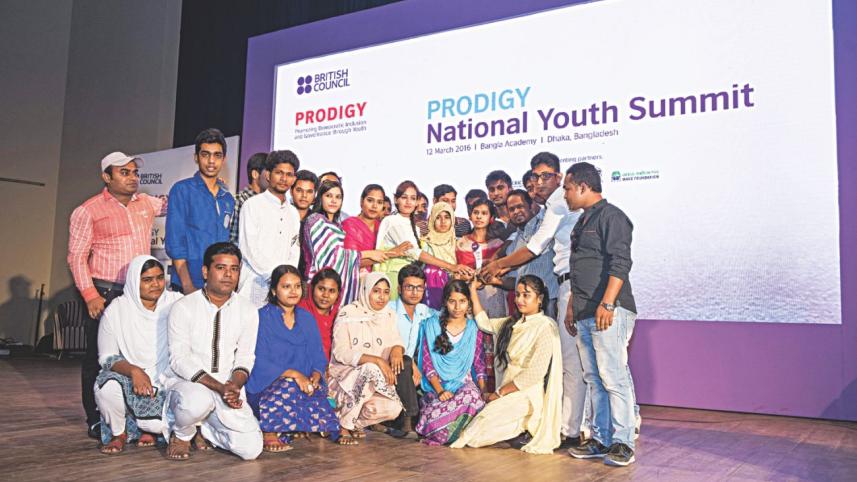
PRODIGY (Promoting Democratic Inclusion and Governance through Youth) was a 21-month long project of the British Council that started in September 2014 with an aim to increase peaceful civic participation in local governance in Bangladesh by empowering the youth through capacity development. The project has developed knowledge and skills of 540 young Bangladeshis in 15 Union Parishads (UP) of three Divisions through volunteer activities including youth club activities, theatre performances, internships with local government, community radio programs and public dialogues, creating platforms and channels to ensure that the wider community has access to government information.
During the course of the project, the 540 young participants have been given the necessary skills to assess whether local government bodies are fulfilling their commitments and responding to citizens' needs. Their capacities were developed in the areas of leadership, accountability, transparency, good governance and inclusivity and grant management.

Once trained, these community leaders designed and initiated 75 Social Action Projects (SAPs) to provide information and raise awareness amongst their communities with particular focus on women, the poor, and marginalised groups about their civil rights. Through these innovative SAPs, the young community leaders continue to empower their communities by enabling them to demand greater transparency from the local governments.
PRODIGY had three strands to achieve its objectives. The first was knowledge development of young people through identification and training of 540 youths across three divisions - building them into agents for positive social change.
The second was community engagement. Experts from partner organisations assisted the young leaders to design and plan their projects, advising on outreach to local communities, and engagement of local government authorities.
The third and final strand was recognition and demonstration of positive youth engagement. PRODIGY participants celebrated International Youth Day all 15 locations of the project involving more than 2500 young people along with representatives from local government, Department of Youth Development (DYD), civil society, electronic and print media personnel. PRODIGY National Youth Summit took place in Dhaka to recognise and showcase the work that PRODIGY youth leaders are doing through their SAPs in all PRODIGY locations.
Half of the PRODIGY participants were female, while 10% belonged to the marginalised section of the community, which included people with disability, ethnic or religious minority, and people living in extreme poverty. A total of 15 participants, which comprises of 8 female and 7 male participants, were provided internship opportunities at local government offices.
Analysis of the 21-month long project, whose curtains fell on June 2016, yielded inspiring results. More than 80% of the young people trained through PRODIGY have developed knowledge and skills in transparency, accountability, inclusivity, basic citizen rights, leadership, grants management, project design, and community needs assessment. In addition, more than 80% of the youth trained have continued to act as agents of social change within their communities. Also these trained young people have initiated 75 SAPs to create awareness among the community people about different services which are supposed to be provided by the local government. These young people also motivated the community people to engage more with the local government body through various channels/activities through these projects. The result has shown that the effort of these young people have contributed to increase peaceful civic participation in local governance in the work areas of PRODIGY.
PRODIGY has left a mark in communities where it was conducted. The project inspired an additional 1,000 young people and their networks to take up similar initiatives. The 75 SAPs initiated by the project are being continued even after the formal closure of the project in June 2016 which reflects a true ownership of the community over these initiatives. This signals that a positive transformation is on the way for the country.
 For all latest news, follow The Daily Star's Google News channel.
Comments