


Voters must hold politicians to task over health and education
On January 25, a 20-year-old female patient suffering from kidney and heart complications jumped to her death from the eighth floor of Dhaka Medical College Hospital. The deceased, mother to a four-month-old baby, had been undergoing treatment intermittently for several months, but her family could no longer afford to continue it. Their resources were exhausted.
This incident received little media attention. But it should have shaken us because it is not an isolated tragedy, nor is it merely a personal story of despair. It is a clear and devastating signal of the deep insecurity within which the majority of people in Bangladesh are forced to live.

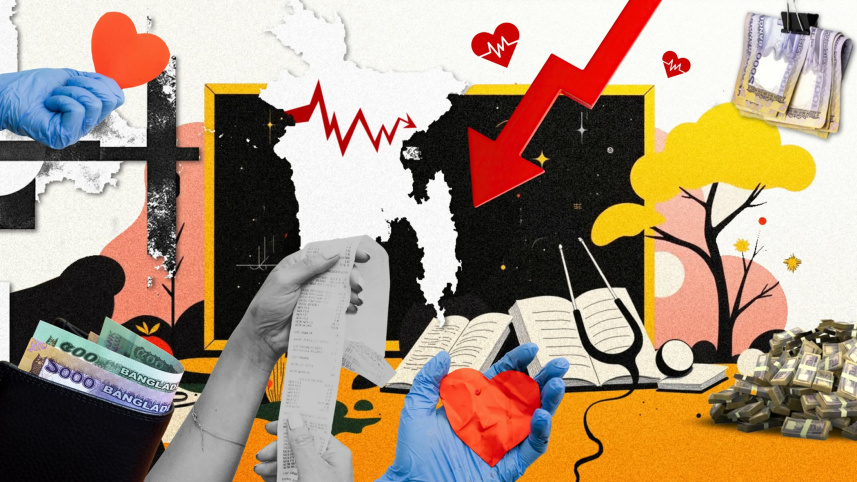
Across the country, countless families have been ruined while trying to pay medical bills. Many cannot afford treatment at all. In Bangladesh, illness does not only attack the body; it dismantles entire households. People sell off land, jewellery, livestock, and dignity. And often, even that is not enough.
At first glance, the healthcare sector appears to be flourishing. New private hospitals and clinics are emerging everywhere. They are modern, well-equipped, and prohibitively expensive. However, this surface-level brightness hides a darker reality. Access to healthcare, recognised as a fundamental right and enshrined in our constitution since 1972, has steadily moved further out of reach for ordinary people.
Healthcare has become expensive because it has been systematically commercialised. Successive governments, with policy support from institutions such as the World Bank, have promoted privatisation and market-driven reforms. As a result, healthcare is no longer treated as a public service but as a profitable business sector. The state has retreated, and citizens have been left to fend for themselves.
The interim government has not initiated any meaningful departure from this trajectory. The latest budget reflects the same pattern as previous governments: minimal allocations for health and education, which is among the lowest not only in South Asia, but globally. Even within these limited allocations, irregularities persist. There is no visible policy shift that recognises healthcare and education as fundamental rights deserving structural reform.
This absence of recognition is glaring, particularly given the promises made in the name of building a discrimination-free Bangladesh. Those commitments find no reflection in budgetary priorities.
The incident cited above and others like it are not random acts of desperation. They are the outcomes of continued systemic failures.
As the country moves towards another national election, political parties are making a wide range of promises. Yet, among these, what is conspicuously absent is a clear and firm commitment to making the state fully responsible for ensuring healthcare for all.
This silence must be challenged. All political parties should clearly declare that healthcare is a fundamental right, a public good and that the state must bear responsibility for ensuring universal access. This requires a sustained increase in budgetary allocation, as well as the strengthening of public institutions, including government hospitals, clinics, and community health centres.
One crucial and often overlooked step towards strengthening public healthcare is accountability at the highest level. There must be a political commitment that the president, prime minister, ministers, bureaucrats, and all government officials will receive treatment in public hospitals. Such a commitment, or binding requirement, would fundamentally alter the system.
If those in power were required to rely on public hospitals, their own urgency would drive institutional reform. Capacity would improve, funding would increase, and long-overdue overhauls would finally receive attention. At present, the opposite happens. Those in power travel abroad for treatment at public expense. Those with money follow suit. And because the powerful do not depend on the domestic system, there is little incentive to fix it.
The education sector mirrors this crisis.
Here too, privatisation and commercialisation have expanded rapidly. From primary schools to universities, private institutions dominate the landscape. There is visible glamour and growth. But there is no uniform education standard. Instead, inequality has deepened.
Those with money can purchase better-quality education. Those without are confined to a deteriorating public system. Public schools, especially those in rural areas, are often in a state of neglect, struggling with poor infrastructure and limited resources. This has created a sharp divide between public and private education. However, even within the private sector, a wide spectrum of quality can be observed.
Multiple layers of inequality have emerged from the various streams of education—religious versus secular education, Bangla medium versus English medium, Bangla version versus English version and so on. Education, instead of reducing inequality, now actively reproduces it.
The interim government has not attempted to reverse this trend of increasing inequality in education. On the contrary, a new and dangerous development has taken hold within educational institutions. Teachers, from primary schools to universities, are increasingly living in fear. They are uncertain whether they can teach freely, whether they can speak openly in classrooms, or whether they can properly discuss history, social science, or philosophy.
An organised practice of suppressing independent opinion through mob violence has emerged, with no sustained action by the state to counter it. Across schools, colleges, and universities, incidents have occurred where teachers have been threatened, forcibly removed, or barred from entering campuses. Groups demand that teachers be answerable for what they teach, questioning why certain topics were discussed and why certain ideas were introduced.
The most recent incident in this regard took place at the University of Asia Pacific, where two teachers were dismissed without due process. They were given no reasonable explanation and no opportunity to defend themselves. Their dismissal was not based on professional misconduct but on their independent views on certain ideologies or beliefs. It was carried out in response to mob pressure, using religion as a tool of intimidation. The teachers had no minimum guarantee of job security. Academic freedom was discarded without hesitation.
The ability to ask questions lies at the heart of education. It is meant to cultivate analytical and critical thinking, to bring everything under scrutiny and open new avenues of knowledge. What we are witnessing now is a direct assault on that foundation. It is deeply alarming.
 For all latest news, follow The Daily Star's Google News channel.
 As elections approach and political rhetoric intensifies, citizens must pay attention and note which parties genuinely recognise public education and public healthcare as fundamental rights. Those who do not must be questioned. Those who claim they do must be pressed for clear roadmaps. How will they bring these sectors back under public control and ensure universal access?
Political parties must also be held accountable for the threats facing freedom of opinion and academic independence. We must ask who is responsible for creating this climate of fear within academia. It is also crucial to note which parties oppose this trend and how vocal they are in demanding change.
Public scrutiny is essential. Political actors must be brought under public surveillance and accountability so that whoever comes to power cannot ignore these crises.
A society where people die because they cannot afford treatment, and where teachers are threatened for teaching, is not sustainable. Bangladesh must move towards a future where every citizen can access education and healthcare without fear or discrimination, and where dignity is not a privilege, but a right.
Anu Muhammad is a former professor of economics at Jahangirnagar University.
Views expressed in this article are the author's own.
Follow The Daily Star Opinion on Facebook for the latest opinions, commentaries, and analyses by experts and professionals. To contribute your article or letter to The Daily Star Opinion, see our guidelines for submission.
Comments