


Unmasking the systemic crisis behind our deadly roads

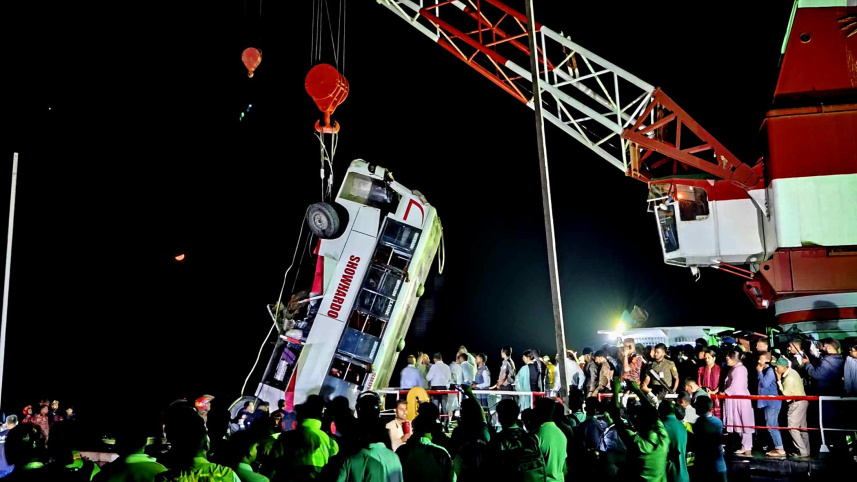
Bangladesh stands at a crossroads where our economic progress is being held back by profound structural failures, and nowhere is this more starkly visible than in the transport sector. When a bus loses control and plunges into the depths of the Padma River while waiting to board a ferry, as it happened recently, it is not just an accident; it stands as a harrowing symbol of our fragile transport system that frequently allows for such tragedies. According to the Bangladesh Jatri Kalyan Samity, the death toll from road accidents in 2025 was 9,111, averaging 25 lives lost every day. But such annual or monthly figures are often a fraction of the reality, as they mostly account only for those who die on the spot. For example, according to the WHO, the actual death toll in 2021 was 31,578, whereas local estimates cited only 7,809.
In public health, the severity of a crisis is measured by the case fatality rate. For Covid-19, this rate was 1.45 percent; for dengue, it is 0.45 percent. But for road accidents, this rate has consistently hovered between 18 and 36 percent over the last decade. Another statistic underscores this horror: Bangladesh is among the countries with the highest fatalities per vehicle. It records 102 deaths per 10,000 vehicles, compared to just 13 in neighbouring India and seven in Sri Lanka. So, every time a vehicle hits the road here, it is significantly more dangerous than in most countries.
 For all latest news, follow The Daily Star's Google News channel.
 The reasons behind this relentless procession of deaths in Bangladesh are manifold. Among them, one factor that is seldom discussed is the role of fiscal policy. Import duties on new, safety-equipped vehicles range from 100 to 300 percent. This high tariff is not limited to private cars; it extends heavily to public transport. The total tax incidence on passenger buses averages 36 to 59 percent, while for minibuses, it ranges from 89 to 127 percent. For large air-conditioned buses, the burden is even higher. These exorbitant rates do not just prevent individuals from buying safer vehicles; they also stifle the import of modern public transport, effectively serving as a state “incentive” to keep aged, unfit vehicles on the road.
Safety is further compromised through steep duties on life-saving equipment. Tariffs on high-quality helmets range from 58 to 90 percent; airbags and sensors face tariffs of 59 to 107 percent; and brake pads or linings incur tariffs of 58 to 89 percent. On average, anyone seeking to repair a vehicle with new parts faces a tax burden of 58 to 107 percent. Consequently, most mechanics in Bangladesh resort to using substandard or second-hand parts, further escalating the risk of accidents. Our roads thus remain haunted by dilapidated vehicles with zero crash-test ratings; in other words, “mobile death traps” devoid of basic safety features, such as airbags or advanced braking systems.
The scarcity of public transport is another driver of this crisis. Bangladesh has one of the lowest rates of motorisation globally, a shortage that forces the repeated repair of old vehicles and encourages chronic overloading. A big part of the problem here is the corruption festering within the Bangladesh Road Transport Authority (BRTA). It is an open secret that vehicle fitness certificates are often provided without inspection, while “contract” licences are handed to unskilled drivers for a price.
A 2025 survey revealed that 63.29 percent of BRTA service recipients had to pay bribes. This is compounded by powerful syndicates and “token systems,” where unfit vehicles ply the roads under the very nose of the administration in exchange for fixed extortion. Currently, over 600,000 vehicles are unfit or without updated fitness certificates, and many drivers are either unskilled or unlicensed. According to Transparency International Bangladesh, annual corruption and extortion in the road transport sector amount to approximately Tk 1,060 crore. Moreover, most transport owners are directly involved in politics, contributing to political criminalisation of our roads and highways.
The quality of roads is also to blame. Some surveys suggest that 80 percent of Bangladesh’s roads are “1-star” rated, largely due to rampant engineering flaws and the lack of pedestrian access. While “black spots” or accident-prone areas are identified, they are rarely permanently fixed. As a result, tragedies keep recurring in the same locations, year after year. Furthermore, pedestrian safety is virtually non-existent. While overpasses exist in considerable numbers, pedestrians rarely use them. Unlike in many other countries, Bangladesh also does not have enough signalled zebra crossings. Pedestrians now account for nearly one-third of all road fatalities.
Added to this are the inhumane working hours of drivers. Long-haul drivers operate for days without adequate sleep, often handing the steering wheel to unskilled assistants. Unlike in many countries, where driving hours are strictly regulated and violations carry severe penalties for both the owner and the driver, our system remains largely lawless. Furthermore, nearly 22 percent of drivers reportedly use narcotics while on duty. Without professional training or mandatory drug testing, the lives of passengers remain perpetually at risk.
Finally, our grasp of post-accident management—the “golden hour”—is negligible. The persistent lack of skilled paramedics and modern trauma centres on our highways means that many who survive the initial impact die en route to the hospital. The uncontrolled surge of motorcycles and reckless speeding by young riders has further worsened the crisis. The lack of medians and faulty road signs also continues to confuse drivers, with fog or rain often leading to disastrous consequences.
To cure these system-wide issues, we must adopt the following strategic measures immediately.
First, fiscal reform is essential: high import duties on safe, modern vehicles should be reduced to the extent possible, and taxes on public transport and essential spare parts (helmets, brake pads, etc.) eliminated. Second, the BRTA must be reformed: it must be fully depoliticised, and the licensing and fitness processes digitised to ensure complete transparency. Corruption must be met with swift, proper punishment. Third, the emergency response system should be strengthened by establishing modern trauma centres and paramedic units at regular intervals along highways. Fourth, traffic laws must be strictly enforced, with driving hours properly regulated and regular drug tests mandated.
Fifth, all “black spots” must be permanently fixed; ferry and launch boarding platforms and pontoons must be modernised; and regular zebra crossings, traffic signals, and automated railway gates must be ensured. Sixth, there must be zero tolerance for extortion: the “token system” and syndicates must be abolished, and sufficient traffic cameras installed for automated enforcement. Finally, the government should establish a high-powered commission for the transport sector to ensure direct accountability.
Undertaking all this will be a big challenge, of course, but it still must be done given the ever-increasing human toll. The new government must act decisively to deliver meaningful results.
Mahtab Uddin is assistant professor of economics at the University of Dhaka, and research director at the South Asian Network on Economic Modelling (SANEM).
Views expressed in this article are the author's own.
Follow The Daily Star Opinion on Facebook for the latest opinions, commentaries, and analyses by experts and professionals. To contribute your article or letter to The Daily Star Opinion, see our guidelines for submission.
Comments