


Insurers must pay claims properly to regain trust

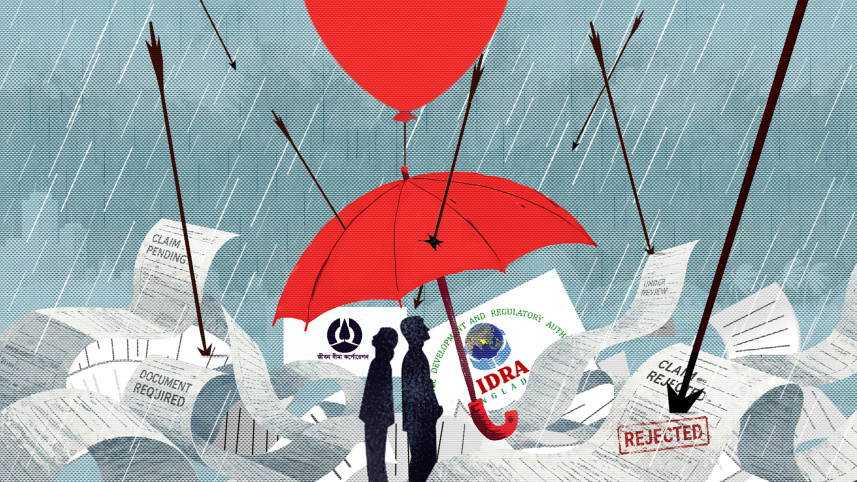
What happens to the farmer who loses his crop to a tidal surge? To the garment manufacturer whose shop burns down? To the widow who comes to collect on her late husband’s matured life insurance policy? Too often, the answer is nothing. Files move. A surveyor visits. More documents are demanded. Months turn into years, but the insurance money remains elusive. This is often how the country’s insurance industry operates these days.
My research has examined how takaful or cooperative Islamic insurance can serve as an ethical alternative to conventional insurance, ranging from foundational work on takaful business models to reviews of the global takaful literature and the analyses of comparative performance of Islamic and conventional insurers during the Covid pandemic. The gap between what the insurance sector in Bangladesh promises and what it delivers is impossible to ignore.

The country’s insurance penetration—the share of insurance premiums collected by insurance companies to GDP—sits at 0.5 percent of GDP (2024 World Bank data), the lowest in Asia. India’s was nearly four percent in 2024; in 2022, Malaysia’s insurance penetration was five percent and Singapore’s 9.2 percent.
The bigger scandal is what happens when the insured tries to make a claim. In the October-December 2025 quarter, general insurers settled only 9.37 percent of total claims, i.e. Tk 372 crore out of Tk 3,971 crore filed. The state-owned Sadharan Bima Corporation paid 3.41 percent. Meanwhile, several large private insurers’ percentage of claim settlement was much lower than the percentage of dividend payout. Life insurance is no better. Approximately 12 lakh policyholders are still waiting for payouts, with unsettled claims of Tk 4,403 crore by the end of 2025. The settlement rate fell from 85 percent in 2020 to 66 percent in 2025, against a global benchmark of 97-98 percent.
At Fareast Islami Life Insurance, the Insurance Development and Regulatory Authority (Idra) commissioned an audit in 2021 and found Tk 2,367 crore embezzled, much of it through inflated land purchases. The firm paid only six percent of outstanding claims, leaving 5.66 lakh people waiting on Tk 3,228 crore. Fareast’s case should haunt anyone who believes the words “Islami insurance” or “takaful” alone confer ethical legitimacy. They do not.
When a World Bank-supported project worth Tk 925 crore, aiming to expand the number of insured Bangladeshis from 1.36 crore to two crore, saw the figure fall to 82.2 lakh by the end of 2024 instead, it does not point to an underdeveloped sector but one that is shedding trust.
Insurance is not discretionary spending. In an economy exposed to climate shocks, road accidents, fires, and health crises, insurance is the difference between a household setback and intergenerational poverty. PwC, an international consulting firm, notes that nine percent of Bangladeshi families face catastrophic healthcare costs and seven percent sell assets to pay medical bills. Health insurance is virtually non-existent. Our population of over 60 years of age will more than quadruple by 2050. No country with that demographic profile can sustain an industry that settles less than 10 percent of the claims.
Takaful operates on different principles. Members contribute to a shared tabarru’ fund through mutual donations. The operator acts as wakala (manager), mudaraba (profit-sharing partner), or hybrid. The contract prohibits riba (interest), gharar (excessive uncertainty), and maysir (gambling). In our 2007 paper, my co-authors and I identified the Shariah concerns competent operators must resolve: the segregation of participant funds from shareholder funds.
Since approximately 90 percent of Bangladeshis are Muslim, the cultural fit is obvious. So is the untapped potential. The global takaful market reached $51.69 billion in 2024 and is projected to grow at a 15.1 percent compound annual growth rate through 2032, while Bangladesh—alongside Pakistan, Nigeria and Egypt—remains embryonic. UNDP notes that the top five Muslim-majority countries hold roughly one billion people, but under two percent of insurance access.
But takaful is not a magic word. My research, mentioned earlier, reveals that Islamic insurers experienced a greater performance reduction during Covid than their conventional counterparts due to weaker liquidity buffers and a narrower investment universe. The lesson is not that takaful is inferior in principle; rather, under-capitalised, weakly governed takaful operators are no more resilient than weak conventional operators.
Most takaful operators in Bangladesh do not properly segregate participant and shareholder funds. Investment options remain narrow, dominated by Mudaraba Term Deposits with limited use of sukuk. The Insurance Act, 2010 makes no real distinction between conventional and Islamic insurance—a problem researchers have flagged for nearly a decade.
What’s needed is a four-pillar framework. First, enforce the basics. The 90-day claim settlement deadline must carry consequences. Idra should publish a quarterly claims dashboard, and dividend payouts by insurers below a defined settlement threshold should require regulatory approval for both conventional and Islamic insurers.
Second, empower Idra with the legal authority the Bangladesh Bank enjoys, including board restructuring powers, real-time transaction monitoring, and appropriate and proper licence revocation. The Insurer Resolution Ordinance, 2025 should be passed without delay. Drawing on my work on Islamic deposit insurance (Sabah & Hassan, 2019), the country could also design a kafalah-based policyholder protection fund for takaful participants.
Third, follow Malaysia, Pakistan and Indonesia in enacting separate takaful regulation, with mandatory fund segregation, Shariah governance aligned with the Accounting and Auditing Organization for Islamic Financial Institutions (AAOIFI) and the Islamic Financial Services Board (IFSB), and a clear sukuk-based investment universe.
Fourth, fix demand. Bangladesh needs compulsory third-party motor insurance with real enforcement, mandatory fire and earthquake coverage for industrial buildings, weather index-based agricultural insurance, and a national health insurance pilot. Bancassurance—strategic partnership between banks and insurance companies—should be expanded. Islamic banks, which command roughly a quarter of banking assets, are a natural channel for micro-takaful bundled with Islamic microfinance.
Insurance is a promise. Conventional insurance requires belief in actuarial tables and corporate solvency. Takaful demands belief in mutual obligation and Shariah-compliant stewardship. Both work only when honoured. The widow waiting on her matured policy, or the manufacturer waiting on his fire claims, does not care whether the contract was wakala or not. They care whether someone pays. Therefore, start by paying claims, then build a reliable system—conventional and takaful, side by side—so Bangladeshis can start believing that insurance actually insures.
Dr M Kabir Hassan is professor of finance and Moffett chair at the University of New Orleans in the US, and the 2016 Islamic Development Bank Prize laureate in Islamic banking and finance.
Views expressed in this article are the author's own.
Follow The Daily Star Opinion on Facebook for the latest opinions, commentaries, and analyses by experts and professionals. To contribute your article or letter to The Daily Star Opinion, see our guidelines for submission.
 For all latest news, follow The Daily Star's Google News channel.
Comments