


Has our ADP governance gone backwards?

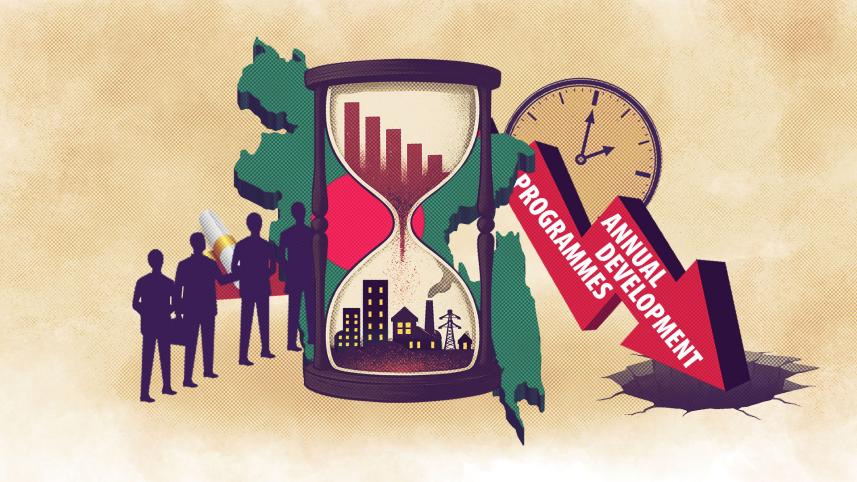
Fifteen months have passed since the interim government assumed office, bringing celebrated development thinkers and outspoken reformers into the cabinet. Their inclusion raised hopes among citizens and development activists that the long-standing weaknesses of the annual development programmes (ADPs), the central mechanism through which the nation's development agenda is operationalised, would finally be addressed or at least meaningfully initiated. The absence of party-driven pressures and the strong record of many advisers in advocating for efficient public spending further amplified these expectations. As the tenure of this interim administration draws to a close, a pressing question emerges. Have these vibrant reformers strengthened the ADPs in any meaningful way, or have they simply allowed long-standing failures to continue under a new banner?
In this context of heightened public expectation, it is important to recall how the ADP evolved under the previous government. During their sixteen years in office, the allocation expanded dramatically, rising from Tk 25,600 crore in fiscal year (FY) 2009 to ten times that size at Tk 2,63,000 crore in FY24, a scale that signalled the country's steady economic progress. Implementation performance was also notable, reaching a high of 94.66 percent in FY19 and falling to 80.18 percent in FY20, a year heavily affected by the Covid-19 disruption. This period contributed to broader gains in growth and development, and the World Bank recognised Bangladesh as one of the fastest-growing economies in the world. At the same time, the government also faced legitimate criticisms about faulty feasibility studies, last-minute spending surges and governance gaps that often undermined project quality.

Given this trajectory, the interim government entered office with ample scope to strengthen the ADPs and address longstanding weaknesses in development management. It inherited the ADPs for FY25 and revised the fund to Tk 2,26,125 crore after an 18 percent cut, and it also designed a fresh ADP of Tk 2,30,000 crore for FY26. Yet, these opportunities did not translate into meaningful progress. ADP implementation fell to a historic low of 67.85 percent in FY25 and reached only eight percent in the first four months of FY25-26. In this backdrop, it becomes essential to review recent patterns of development spending and determine how far the interim government has delivered in the priority sectors of health, education and power and energy, given their central role in socio-economic development.

A closer look at the health sector presents one of the clearest illustrations of the interim government's shortcomings. In FY25, the sector's allocation was cut by 50 percent from the original budget despite being classified as a priority area, and by year's end, the Health Services Division delivered an implementation rate of only 21.74 percent, among the lowest of all ministries. Early FY26 indications show the situation deteriorating further. In the first quarter, the Medical Education and Family Welfare Division spent just 0.003 percent of its Tk 4,809 crore allocation, while the Health Services Division managed to spend only 1.13 percent of its Tk 7,484 crore allocation. These trends reveal a sector where financial cuts, administrative inertia and weak coordination came together to halt progress, leaving essential projects without direction and the broader health system without the capacity to respond to national needs.
Turning to education, the sector has consistently been allocated around 11-12 percent of the total ADP, well below the Unesco recommendation of 15-20 percent of total public expenditure. Yet, even with a steady share, utilisation has weakened over time, with spending declining from 102 percent in FY10 to 79 percent in FY24. Under the interim administration, the situation has worsened. In FY25, education began with 11.36 percent of the total ADP, but the revised allocation imposed a sharp 34 percent cut. For FY26, the education ADP stands at about 12.1 percent of the total, still below the global standard and insufficient for meaningful reforms. Implementation has been weak as well. In FY25, the Ministry of Primary and Mass Education spent only 58 percent of its development allocation, placing it among the five lowest-performing ministries. In the first quarter of FY26, spending reached only 4.25 percent for primary and mass education and only 6.52 percent for secondary and higher education. Taken together, these figures expose a sector where investment levels remain inadequate and administrative capacity remains limited, resulting in a widening gap between policy ambition and actual learning outcomes.
When the interim government took office, the power and energy sector already held a central place in the national development agenda, with ADP allocations supporting major gains, including universal household electrification. The sector has also demonstrated strong execution with the Power Division implementing 101 percent of its revised fund in FY24, an exceptional outcome in public investment. During the interim period, however, the sector has clearly lost momentum. Although allocations remain substantial, project delivery has slowed, and strategic reform has stalled. In FY25, the Energy and Mineral Resources Division recorded 85.95 percent implementation, a respectable figure but significantly lower than earlier performance. The spending pattern has also shifted. Allocation for power generation projects fell by six percent from the previous year's revised ADP, while transmission and distribution claimed larger shares. Analysts warn that this shift again prioritises visible infrastructure over deeper issues such as subsidy pressure, fuel cost volatility and persistent system losses. In effect, the interim government has maintained large budgets but failed to set a coherent reform plan, leaving the sector without measurable gains in efficiency, financial stability or service quality.
Across these sectors, the evidence shows that development governance has not only weakened under the interim government but has moved in reverse, falling far short of the public expectations it sought to embody. Instead of strengthening the foundations of the development system, it has overseen collapsing implementation, drifting priorities and a clear distance between stated intentions and actual outcomes. What began with the hope that experienced reformers would correct long-standing weaknesses has ended with a development machinery more fragile, uncertain, and less capable than the one they inherited, raising serious questions about the cost of this transitional period for the country's development trajectory.
Muhammad Muktadirul Islam Khan is country researcher and head of consultants at Sustainability Action Learning Lab. He can be reached at muktadirr@hotmail.com.
Views expressed in this article are the author's own.
Follow The Daily Star Opinion on Facebook for the latest opinions, commentaries, and analyses by experts and professionals. To contribute your article or letter to The Daily Star Opinion, see our guidelines for submission.
 For all latest news, follow The Daily Star's Google News channel.
Comments