


The strong case for staying and building in Bangladesh

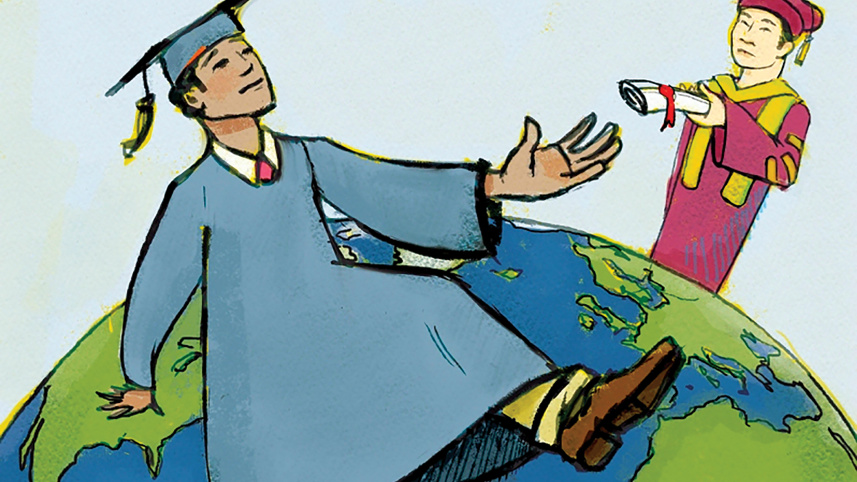
For a long time, success in Bangladesh came with a passport stamp, and the highest form of validation was going abroad, either to study or to work, and to finally make it. Staying back was often framed as a compromise, a temporary stop, or worse, a failure of ambition. Families celebrated visas as victories, and the idea that the brightest minds would leave was accepted as inevitable.
But that definition of success is quietly, decisively changing.
 For all latest news, follow The Daily Star's Google News channel.
 For many people of our generation, success no longer automatically points outward. Increasingly, it points inward, towards building something that matters here. This shift is not driven by nostalgia or romantic attachment to place. It is shaped by exposure, calculation, and lived experience. A generation that grew up globally connected understands both the possibilities and the limits of “elsewhere”. Many are concluding that meaning, agency, and impact are not guaranteed by geography alone.
We grew up watching the world in real time. We studied global case studies, followed international movements, worked across borders, and learned from people we might never meet. Instead of motivating us to leave home, that exposure made us more aware of what was missing here, and more interested in fixing it. We no longer romanticise elsewhere the way earlier generations did. We understand that every place has its struggles. The difference is that here, the problems feel personal. Solving them feels consequential.
What has emerged is a form of homegrown confidence. Young people are starting companies because they see gaps no one else is addressing. They are choosing careers that allow them to contribute locally while remaining globally relevant. They are redefining success as impact, continuity, and ownership, rather than distance. This confidence is not loud, but it shows up in choices: in the decision to return after studying abroad; in the choice to turn down a safer job for a riskier idea; in the insistence that staying does not mean settling. These choices are reshaping how Bangladesh appears, not just to the world, but to itself.
However, there is also a deeper emotional shift at play. This generation has lived with uncertainty as a constant. For them, economic volatility, political unrest, climate disasters, and institutional fatigue are not abstract concepts but lived realities. And yet, instead of producing only cynicism, they have fostered a strange kind of ownership. When systems fail, young people organise. When crises hit, they respond. When something breaks, they try to rebuild it.

Illustration: Zarif Faiaz
This instinct to take responsibility, even without authority, has begun to shape how people think about their careers. Work has become less about survival and more about relevance. Many young Bangladeshis want to see the effects of what they do, to know that their skills are contributing to something tangible. This desire has fuelled a rise in social enterprises, creative industries, grassroots initiatives, and locally grounded businesses. The goal is not to replicate what exists elsewhere, but to adapt ideas to local realities.
This matters because countries that become future hubs for builders, thinkers, and creatives are defined by how many choose to stay and shape. Bangladesh is beginning to show early signs of this shift. It is evident in the way young professionals talk about their work, in the way students think about their futures, and in the growing refusal to accept that meaningful work can only exist beyond our borders.
Crucially, this confidence does not reject the world. It engages with it differently. Young Bangladeshis today are deeply global in outlook even when they are physically local. They collaborate across time zones, learn continuously, benchmark themselves against international standards, and remain intensely curious about what is happening elsewhere. The difference is that they no longer see global exposure as a one-way exit. They see it as a resource they can bring back, apply, and build upon.
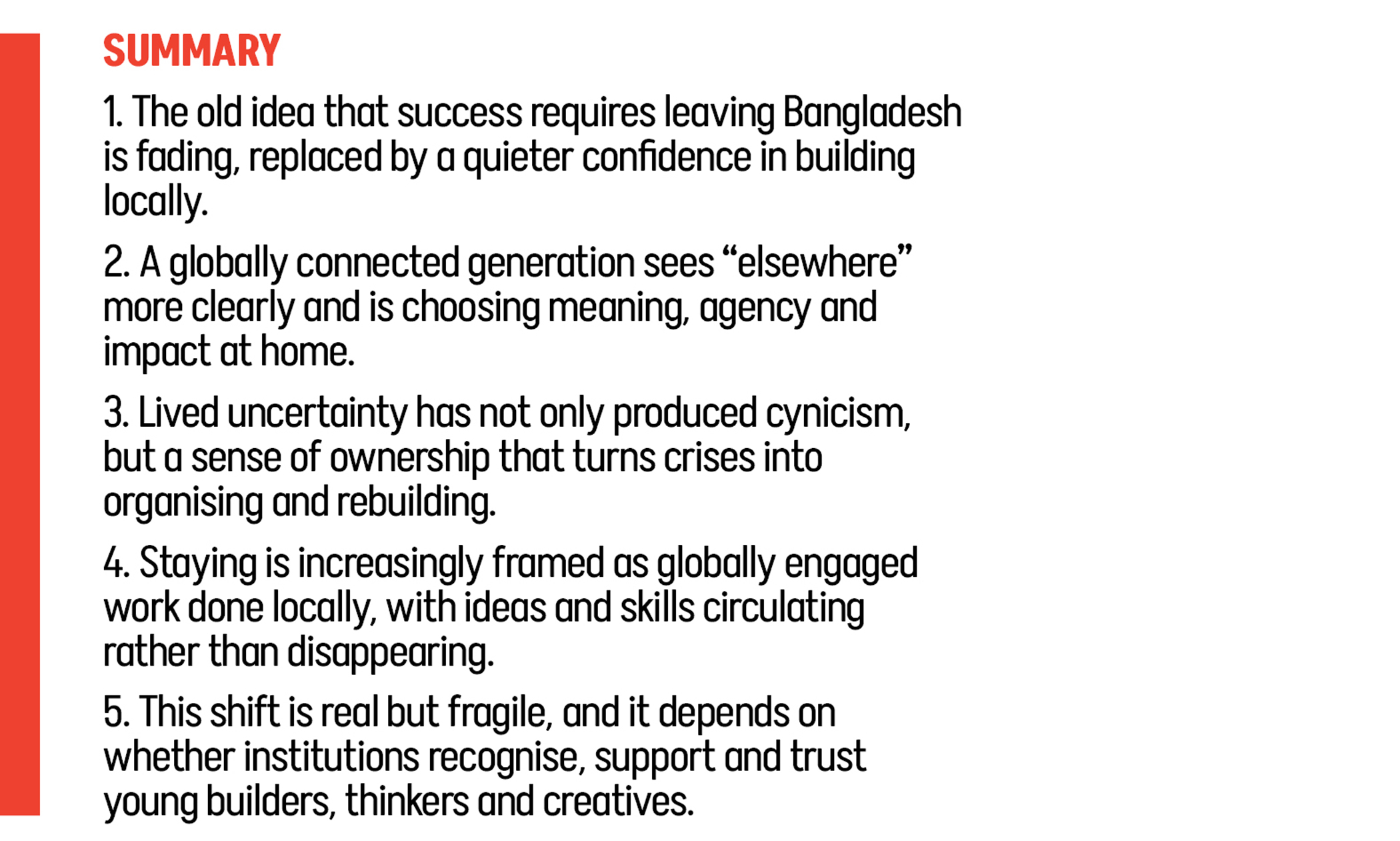
That creates a powerful dynamic. Instead of losing talent permanently, Bangladesh benefits from circulation: ideas flow in, skills are adapted, and global perspectives are localised. There is also an emerging redefinition of ambition. Earlier generations often had to choose between stability and significance. Today’s young people are trying to refuse that trade-off. They want careers that are sustainable but also meaningful. They want to grow without disconnecting from their communities. They want to succeed without disappearing.
Of course, this shift is neither uniform nor guaranteed. Structural challenges remain significant. Opportunities are unevenly distributed.
Institutions often move slower than the people they are meant to serve. Many still feel compelled to leave, and for valid reasons. But what has changed is the collective mindset around these challenges. They are no longer seen as final verdicts on what is possible. They are treated as constraints to navigate, systems to push against, realities to improve incrementally.
We need to acknowledge this transformative mindset. It replaces resignation with experimentation. It turns frustration into momentum. It allows young people to imagine futures that do not require erasing where they come from. Slowly, it begins to reshape the country’s global identity, not as a place people escape from, but as a place people build from.
Bangladesh’s place in the world of the future will be shaped by whether this emerging confidence is recognised, supported and trusted: whether young builders are given room to try and fail without being dismissed; whether thinkers are invited into conversations that shape the future rather than spoken about after decisions are made; whether creatives are valued as contributors, not distractions.
What is most striking is that this transformation is happening without spectacle. It is unfolding in classrooms, co-working spaces, neighbourhood offices, and late-night conversations about ideas that may or may not work. It is happening when someone chooses to invest their energy locally, not because it is easier, but because it feels meaningful. It is happening in small acts of belief, repeated often enough to become momentum.
There is also dignity embedded in this choice. When people decide to stay and build, they assert that their country is worth their best effort, not just their leftover energy. They refuse the idea that value must be validated elsewhere. For the first time in a long while, many young Bangladeshis are not asking, “How do I get out?” They are asking, “What can I do here?”
That question carries confidence. It suggests that staying is no longer synonymous with stagnation, and that ambition no longer has to be exported to be fulfilled. It reflects a growing belief that Bangladesh is not just a place to survive until departure, but a place where futures can be actively shaped. It carries responsibility. It carries the possibility of a nation that is not just keeping up with transformation, but shaping its own place in the world of the future. And it begins with the question that is finally facing inward: what can we build here, together?
Maisha Islam Monamee is a graduate from Institute of Business Administration, University of Dhaka, and currently works at Unilever.
Comments