


Can tourist visa resumption mend our bilateral ties with India?

Dinesh Trivedi did not have an easy entry into Bangladesh’s public consciousness. Shortly after arriving in the country as India’s new high commissioner on June 12, he was asked about the push-in crisis and the possibility of lifting restrictions on travel and trade. His answer was not what Bangladesh was waiting to hear. “India and Bangladesh share the same sky, the same air, the same pain,” said Trivedi, the first politician to serve as India’s high commissioner to Bangladesh. “I do not feel as though I have come to Bangladesh. Whatever is good for the 1.4 billion people of India and the 200 million people of Bangladesh—for these 1.6 billion people—is what will be done. We will take those steps in the future that are beneficial for both countries.”
The sentiment was warm, even poetic. After all, it was an almost direct reference to Bhupen Hazarika’s iconic song “Ganga Amar Maa, Padma Amar Maa.” The response it provoked, however, was anything but desirable.

In Bangladesh, where questions of national sovereignty carry a particular sensitivity—shaped by the memory of 1971, and enduring anxieties about how the country is perceived and treated by its vastly larger neighbour—the remark was met with immediate suspicion. To many, it sounded like an echo of the “Akhand Bharat” sensibility that occasionally surfaces in BJP-aligned rhetoric. Whether Trivedi, who joined BJP in 2021 from Trinamool Congress, intended such a reading is beside the point. In diplomacy, perception often matters as much as intent.
But Trivedi followed that inauspicious opening with a move many perceive as positive.
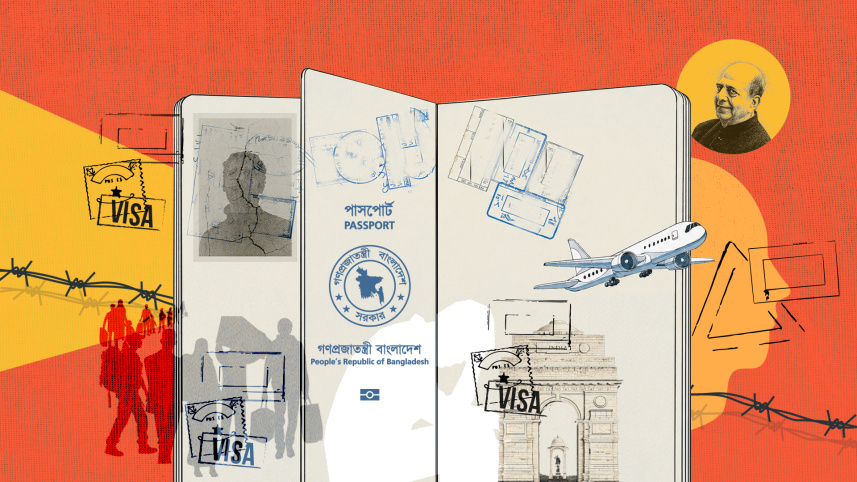
Hours after presenting his credentials to President Mohammed Shahabuddin on Thursday, Trivedi announced that tourist visa services—processed across five centres in Dhaka, Rajshahi, Chittagong, Sylhet, and Khulna—would resume from tomorrow.
Bangladesh-India relations have needed such a reset for some time. Since August 2024, when India suspended tourist visa services in the wake of the July Mass Uprising that ousted Sheikh Hasina’s government, the bilateral relationship drifted under the weight of accumulated grievances on both sides. Anti-India sentiment surged across Bangladesh, fed by factors including, but not limited to, border killings and push-ins, misinformation in sections of the Indian media, and New Delhi’s decision to shelter Hasina and a string of Awami League leaders.
So, the announcement of visa resumption is a welcome initiative on India’s part.
But what it sidesteps is the reality on the ground. Even as Trivedi was announcing the reopening, the border remained a site of active hostility. According to West Bengal Chief Minister Suvendu Adhikari, approximately 10,000 people have been forcibly pushed into Bangladesh since May, with 1,800 more detained in Indian holding centres awaiting deportation. However, Bangladesh’s official tally of receiving alleged “illegal migrants” from India is much lower. Daily reports show India's Border Security Force (BSF) attempting to push people across the border while the Border Guard Bangladesh foils these operations, making the frontier a virtual war zone.
Besides, anti-Bangladesh rhetoric continues to emanate from influential quarters in West Bengal and across India’s political discourse, which has real consequences. It shapes how ordinary Indians perceive Bangladeshis and creates a climate in which hostility—at immigration counters and in public spaces—may become culturally normalised, making the stay of Bangladeshis anywhere in India fraught with anxiety and insecurity.
To be sure, medical visas for Bangladeshis had already been available in a limited capacity. With the reopening of tourist visa services, Bangladeshis will once again have broader access to Indian hospitals and medical care that have historically been affordable and geographically proximate in ways that alternatives are not. India is also the first foreign destination for many middle-class Bangladeshis for holidays, wedding shopping, business trips, educational purposes, religious pilgrimages, and visits to relatives in West Bengal as well as Assam, Tripura, and Meghalaya.
The numbers before the suspension were significant: between April 2023 and March 2024, more than 2.1 million Bangladeshis visited India—accounting for over 20 percent of all foreign tourist arrivals in the country. After the suspension, that figure fell to roughly 470,000 by 2025. Bangladesh once accounted for 70 to 75 percent of all medical visas issued by India annually. After 2024, Bangladeshis opted for alternatives such as China, Thailand, and Singapore.
Yet, the restoration of tourist visa services does not automatically restore a welcoming environment for Bangladeshi visitors. If hostility towards Bangladeshis in India persists, especially in West Bengal, the resumption risks becoming little more than a formality. Also, reopening the service at five centres is a partial restoration, not a full one. Trivedi has acknowledged that expansion is planned, but plans must be followed by pace. A reopening that produces long queues and scarce appointments will not sustain the goodwill the announcement has generated.
More critically, the tourist visa alone cannot carry the full weight of a relationship that needs repair in several registers: Trivedi’s evasiveness on the push-in question in his very first public remarks in Bangladesh and deflecting it with a lyrical non-answer is precisely the pattern Bangladesh has grown weary of. BSF firing on unarmed Bangladeshi civilians also remains the deepest wound in this relationship. No amount of visa liberalisation can substitute for accountability on this question.
The Teesta water-sharing agreement too is unresolved after decades. Hasina’s continued presence in India, as well as the pro-Awami League narrative being generated in Indian mainstream media—including an “opinion piece” by Hasina on The Print on June 23, which two days later was reprinted by The Indian Express—also cast a shadow on the relationship.
What the tourist visa announcement offers, for now, is a shift in atmosphere—and atmospherics matter. Trivedi, who began with a phrase that unsettled more than it reassured, has at least demonstrated that he is capable of more than rhetoric. Bangladesh should receive that as a signal worth responding to, while remaining firm on demands that are legitimately its own, whether the demand is for accountability on border violence or for greater equity in the management of shared rivers.
Whether this recovery marks the beginning of a genuine change in direction remains to be seen. The harder questions in the Bangladesh-India relationship have not gone away, and the real test will be whether they are met with the same willingness to act that produced the visa decision, or whether, once again, they will be answered mainly with song lyrics that, in today’s age, seem less like poetry than rhetoric.
Jannatul Naym Pieal is a writer, researcher, and journalist. He can be reached at jn.pieal@gmail.com.
Views expressed in this article are the author's own.
Follow The Daily Star Opinion on Facebook for the latest opinions, commentaries, and analyses by experts and professionals. To contribute your article or letter to The Daily Star Opinion, see our guidelines for submission.
 For all latest news, follow The Daily Star's Google News channel.
Comments