


Young voters want credible pledges
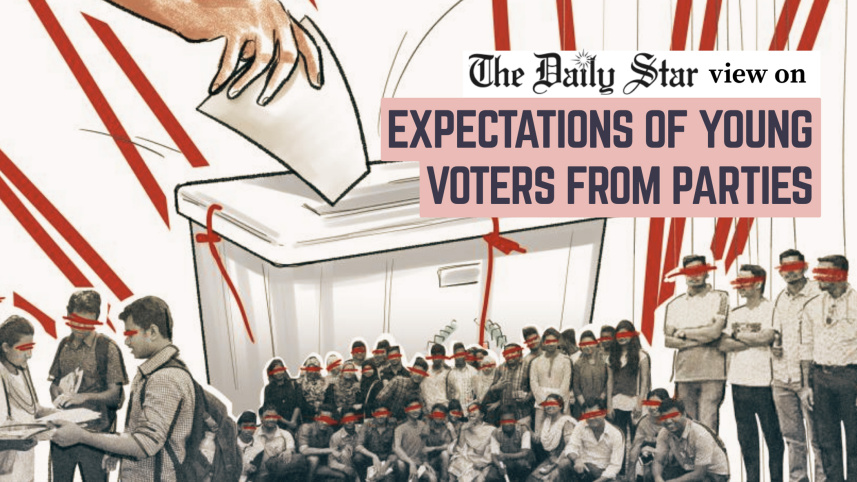
Many have their hopes pinned on the 13th parliamentary election scheduled to be held on February 12. It is a moment Bangladeshis have long been waiting for after three largely questionable and non-participatory elections held under the Awami League government. So, while the interim government and participating political parties must ensure that voters can exercise their rights enthusiastically, without fear or coercion, it is equally important to listen to the concerns and aspirations of voters, particularly the younger ones aged between 18 and 35 who are defined as youth under the National Youth Policy 2017.
Many in this age group will be exercising their right to franchise for the first time. Given the role of young people in the 2024 mass uprising, it is only natural to expect that they will be influencing Bangladesh’s post-election trajectory as well. Furthermore, their votes carry significant weight as they account about 40 percent of the total electorate based on Election Commission data. Therefore, the old way of doing electoral politics—simply dumping empty promises into manifestos—is unlikely to work with this increasingly vocal voter population. They are looking for credible, time-bound commitments from political parties.

While talking to this daily, several voters from this age group have placed safety—including an end to mob violence—at the top of their list of demands. They also want manifestos to clearly state political parties’ commitment to making the justice system impartial and accountable, ensuring law enforcement agencies are free of political interference, and guaranteeing the security of minority communities. People’s freedom to express opposing views without fear is also important to many. Other priorities include jobs, fair recruitment, digital education, better curricula, good governance in the health sector, and closing the “digital divide” in madrasa education. These voters also want the next government to rely more on domestic assets and reduce dependence on imports. Most importantly, they expect the next government to maintain zero tolerance for corruption and all forms of injustice.
As Bangladesh once again transitions into a democratic process, political parties—both those forming the government and those to be in opposition—must remember that these are not mere aspirations. While voters can decide parties’ fates through their ballots, this generation also retains the power to hold them accountable, as was evident in July-August 2024. Moreover, they are living in a time of high geopolitical tensions and an unstable global economy. Therefore, it is even more crucial for young people to trust that they can build their future in this country. To do so, they need to first trust political governments to carry out reforms and take initiatives that align with their aspirations and priorities.
That is why political parties, old and new, must move beyond the outdated practice of treating their manifestos as mere promotional leaflets. Instead, they should regard them as binding commitments to fulfil their promises.
 For all latest news, follow The Daily Star's Google News channel.
Comments