


Why are there so few women candidates?
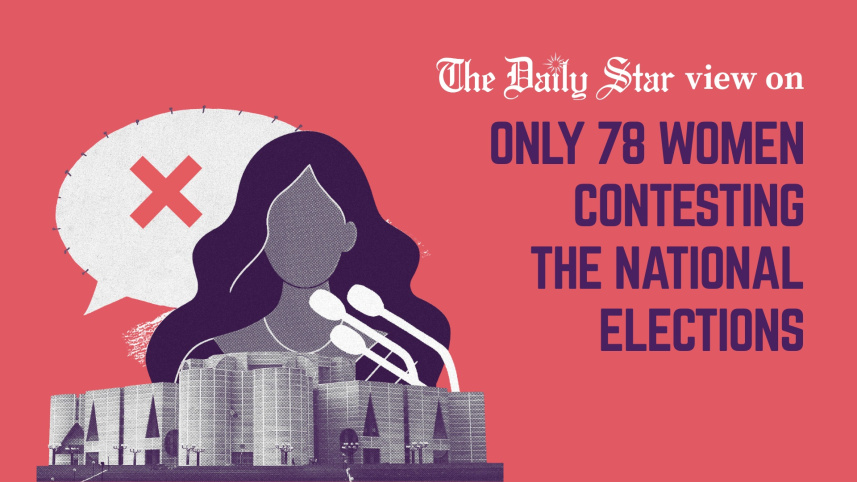
The number of women contesting the upcoming parliamentary elections starkly exposes the persistent under-representation of women in Bangladesh’s politics. Of the 1,981 candidates competing in the polls, only 78 are women. This glaring imbalance reflects the deep-rooted chauvinism and discrimination faced by women with political ambition. Moreover, nearly a third of nominated women candidates are wives, daughters, or relatives of influential men, indicating how difficult it is for women to participate in politics independently and on their own merit.
This reality is particularly troubling in a country where women constitute half the population yet make up less than four percent of electoral candidates. Of the 78 women, only 17 are independents. As an analysis of Election Commission data by The Daily Star shows, around 30 parties have not nominated a single woman candidate. Two-thirds of parliamentary seats have no female contenders at all, and women with familial or marital ties to powerful political figures are far more likely to succeed than those without such connections. Thus, women are still not regarded as serious contenders.

The exclusion of women is especially disheartening given their central role in the 2024 uprising, where women mobilised, organised, and took significant risks alongside men. Yet, their participation has not translated into greater political representation. Instead, women have increasingly been pushed out of public and political spaces, both overtly through exclusion and more insidiously by intimidation. Anti-women rhetoric has intensified both online and offline in recent times, sometimes driven by religion-based political groups seeking to silence women’s voices. Even the few women who have dared to contest elections have faced coordinated online attacks.
Existing legal frameworks have done little to address the prevailing imbalance. The Representation of the People Order, 1972 requires political parties to reserve at least 33 percent of committee posts for women, including at the central level. Yet, most parties have failed to comply with this provision. Even one of the country’s largest and oldest parties, the BNP, has nominated fewer than ten women, while Jamaat-e-Islami has fielded none. Electoral politics in Bangladesh—shaped by money, patronage, and muscle power—systematically disadvantages women as parties, focused solely on winning seats, continue to prioritise male candidates. Women nominees are often expected to rely on the backing of fathers, husbands, or brothers.
Even the proposal by the Women’s Affairs Reform Commission to increase the number of reserved seats to 100 with direct elections was not accepted by political parties. With no women representatives included in the July Charter consensus discussions, it was unsurprising that reserved seats were kept at only 50, with no provision for direct elections.
If we are serious about democratic reform, women’s presence in parliament and political leadership must be substantially increased. A democracy cannot claim legitimacy when half its population remains so poorly represented. Political parties must move beyond tokenism and actively invest in developing women leaders, ensuring they have equal opportunities to compete, win, and shape the country’s future.
 For all latest news, follow The Daily Star's Google News channel.
Comments