


Stop landfill fires, open waste burning
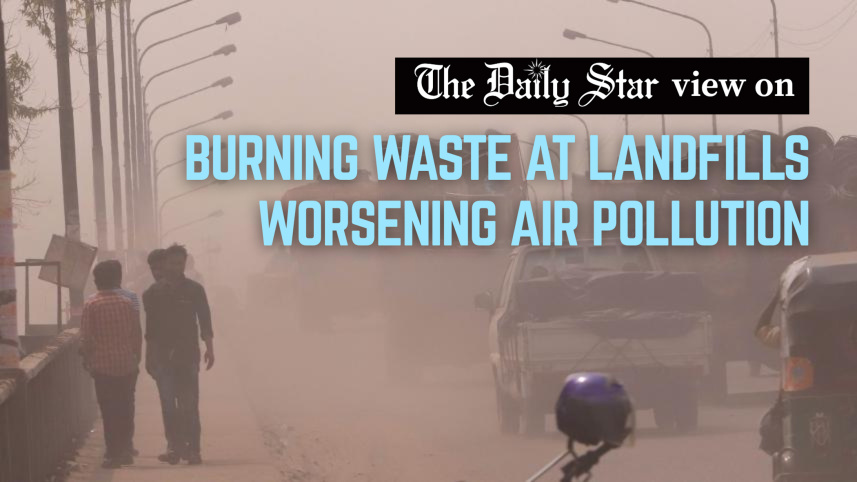
It is alarming that smoke from burning garbage at the Matuail and Amin Bazar landfills frequently blankets Dhaka’s skies, worsening the capital’s already severe air pollution. The city regularly ranks among the most polluted in the world, with the average Air Quality Index (AQI) hovering around 200 and occasionally exceeding 600. On the AQI scale, any value above 300 is considered “hazardous,” and Savar recorded an AQI of 640 on March 4. These numbers reveal how air pollution has worsened over the years in the absence of proper planning and effective action by successive governments.
At the Matuail landfill—where waste has accumulated for decades—towering mounds of garbage, reaching 50 to 80 feet high at many points, frequently catch fire. According to officials, methane gas trapped within layers of waste often triggers spontaneous fires, sending thick plumes of smoke up into the air. These fires can burn for long periods unless fire service units intervene. The site reportedly emits thousands of kilogrammes of methane every hour. Moreover, along highways going out of Dhaka, waste collectors and traders frequently burn rubbish (especially polythene), releasing large amounts of toxic pollutants. Emissions from brick kilns and older vehicles, along with dust from construction, further worsen air quality.
 For all latest news, follow The Daily Star's Google News channel.
 Last August, the government declared Savar a “degraded airshed,” ordered the closure of 106 brick kilns, and also banned open waste burning. However, several brick kilns have reportedly resumed operations after securing court orders to do so, while open waste burning continues. Meanwhile, in January this year, Dhaka’s average PM2.5 concentration rose to 193 microgrammes per cubic metre, which is 38 times higher than the WHO’s recommended limit of five microgrammes.
The consequences of such unchecked pollution are devastating. The National Institute of Diseases of the Chest and Hospital, the country’s premier respiratory treatment centre, reportedly remains packed with patients suffering from respiratory illnesses including breathing difficulties, asthma, and chronic obstructive pulmonary disease (COPD). Hospital data show that the number of patients has been rising steadily in recent years, reaching around 195,000 last year alone. Doctors attribute this surge largely to worsening air pollution.
The situation demands urgent action from the relevant government authorities. They must ensure proper management of landfills, prevent fires by using modern waste treatment technologies, and strictly enforce the ban on open waste burning. At the same time, stronger measures are needed against polluting brick kilns, ageing vehicles, and uncontrolled construction dust. Without immediate and sustained intervention, Dhaka’s air pollution will only worsen and continue to threaten the health and wellbeing of its residents.
Comments