


Family Card launch signals a positive start
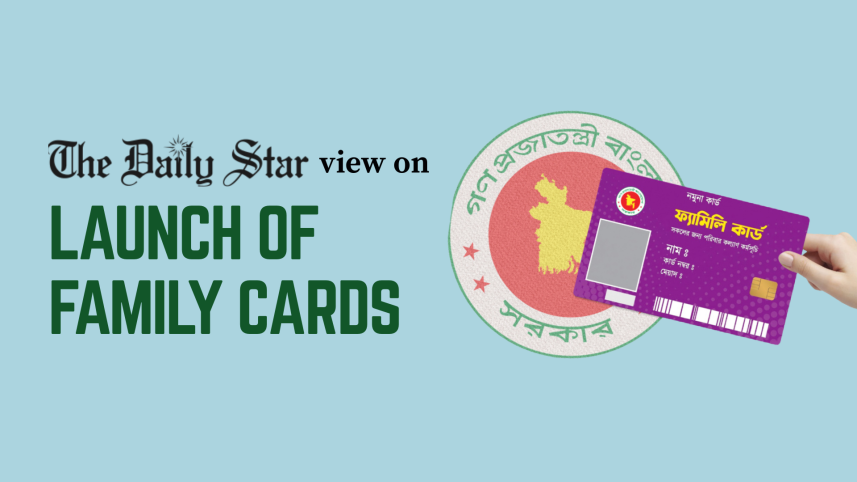
We laud the pilot launch of the BNP government’s promised Family Card programme within less than a month of assuming office, even before the first session of parliament. During the first phase of the pilot between March and June this year, 37,567 women-headed households in 14 upazilas across the country, including several urban slums, will receive Tk 2,500 in their bank accounts or mobile wallets. A part of BNP’s election manifesto, this initiative aims to gradually bring two crore families under the social safety net programme and turn the card into a universal social identity instrument by 2030, with a plan to allocate three percent of GDP for social security by 2028. So far, the launch of the pilot phase—from household selection to data verification—has been positive, without any major complaints. However, the government must be vigilant about partisan influence and scammers that could undermine this initiative.
This daily has found at least 31 Facebook pages and groups that are phishing for users’ personal data by using deepfake videos of the prime minister and his family members in which they appear to offer Family Cards or cash rewards. What is concerning is that some of these videos have been shared many times, and social media users have left their bKash numbers and even addresses in the comment sections of some of these videos. Not all are harvesting personal data, however; some pages are uploading and sharing these deepfake videos only to increase followers rapidly and subsequently sell their pages, as revealed by fact-checking organisation Dismislab. Whatever the case may be, cybercrime units must identify these pages and take necessary action before more people fall prey to these scammers. At the same time, the government must run countrywide awareness campaigns to educate people about the selection and cash disbursement process under Family Cards, and make them aware of social media scams.

As for partisan influence, we have seen in the past how such influences led to huge inclusion and exclusion errors in social safety net programmes. That is why experts suggest incorporating a strong grievance and appeals mechanism as well as routine recertification into the Family Card programme. Also, a single dynamic registry used across ministries can mitigate the problem of “double-dipping.” The government should also be cautious about merging all social safety net programmes as the Family Card may not necessarily fulfil the goals of some specific programmes.
While targeting women-headed households at the pilot phase has been a good decision, once the fully fledged programme is launched, the government should allow for more flexibility and also take into account gender diversity in the selection process. Above all, the BNP leadership must remain steadfast about the proper functioning of this initiative and not allow corruption to seep into this programme, like we have seen in the past.
 For all latest news, follow The Daily Star's Google News channel.
Comments