


‘She does not talk, but at least she’s alive’

For five years, three children waited for news of their mother. They waited for a phone call that never came and eventually came to believe she was dead.
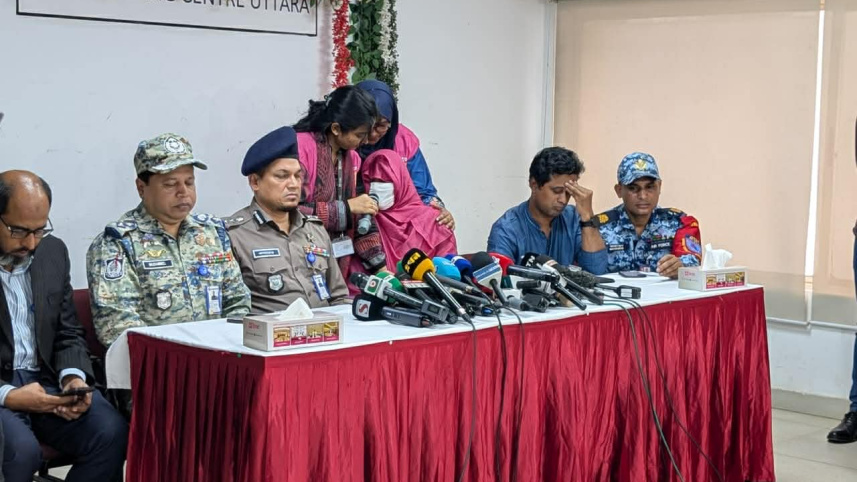
When Rizia Begum finally stood before her family at Brac’s Migration Welfare Centre in Dhaka's Uttara today, there were no dramatic speeches -- only tears.

“She does not speak,” said her daughter, Liza Akter, struggling to hold back tears. “We thought she was no more. We had accepted that she might be dead.”
Rizia left Bangladesh in 2019 for Saudi Arabia through a local broker and a Dhaka-based recruiting agency. Like thousands of women every year, she went as a domestic worker, hoping to give her three children a better future.
But according to her family, the abuse began almost immediately.
“From the beginning, she was tortured by her employer,” Liza said. “We informed the broker and the agency many times. Nothing changed.”
After 2021, all communication stopped.
In 2023, the family filed a written complaint with the Bureau of Manpower Employment and Training. Still, there was no trace of her.
“We slowly prepared ourselves for the worst,” Liza said. “Years passed. We had no hope left.”
Found without identity
On February 12 at 4:45 pm, a Saudi Airlines flight landed at Hazrat Shahjalal International Airport. Among the passengers was a woman who could not say her name, could not say where she lived, and carried no documents.
Warrant Officer Mahbub Alam of Civil Aviation Security said, “Her physical and mental condition was unstable. She could not provide any address or family information. We immediately handed her over to Brac for safe shelter.”
For nearly two weeks, Brac tried to identify her. Her photos and details were shared with media outlets and on social media. Finally, the Police Bureau of Investigation collected her fingerprints and matched them with national ID records.
They confirmed she was Rizia Begum from Mamdannagar village in Barlekha, Moulvibazar.
When Brac workers reached her village, her family could hardly believe it.
“When we saw her, we could not recognise her,” Liza said. “The torture completely changed her… She doesn’t speak anymore...”
Another woman, another nightmare
At the same event, another Saudi returnee, introduced as Rima Akter (not her real name), shared her story in a trembling voice.
Rima lost her parents in childhood and grew up in an orphanage. Later, she worked as a domestic helper in Dhaka, got married, and had two children. When her husband abandoned her, she decided to go abroad in July 2024.
She said, she was sold four times after reaching Saudi Arabia.
“I was physically and sexually abused,” she said, struggling to continue. “At one point, I was handed over to the police. That’s when I learnt I was pregnant.”
 For all latest news, follow The Daily Star's Google News channel.
 Now six months pregnant, Rima was sent back to Dhaka on February 9.
Airport Armed Police transferred her to Brac for shelter and medical care.
A system without structure
Officials present at the programme admitted the challenges.
Enayet Hossain Mannan, additional DIG of PBI, said, “This is the first time PBI identified a distressed female migrant worker using fingerprint data. We will continue to stand beside victims and take action against trafficking networks.”
Shariful Hasan, associate director of Brac’s Migration Programme and Youth Platform, said the problem is deeply systemic.
“Women return mentally broken, abused, and sometimes pregnant. But there is no formal standard operating procedure at the airport to support them.
“The traffickers remain powerful. The victims return to uncertainty,” he said.
He called for a structured state mechanism at airports to immediately assist abused migrant workers. “These incidents deeply pain us. We cannot allow women to leave with hope and return in silence.”
The silence that remains
Back in Moulvibazar, three children are adjusting to a mother who has come home but not fully returned.
“She does not talk,” Liza said softly. “But at least she’s alive.”
For families like Rizia’s and Rima’s, survival itself has become the only relief, even when justice is still unattainable.
Comments