


Deal a ‘declaration of US defeat’
Iran called the deal it struck to end the Middle East war “a declaration of America’s defeat” yesterday, as the top US diplomat kicked off a tour of Gulf countries hit hardest by Tehran.
The war that began with a massive US-Israeli campaign of strikes against Iran on February 28 ended with the Islamic republic striking an agreement its leaders have sought to portray as a victory.

The US and Iran signed the agreement last week and launched a process aimed at reaching a permanent settlement -- with the Islamic republic’s leadership transformed but the system of rule firmly in place.
“The Islamabad understanding was not the result of pressure and coercion, but rather the result of the resistance and authority of the brave Iranian nation,” Iran’s top negotiator Mohammad Bagher Ghalibaf said yesterday of the deal, which was finalised through Pakistan’s mediation.
“That is why, the Islamabad Memorandum of Understanding became a declaration of America’s defeat,” he said, adding that security in the Middle East must be ensured by the countries of the region.
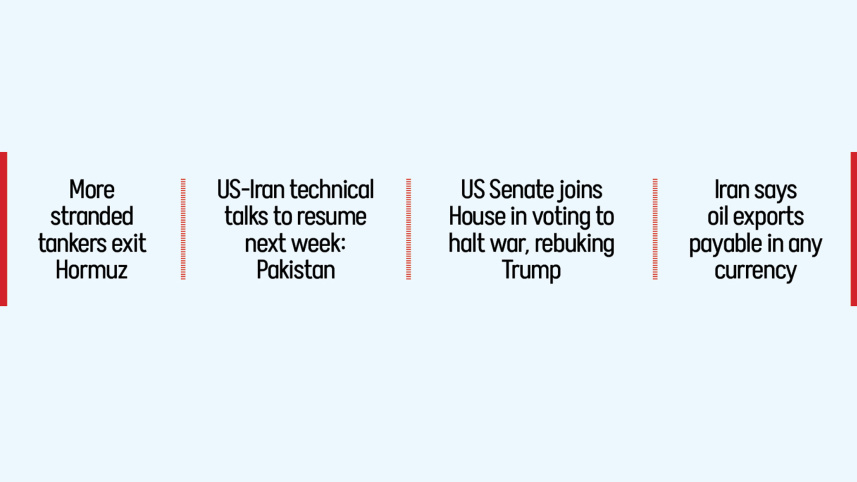
Meanwhile, the US Senate passed a largely symbolic resolution Tuesday calling for an end to President Donald Trump’s war with Iran, delivering a fresh rebuke to the White House as it tries to negotiate a lasting settlement with Tehran.
The US maintains several military bases across the Middle East, notably in the Gulf where US Secretary of State Marco Rubio kicked off a tour yesterday in a bid to reassure allies, reports AFP.
Rubio arrived in the United Arab Emirates on Tuesday and was scheduled to hold closed-door talks with its leader, Sheikh Mohamed bin Zayed, before flying to Kuwait and then Bahrain, where he will attend a Gulf Cooperation Council meeting.
Rubio said he intended to discuss the US-Iran memorandum of understanding with Gulf leaders, which does not address Iran’s missile programme and proxies -- two long-standing concerns for Gulf nations and Israel.
But Iran was defiant, appearing to insist that the Gulf nations might do better by aligning themselves with the Islamic republic instead of with the West.
“We see the future of the region not in confrontation but in interaction and not in elimination but in coexistence,” Ghalibaf said.
Iran’s chief negotiator also reiterated that peace in Lebanon, which was drawn into the war when Tehran-backed Hezbollah launched attacks on Israel, was a fundamental pillar of reaching a definitive agreement with the US.
Lebanon and Israel are discussing a US-backed proposal for Israeli forces to pull out of some of the territory invaded in the war with Hezbollah and hand it to Lebanese army control during talks in Washington, officials on both sides said.
But Israel’s Defence Minister Israel Katz said Israeli troops will not withdraw from southern Lebanon, highlighting the hurdle to peace talks.
Pakistan said yesterday that technical talks will resume next week. “I presume on Tuesday,” foreign ministry spokesman Tahir Andrabi told journalists in Islamabad, adding next Monday or Wednesday were also possible dates.
One of the key sticking points has been Iran’s nuclear programme, long a source of friction with Western powers who suspect Tehran is building a bomb, a claim it has systematically denied.
Trump said Tuesday that Tehran had “fully and completely agreed” to allow United Nations inspectors to return to the country, but Iran said it has no intention of doing so.
Yesterday, the head of the UN’s nuclear watchdog said inspections of Iranian nuclear sites were “going to happen”.
Three stranded tankers carrying 5 million barrels of crude oil were exiting the Strait of Hormuz yesterday, with two heading to Asia, shipping data showed.
Oman said it was working with the United Nation’s International Maritime Organisation (IMO) to put in place a temporary transit corridor for vessels passing through the Strait of Hormuz, reports Reuters.
 For all latest news, follow The Daily Star's Google News channel.
 In a post on X yesterday, Oman’s Maritime Security Centre has said the corridor is in line with Oman’s commitment to international law and ensuring toll-free navigation of the strait, reports Al Jazeera online.
“Iran has informed the U.S. that... there are ‘NO TOLLS, NO INSURANCE COSTS, & NO OTHER CHARGES OF ANY KIND BEING SOUGHT OR RECEIVED BY IRAN ON SHIPS TRAVELING THE STRAIT OF HORMUZ’,” Trump wrote on his Truth Social platform yesterday, without specifying whether those assurances would remain in place after the 60-day negotiating period.
Iran’s Central Bank Governor Abdolnaser Hemmati has highlighted new details emerging from recent negotiations with the US, including on the reported release of $12bn in Iranian assets and the waiving of sanctions on Iranian oil.
In a video message shared by Ali Ahmadnia, head of the Iranian government’s information office, Hemmati said that Iran has no obligation to use the funds to buy US agricultural products, as claimed by US officials, but that it is not opposed to doing so if the US products are competitive.
In a separate development, the EU aviation safety agency EASA said yesterday that airlines should continue to avoid the airspace over Iran, Iraq and Lebanon and remain cautious across the region despite the framework deal between Washington and Tehran, because violations remained possible.
EASA said it was extending its conflict-zone advisory for the region until July 1.
Comments