


Logging in, competing in real time

For Dr. Umme Hafiza Riya, preparing for FCPS—one of Bangladesh’s most demanding postgraduate medical qualifications—did not mean crowded coaching centres or long commutes. Her preparations took place on a mobile screen.
Her routine centred on recorded lectures, mock tests and revision cycles. She did not rely on physical classrooms. The structure once provided by coaching centres was replaced by a digital schedule she managed herself.

“I prepared mainly through a structured online routine. I divided my day into many sections, starting with reading in the morning, followed by watching recorded lectures. In the afternoon, I focused on solving MCQs and reviewing explanations. At night, I revised important topics and made short notes,” said Dr. Riya, who is currently a student of FCPS at Shaheed Suhrawardy Medical College and Hospital.
The flexibility of online learning, she found, came with its own demands.
“The biggest challenge was staying consistent without a physical classroom environment. Distractions at home and lack of direct interaction with teachers sometimes made it harder to stay focused. Technical issues like internet instability also occasionally interrupted classes or exams,” she said.
Riya believes online simulations are not identical to real exams but are still useful.
“Online exams at Genesis made me more practice-oriented. I focused more on time management and quick decision-making while answering MCQs. I also started analysing my mistakes more carefully after each mock test, which helped me improve faster. Overall, I found online platforms quite reliable and easy to use,” she added.
In the gaps between everything else
For Sowkot, a student at the University of Dhaka, the story is a bit different. His only constraints? Time.
“I started taking preparations after my 3rd year final. Since I have classes and tuition, an online platform is the easiest and most convenient way for me to take preparations. Let’s see what happens,” Sowkot said.
For him, preparation is not about long hours but small, consistent sessions.
“I try to take at least 20 minutes out of my daily routine for preparations no matter how busy I am. I have been using it for over a month now. The ranking helps me understand how I do in the exams and how much more serious I need to be. Online platform exams have made me more conscious about my preparations. It keeps me focused,” he said.
His approach reflects how fast-paced society is slowly changing our overall behaviour. Study time is increasingly fragmented, often integrated into daily life through mobile platforms rather than set aside in fixed blocks.
From coaching centres to digital platforms
For decades, preparation for competitive exams in Bangladesh centred on coaching institutions in major cities. These required fixed schedules, physical attendance and, often, significant expense. Digital platforms are now reshaping that system.
Among them, LiveMCQ has emerged as a widely used tool. With more than one million downloads on the Google Play Store, it allows thousands of candidates to take the same test simultaneously and receive instant rankings. Founded in 2016 by Mehadi Hasan Farhad and Jeko Paul under CrackTech, the platform operates from Cumilla and employs more than 140 full-time staff and hundreds of freelancers.
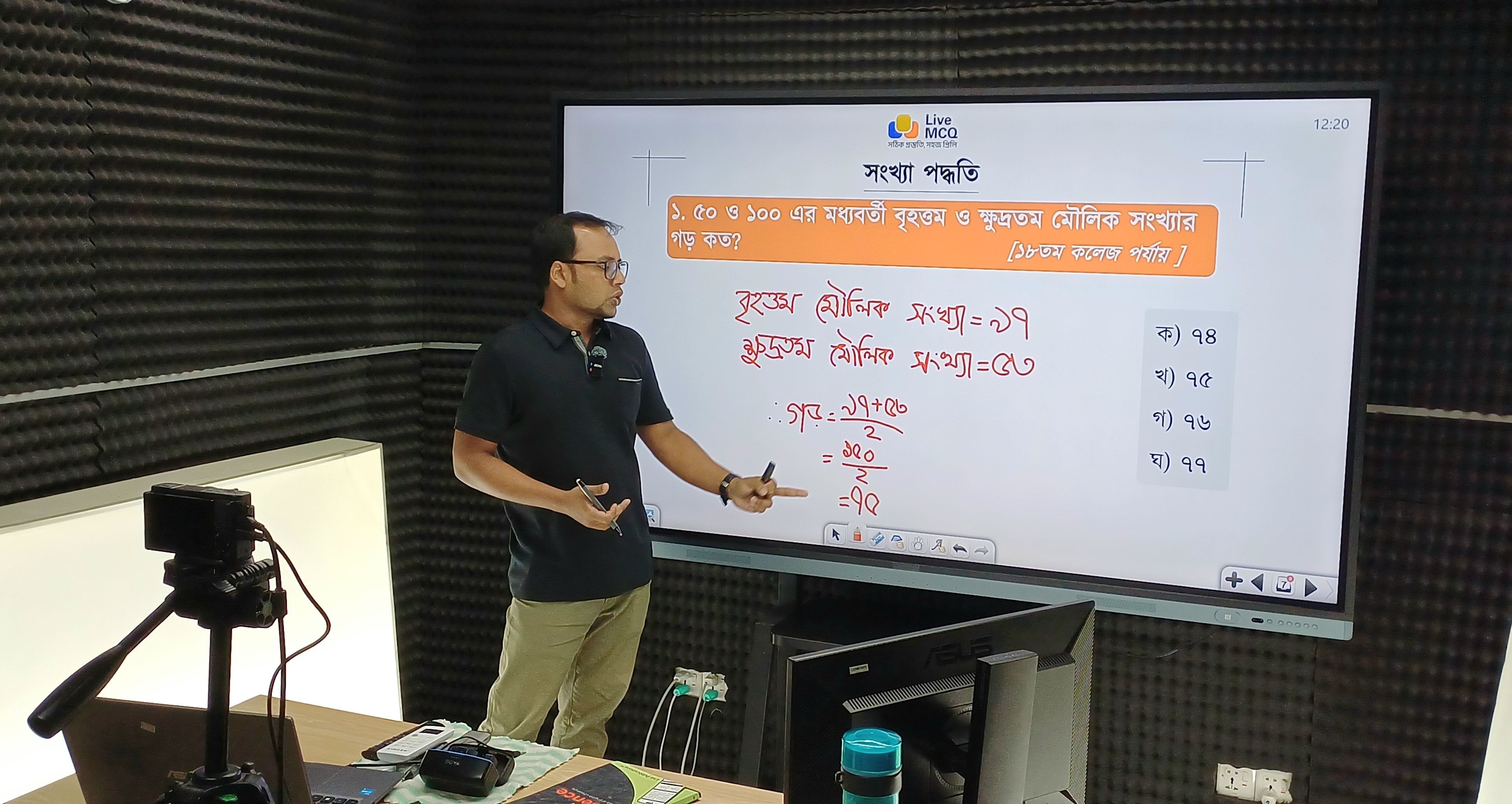
Paul, the co-founder and chief technology officer, describes an unconventional path into technology. Without formal computer science training, he led early development work.
“I studied chemistry at university, and I was never a really academic person. But in 2017—our early days—I was responsible for the front-end, back-end, and server management of LiveMCQ. And yes, I learned these technical things by watching YouTube videos,” Paul said.
The team, whose members share a similar passion for Call of Duty (CoD) games, initially aimed for a lot of things outside traditional jobs, which led them to building an online platform for learning.
“When we started LiveMCQ, we ran the platform free for about two years. Afterwards, we had to introduce a payment system to cover costs. The company was built through bootstrapping, without taking on external investors,” Paul added.
A central feature of LiveMCQ is its attempt to replicate exam conditions at scale. Users take tests alongside thousands of others answering identical questions within the same timeframe. Results are generated instantly, along with rankings. This allows candidates to assess their performance in relation to a wider pool, rather than in isolation.
According to Paul, the platform has expanded beyond multiple-choice testing. Its “Live Written” feature enables users to submit written responses for evaluation, extending preparation into subjective formats. The company has also developed supporting materials and study guides.
 For all latest news, follow The Daily Star's Google News channel.
 A shift in preparation culture
The rise of online study platforms shows a transformation in Bangladesh’s exam culture. Competitive exams remain central to many career pathways, but preparation methods are changing rapidly.
For some, the new methods are making preparations more structured and analytical, while for others, they are saving their precious time. However, for everyone using online platforms, some things remain the same. These include discipline, feedback, and competition—without which online platforms can never be truly beneficial.
The shift has lowered some barriers, particularly those related to location and cost. At the same time, it has introduced new demands, including self-management and continuous comparison with peers.
As competition grows, logging in has become more than a technical act. It now marks entry into a continuous, data-driven system of preparation where learning and competition increasingly overlap.
Comments