


‘North has long been treated like a stepchild’
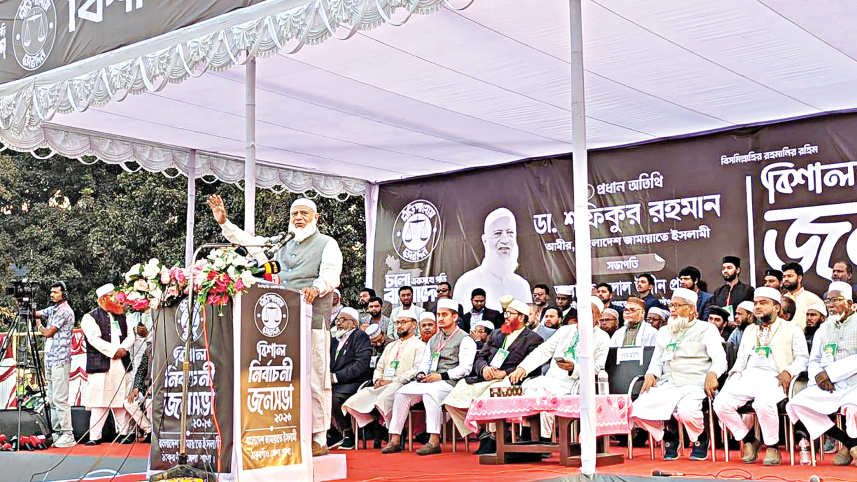
Jamaat-e-Islami Ameer Shafiqur Rahman yesterday said five years would be enough to transform the northern region, asserting that “the region is not poor but has been kept in this condition through deliberate neglect”.
“The North has been treated like a stepchild. It has been intentionally kept backward,” he told an election rally in Panchagarh.

The Jamaat leader is touring the region as part of the campaign for his party and the 10-party alliance. He left Dhaka in the morning and addressed rallies in Panchagarh, Thakurgaon, Dinajpur and Rangpur.
At the gatherings, he promised that if Jamaat came to power, the northern region would be developed as the country’s “capital of agro-based industries”.
He also pledged to upgrade Dinajpur into a city corporation, reopen closed sugar mills and revive the region’s rivers.
He said the first and most important task would be implementing the Teesta project. “If the Teesta can be saved, the northern region will survive.”
Before leaving Dhaka for a two-day tour of eight northern districts, Shafiqur told reporters at Hazrat Shahjalal International Airport that national unity is essential. “We need to reach the people with our own programmes without attacking each other.”
He flew to Syeddpur and then travelled by helicopter to the sugar mill ground in Panchagarh, where he criticised the BNP’s promises of “family cards” and “farmers’ cards”.
“Brothers, we don’t have any cards. You, brothers and sisters, are our cards. We want a card of love in your hearts. With your support, prayers and love, we want to build a Bangladesh free from unemployment and impunity. We don’t want to see people of any part of Bangladesh living as recipients of anyone’s charity.”
There, he handed over Shapla Koli, the electoral symbol of 10-party alliance partner National Citizen Party, to Sarjis Alam, the alliance candidate in Panchagarh-1, and Daripalla, Jamaat’s symbol, to Panchagarh-2 nominee Safiul Alam.
Without naming any party, he said some leaders appear before people only once every five years. For the rest of the time, they cannot be found even “with a lantern”.
“Some are like cuckoos of spring. They appear only in spring and sing ‘kuhu kuhu’, then disappear. They have no connection with the people, the grassroots, or the poor and distressed. We hate this kind of politics. We were there, we are here, and we will remain, Insha Allah.”
He also said he does not want to see a single unemployed person in the northern region. If elected, Jamaat would generate large-scale employment and establish medical colleges in all 64 districts, including Panchagarh.
“People chant slogans ‘from Teknaf to Tetulia’. But the development wave of Teknaf never reaches Tetulia. We will reverse this. We will say, ‘from Tetulia to Teknaf’.”
After Panchagarh, he travelled by road to Dinajpur. Speaking at an alliance rally at Gore-e-Shaheed Maidan after Juma prayers, he reiterated plans to modernise agriculture.
“We want the North to be the capital of our agro-industry. Farming will no longer be done in the old ways. We will modernise agriculture, ensure modern logistics, and deliver fair and low-cost inputs to farmers, thereby increasing productivity.”
He also rejected claims that Jamaat would restrict women if it came to power.
“A group of miscreants claim that if we get the chance to run the country, we will confine mothers and sisters to their homes. Those who are frightened by the love and support Jamaat-e-Islami is receiving from women today are spreading these lies.”
In the afternoon, he addressed another rally at Thakurgaon Government Boys’ High School ground, saying voters would support not only Jamaat but the entire 10-party alliance.
“We cannot build Bangladesh alone. A just state must be built by uniting the nation.”
 For all latest news, follow The Daily Star's Google News channel.
 He introduced the alliance nominees for Thakurgaon’s three constituencies and later reached Rangpur, where he spoke at the Public Library ground and stayed overnight.
At the rally, he said that if Jamaat is voted to power, Bangladesh would remain Bangladesh and not become Pakistan, Afghanistan or Iran.
“In governing the country, we will follow the Charter of Madinah as a model, where justice and the rule of law will be established, and people of all religions and backgrounds will enjoy equal rights.”
Expressing frustration over the current situation, he said they had expected a peaceful Bangladesh after August 5, but anarchy had continued.
“Many false cases have been filed. Many innocent people have been accused, and money has been taken to remove their names from the cases.”
Today, he will visit the grave of Abu Sayed, a martyr of the July uprising and a student of Begum Rokeya University. Shafiqur will then address rallies in Gaibandha, Bogura, Sherpur, Sirajganj, and Pabna.
[Our correspondents in Lalmonirhat and Thakurgaon contributed to this report.]
Comments