


‘India somewhat overreacted’
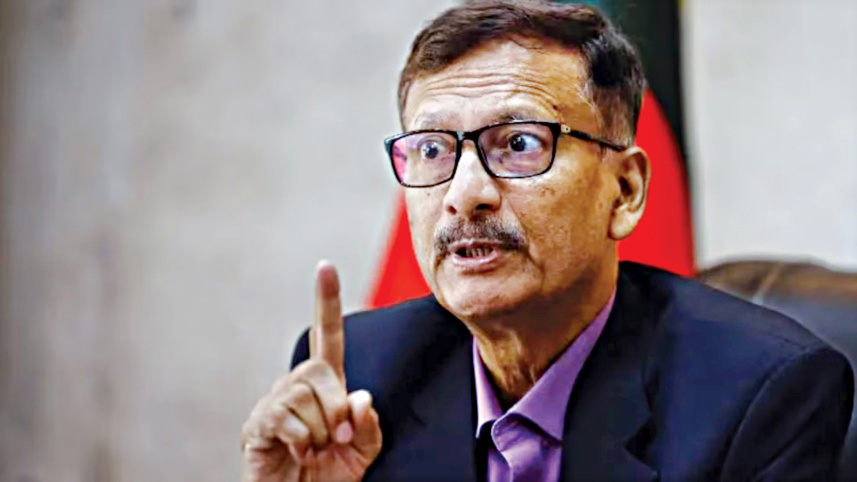
Foreign Adviser Touhid Hossain has said there is no proof that the Bangladesh government has failed to ensure the security of Indians.
He made the comment in an interview with the BBC News India broadcast on Wednesday, a day after India advised the withdrawal of families and dependents of Indian officials from all Indian missions in Bangladesh.

“Given the security situation, as a precautionary measure, we have advised the dependents of officials in the mission and posts to return to India,” the Indian Ministry of External Affairs said.
The Indian missions, however, will continue to remain open and fully operational, it added.
Touhid told the BBC, “There is no proof that we have not been able to ensure security for Indians. But my wishes will not change things. Whether India will categorise Bangladesh as being at par with Pakistan is their decision.”
“Of course, it is regrettable, but I cannot change their decision. If they think they are not safe here, let them do it,” he said.
“If we want good bilateral relations, we first have to decide that we want good bilateral relations. And if we just go on taking one step after another, it will spiral the relations downwards.”
“If I look at my acquaintance with India over the last close to 40 years in different capacities, I would say that it has overreacted somewhat. I would expect more subtle reactions from India.”
Bangladesh-India relations have remained strained since the fall of the Awami League regime and the flight of deposed leader Sheikh Hasina to India. Following recent demonstrations in various parts of India, including near Bangladesh missions, Bangladesh suspended consular services at its missions in New Delhi, Agartala and Kolkata.
Touhid said both Bangladesh and India need to take positive steps to keep relations strong, as they have not been at a desirable level.
“I would say that we should have had more interactions, more understanding of each other, and I wish that to happen.”
Despite the desire to improve ties, Touhid said there is a general feeling in Bangladesh that India’s response has not been very positive and that Bangladesh’s sensitivities have not been adequately addressed.
Bangladesh expects that as long as Hasina remains in India, she would refrain from making statements that do not align with the situation in Bangladesh and that do not bode well for relations between the two countries, he added.
On India’s allegations of attacks against minorities, the adviser said there is no denial that some incidents have taken place, but the government has taken immediate actions.
He said he does not welcome the official concerns expressed by India in this regard, calling it “absolutely an internal affair of Bangladesh”.
“We do not speak about actions against minorities in India, and I would expect the Indian authorities to follow the same.”
On Jamaat-e-Islami’s rise in Bangladesh, Touhid said Jamaat is an “open political party” in Bangladesh and has had a support base for a long time.
Referring to the BJP’s rise in India, he said there should be no problem in accepting that Jamaat’s footprint might increase in Bangladesh, as “they have been in politics and there are ups and downs in politics”.
Asked why Dhaka’s ties with Islamabad are improving while relations with New Delhi are “seemingly deteriorating”, Touhid said Bangladesh has taken no steps to “take down the relationship with India”.
On the other hand, relations with Pakistan were deliberately worsened throughout the last term of the Awami League regime, he said.
 For all latest news, follow The Daily Star's Google News channel.
 Bangladesh still has certain unresolved issues with Pakistan, which it continues to pursue, but Dhaka has tried to some extent to re-establish a normal relationship with Islamabad.
“There is nothing unusual about it. It’s just another neighbouring country,” Touhid said.
Comments